

 GMA Brandtalk
 Tracking
 Archives

ADVERTISEMENT
Filtered By: Scitech
SciTech
'Enigmatic' stick insect discovered on PHL's Mount Halcon
Scientists have discovered a wingless stick insect with a green-blue head and orange body in the Philippines, and have aptly named it Conlephasma enigma.
The stick insect lives on the ground rather than in trees —and sprays a foul odor against predators, a report on the British Broadcasting Co. said.
"We were baffled. It looked so different from any other known stick insect in the world that we immediately realised it was something very special," it quoted entomologist Marco Gottardo of the University of Siena, Italy as saying.
He said the insect is wingless, with a stout body and rather short legs.
"We concluded that it represented an unknown genus and species of stick insect," Gottardo told BBC Nature.
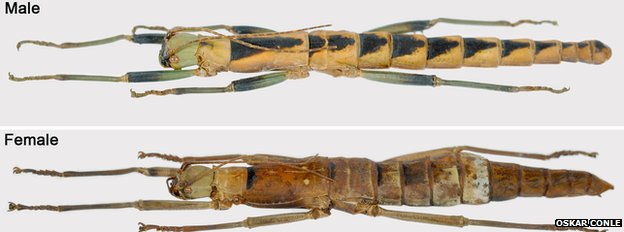
Conlephasma enigma. (photo credit: Oskar Conle, via BBC)
BBC added the stick insect is so unique, scientists have given it its own genus and have yet to establish its relationship to other stick and leaf insects.
Gottardo said a colleague, entomologist Oskar Conle, showed them some museum specimens of a strange-looking stick insect found several years ago on Mount Halcon, in Mindoro.
The insect was found on one of the highest mountains in the Philippines, "considered one of the richest areas of biodiversity in the world," according to the BBC.
The scientists have published details of the discovery in the journal Comptes Rendus Biologies.
"We have named the new stick insect with the specific epithet 'enigma' because its systematic position in the tree of life of stick and leaf insects remains a mystery," said Gottardo.
On the other hand, the scientists noted the microstructures of Conlephasma enigma's mouthparts are strikingly similar to those held by another group of stick insects.
The researchers hope a more detailed molecular analysis of the stick insect's genetics may shed light on its true identity.
"We also hope that the discovery of this particular new insect species may draw attention into the problem of rainforest conservation in the Philippines, which are home to unique and still poorly known wildlife," Gottardo said.
Special adaptations?
The scientists believe the insect's unique features are likely special adaptations for living in the low-growing vegetation of a montane rainforest.
Most tree-dwelling stick insects that live in the forest canopy have slender and elongated bodies and legs, which may provide camouflage among stick and leaves.
Color pattern
Researchers also cited another unique characteristic - the insect's color pattern.
A male has dark bluish-green head and legs, and a bright orange body with distinctive bluish-black triangle-shaped spots on its back.
The scientists theorized the insect uses these striking colours to warn off predators, rather than as a form of camouflage.
Defensive spray
Gottardo also said they discovered the new stick insect has the ability to release a potent defensive spray from glands located behind its head.
"The defensive substance is sprayed when the insect feels threatened, and has a strong distasteful smell, which likely functions to repel potential predators in a similar way to skunks," he said. — ELR, GMA News

