

 GMA Brandtalk
 Tracking
 Archives

ADVERTISEMENT
Filtered By: Scitech
SciTech
Japanese drilling ship to answer questions on abyss
Science exploration has long brought men to the moon. It brought the Mars rover Curiosity to the Red Planet's surface. The Galileo spacecraft studied the planet Jupiter and its moons. Voyager 1 is about to be the first manmade object to leave the solar system and enter interstellar space.
But the Earth's innards remain unknown and nearly untouched by scientific exploration.
Japanese researchers are about to change all that with its new drilling ship, the Chikyu.
This deep sea drilling vessel features the "most advanced drilling capabilities in the world." The Japan Agency for Marine-Earth Science and Technology completed Chikyu in July 2005.
On Sept. 10, Chikyu set a world record for drilling the deepest scientific hole in the world, beating the 19-year-old record of 2.11 kilometers set in the Costa Rica Rift seafloor.
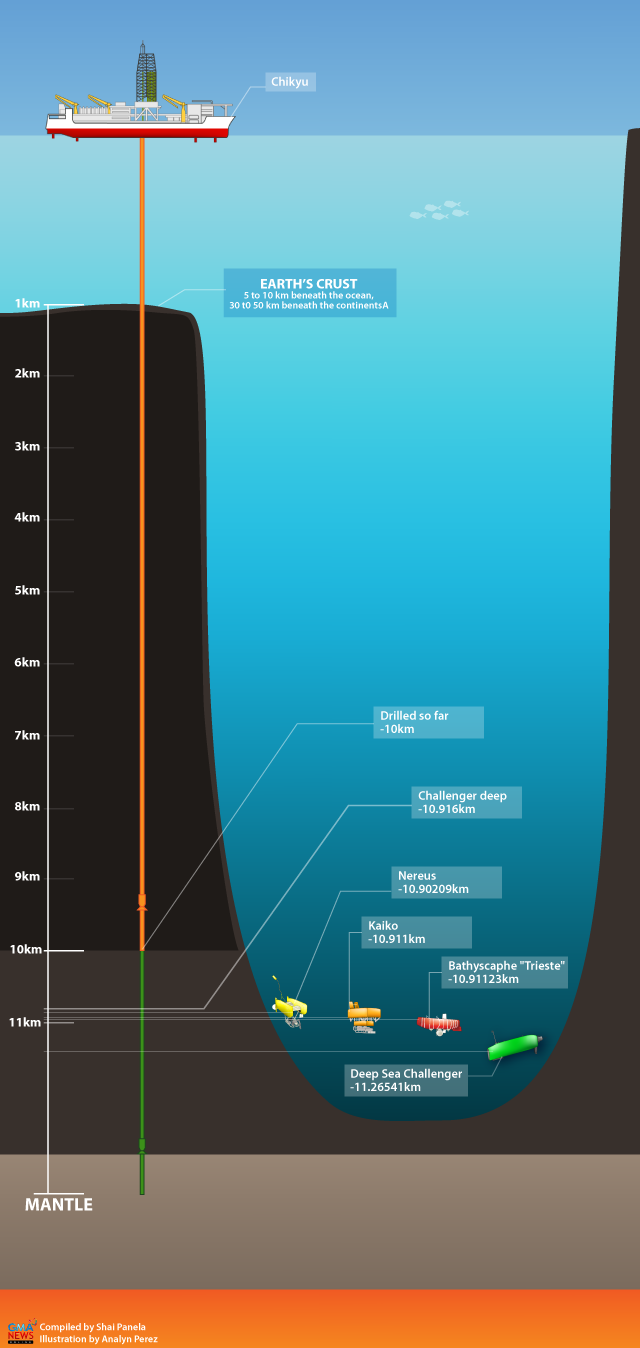
Chikyu reached 2.2 km on a mission to obtain rock samples that could shed some light on the origins of life, earthquakes, and the deep sea environment. Chikyu achieved this record during Expedition 337 of the Deep Coalbed Biosphere expedition.
Fumio Inagaki, co-chief scientist of Expedition 337 told Science Daily, "We have just opened a window to the new era of scientific ocean drilling."
"The extended record is just a beginning for the Chikyu... The deep samples are precious, and I am confident that our challenges will extend our systematic understanding of nature of life and earth," Inagaki added.
Straight to the mantle
Chikyu, according to Japanese researchers, is capable of reaching much farther down. This drilling vessel is the biggest research vessel to date. It is currently operating off Japan's Shimokita Peninsula in the Pacific Ocean.
By the early 2020s, Chikyu is expected to drill a hole reaching through the mantle--the Earth's thickest layer located between its crust and core--given enough money and guts, that is.
PopSci Magazine wrote that the researchers need to raise at least $1 billion for the project. The money would finance their effort to drill at least 6 kms into the Earth's surface. The hole would only be about 30 centimeters in diameter.
One of the project co-leaders Damon Teagle of the University of Southampton believes it would be "the most challenging endeavor in the history of Earth science."
Teagle told CNN, "It will be the equivalent of dangling a steel string the width of a human hair in the deep end of a swimming pool and inserting it into a thimble 1/10 mm wide on the bottom, and then drilling a few meters into the foundations."
"[The mantle] is the engine that drives how our planet works and why we have earthquakes and volcanoes and continents. We have the textbook cartoons but detailed knowledge is lacking," Teagle added.
The drill bits last between 50 to 60 hours before needing to be replaced--which means that drilling could take years to be completed unless technology improves.
On Aug. 27, oil giant Exxon Mobil was able to drill the deepest hole in the Earth, a borehole12.38 kms deep into the crust in the eastern part of Russia. — DVM/TJD, GMA News

