

 GMA Brandtalk
 Tracking
 Archives

ADVERTISEMENT
Filtered By: Scitech
SciTech
Climate change prepping: Nueva Vizcaya acquires Field Monitoring System
By WILFREDO ARELLANO DUMALE, JR. Nueva Vizcaya is a sprawling, land-locked province endowed with rich forest, soil, and water resources and moderate climate. Anm environment that's favorable for rice, corn, highland vegetables, and fruits production.
However, its rich resources are also vulnerable to climate change, considering that the province is predominantly mountainous. The consistent protection of its forests is the ultimate key to preserve its natural riches and wonders like caves which are largely unexplored, breathtaking falls, and centuries-old trees. Forest protection also holds the key to its exceptional weather that nurtures crops, fisheries, and animal production industries.
The Nueva Vizcaya State University (NVSU) is now piloting the use of a portable, relatively cheap, and mobile weather elements monitoring system in cooperation with the University of Tokyo (UT) in Japan. NVSU, barely eight years old since it was chartered as a University by virtue of Republic Act 9272, is identified by the Commission on Higher Education (CHED) as one of the leading state universities and colleges (SUCs) in Cagayan Valley and in the country.
Data on miscellany like simulations of climate disturbances, and even the amount of greenhouse gases (GHG) in the future, may now be easily acquired off the Internet. And these are made possible by dynamic computer simulation models, which use data inputs in the country, regional, or even global scales.
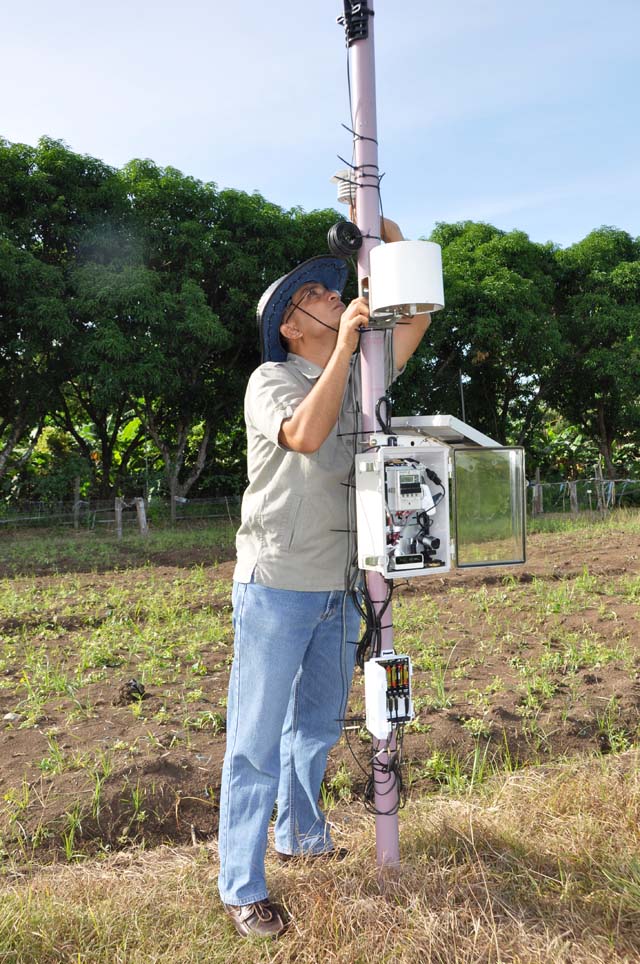
A technician sets up the FMS with weather sensors, a data logger, and a field router with a micro-processor.
These models tell us that certain human practices that result to elevated GHG emissions must be regulated or altogether stopped to halt the increase of atmospheric temperatures.
For real field conditions
In real field conditions over a relatively small area, atmospheric responses would be greatly heterogeneous. This means that climatic variations can be observed even within a small watershed. There is still a need to monitor climatic differences between smaller areas to determine these heterogeneities since the living components like plants and animals, as well as microorganisms will respond differently under given slight differences in climate and weather patterns.
This is why NV's monitoring system was acquired. The said system is composed of three main components: the weather sensors, which do the measurements; a data logger, serving as a hard disk, keeps the data measured by the sensors; and the field router, containing a micro-processor that serves as the brain of the system.
Called the field monitoring system (FMS), it is capable of automatically measuring air temperature, relative humidity, solar radiation, rainfall, among others – at an interval of one hour! This permits the scientists to establish patterns and weather elements behavior in a scale of hours.
The daily measurements are uploaded via a wireless connection that uses USB modem once a day at a designated time to a central server. From the server, collected data are plotted against time to determine the trends. Being portable, the FMS is mobile and can be readily installed even at higher elevations. This permits the scientists to monitor the small differences in weather between low-lying and highland farming areas.
It requires only minimal maintenance cost since the FMS components are simple and easy to use. The components are also dynamic. The FMS capabilities can be expanded and more sensors can be plugged into the system with a little upgrade of the data logger to accommodate more ports. This can be easily configured using the built-in software that comes with the logger. The measurement interval and frequency of the sensors can be easily adjusted based on the needs of the research!
The main objective of the research, which kicked-off last year, is simple: to establish weather differences and changes in climatic patterns between smaller, localized areas. Also, to assess the impact on agriculture as basis for adaptation to climate change in rural low-elevation, and highland farming communities.
May help with harvest, etc.
The researchers believe that even within a small watershed, there are great differences in weather patterns that need to be established. In turn, this will guide local farmers in correctly scheduling their field activities and adjust their cropping calendars. For example, between the low-lying and mountainous areas, the latter receive more and frequent rainfall in a year.
Knowing these, the farmers can adjust when they will start tilling the soil, planting, fertilizer application, pest control, and even the timing of harvest. The ultimate expected output of the collaboration are yield simulations of major crops grown in the province under different weather and climatic conditions. A website will then be developed which can be accessed for free by users who will need the data, like farmers, students, researchers, extension workers, engineers, as well as policy makers.
The FMS is a tool for community empowerment. Data and information generated can provide local communities with options to adapt agricultural practices, among others, to changes in weather patterns.
There are other emerging applications of the FMS. The researchers are building a long-term database to assess the amount of yearly rainfall, the falling air temperature prevailing in specific areas of the watershed. Rainfall data in relation to the soil properties in the watershed can be used to delineate erosion-risk areas to determine which should be avoided for human settlement and vulnerable areas that need to be improved to prevent massive landslides which can damage life and investments in the event of extreme events such as typhoons and earthquakes.
They are also looking forward to the application of the FMS for health and prevention of human diseases. For example, the temperature-dependence of certain mosquito species which cause dengue fever and malaria, and the correlation between dengue and malaria-causing mosquitoes with various weather elements.
The FMS as a research and monitoring tool has enormous possibilities. With the advent of simple but efficient weather, soil, and crop sensors, researchers will be able to measure the pedological, physiological, as well as environmental influences to crop growth and development.
The research is being undertaken by scientists of NVSU and UT, with funding support from the Ministry of Education, Sports, Science & Technology (MEXT) of Japan. --KDM, GMA News
Dr. Dumale holds a PhD in Biological and Environmental Engineering from the University of Tokyo and is recognized as one of the country’s leading scientists working on soil carbon dynamics in agricultural ecosystems. He is currently Presidential Assistant for External Affairs and Associate Professor of Soil and Earth Sciences at the Nueva Vizcaya State University. You can reach him at dumalewajr@yahoo.com. The views expressed herein are solely his own.

