

 GMA Brandtalk
 Tracking
 Archives

ADVERTISEMENT
Filtered By: Scitech
SciTech
Sense and Science: Everlasting flowers and memories
Almost on an impulse, I brought my kids to Dangwa this last Easter Sunday. There’s actually no street by that name: Dangwa being a bus company that connects Manila to the Cordillera region, where the cold weather allows the production of flowers usually associated with more temperate climates. The flowers are transported to Manila on Dangwa’s buses, and the area around the terminal, which is found on J. Marzan street, has become a market for fresh and low-cost flowers.
Easter had gotten me thinking about resurrection and, by extension, everlasting flowers, those intriguing yellow and red garlands which seem to last months, even years, after we brought them back from a vcation in Baguio. I wasn’t about to drive up north to get them but I suspected I’d find the flowers in Dangwa. Mainly I wanted the kids to see the array of flowers and floral arrangements, a sight you won’t find anywhere else in Manila, with the everlasting flowers as a kind of highlight.
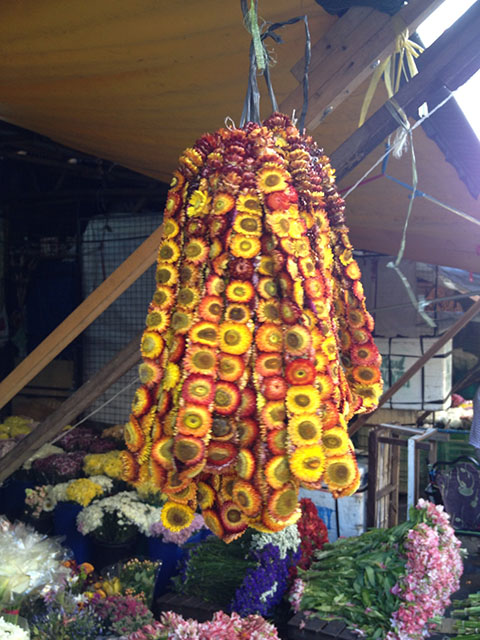
Everlasting flowers at Dangwa market. MICHAEL TAN
The everlasting flowers did turn out to be elusive, one flower vendor referring me to another until, suddenly, we spotted the one shop that did have them, a bunch of garlands that stood out even from afar. I explained to the kids that the flowers were already dried, but would last a long time, its colors never fading. By the end of the day, my son was talking about “forever flowers”.
I had two botany courses in college which I hadn’t found particularly exciting but after graduating, the first job I got was as a researcher to look at medicinal plants in different parts of the Philippines. That got me to appreciate botanists, and the work they do. I’d come back to Manila with plant specimens and their local names, and would go into libraries to look up their scientific names, and whatever research that might have been conducted on their uses, and chemicals. The botanical books are called floras, and for the Philippines, these were compiled mainly during the Spanish and American colonial periods, accompanied by elaborate and detailed illustrations.
This Easter trip to Dangwa I realized I’d never looked up everlasting flowers in the books. So I searched through the Internet and learned its scientific name was Xerochrysum (formerly Helichrysum) bracteatum, part of the largest family of plants on earth, the Asteraceae.
I learned the plant became popular for cultivation around the 19th century in Europe, because its flowers could be kept so long. I suspect the plant was introduced to the Philippines by the Spaniards, who called the flowers inmortal, flor de papel (paper flowers) and siempreviva (always alive, or, everlasting). Oils extracted from some species of these everlasting flowers are still used today in Europe and in Japan for medicinal purposes.
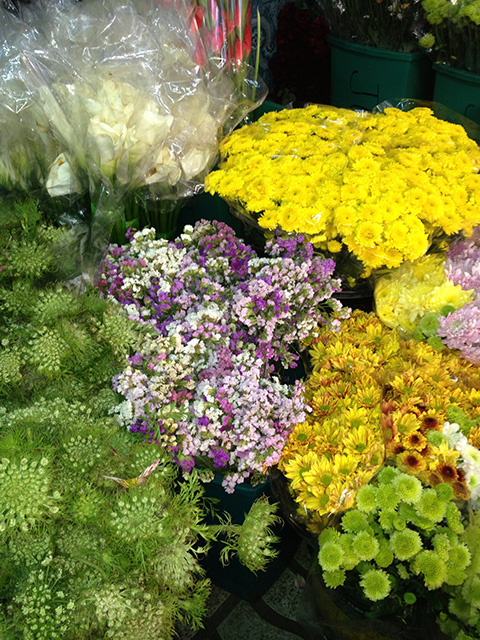
Statice flowers (lavender, pink and white) look almost drab in the center, but will outlast the other flashier ones. MICHAEL TAN
I looked up literature on statice, which turns out to have a scientific name Limonium sinuatum, “limonium” derived from the Latin word for meadows. I could imagine fields of the flowers, swaying gently in the breeze. The purple flowers are also called sea lavender because of their resemblance to marine plants.
Researching on these two plants got me to appreciate the growing number of Internet sites providing detailed information on life on our planet. There’s Catalogue of Life (catalogueoflife.org) a checklist of 1.3 million species of plants, animals, fungi and micro-organisms, and a Tree of Life project (tolweb.org), also with descriptions of thousands of living species discussed by groups.
And then, quite accidentally, I found philippineplants.org, built out of voluminous notes compiled by the late Leonard Co, a botanist and environmentalist. I had known Leonard and knew how obsessed he could get about plants, collecting specimens and taking field notes but I didn’t realize he had built up an extensive checklist of the country’s plants, including cross-references to the floras where the plants are mentioned. The book titles were familiar —Flora Malesiana, Flora of Manila, Useful Plants of the Philippines— reminding me of the hours spent in libraries with dusty old books.
Leonard was shot to death in 2010 while doing field work in Leyte, government soldiers claiming he had been mistaken for a rebel. He was killed a few weeks before what would have been his 57th birthday. Leonard’s colleagues have put his work on the Internet, together with links to photographs of many of the plants.
Who would have known that an Easter Sunday trip to Dangwa, and a virtual field trip through the Internet, would resurrect all kinds of memories, not just of books and libraries and plants in the field, but also of a dear friend, who died too young but lives on through a digital website featuring the plants he loved so much. — TJD, GMA News
Michael L. Tan is a veterinarian and a medical anthropologist. He is currently dean of the College of Social Sciences and Philosophy at the University of the Philippines in Diliman, Quezon City, and Clinical Professor at the College of Medicine at UP Manila. He also writes the opinion-editorial column "Pinoy Kasi" for the Philippine Daily Inquirer. He has been involved in numerous research projects on a range of issues from HIV/AIDS prevention to the culture of impunity. In 2012, he was elected to the National Academy of Science and Technology, the Philippines' highest science advisory body.

