

 GMA Brandtalk
 Tracking
 Archives

ADVERTISEMENT
Filtered By: Scitech
SciTech
Marine biologists use bioluminescence to lure and film giant squid
+
Make this your preferred source to get more updates from this publisher on Google.
Little has been known about the giant squid of the deep, dark, sea until marine biologist and oceanographer Dr. Edith Widder used her expertise in bioluminescence to lure it into the open.
“I have said for a long time now that I think we have been exploring the oceans wrong, that we are scaring the animals away using camera platforms with bright white lights and noisy thrusters,” she said.
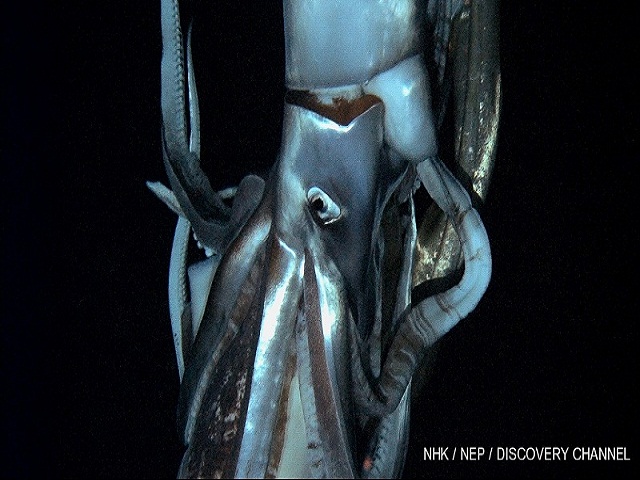
This guy was lured out of hiding by electronic jellyfish bait.Discovery Channel
To mimic this, Dr. Widder used a bait called the e-jelly or electronic jellyfish, an optical lure that imitates certain bioluminescent displays of jellyfish. The e-jelly was attached to the Medusa, a camera that uses a red light, invisible to most deep-sea inhabitants that can only see in blue light.
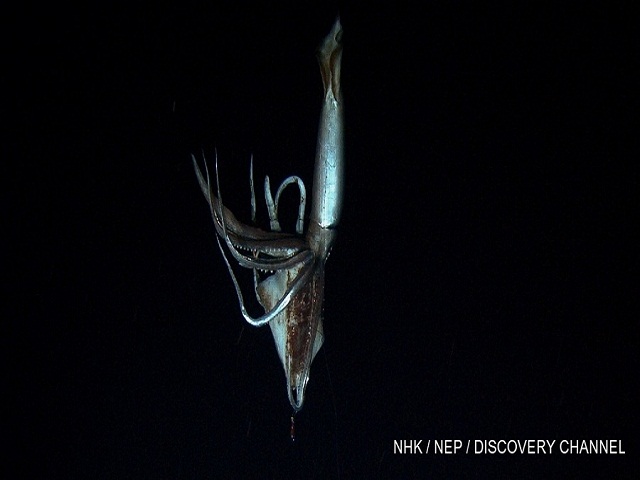
In the second deployment of the camera system, Widder and other deep-sea squid experts Dr. Steve O'Shea and Dr. Tsunemi Kubodera were able to capture the elusive giant in its natural habitat for the first time.
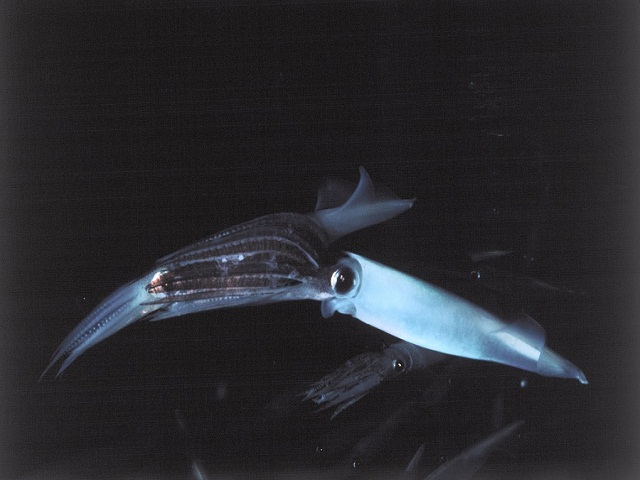
This marks the first time the giant squid has been photographed in its natural habitat. Discovery Channel
“We now know that it’s not a passive sit-and-wait predator, as had been proposed, but an active visual hunter attracted by bioluminescence,” Widder said. “Based on the behavior we observed, which is the only time it’s been observed in its natural habitat, it is not passive but aggressively attacks its prey.”
Their enormous, super-sensitive eyes have no eyelids to protect them from bright lights and thus makes them elusive and extremely shy.
“It appears that we only see them at the surface when they are dying,” Widder said. “They will undoubtedly grab on to anything that comes near under those conditions.” Hence, the stories of the rampaging, monstrous kraken abounded in old mariner's tales.
Although they live in the mid-waters of the deep, it has also been discovered that the flesh of deep-sea squid contains human-made pollutants, like flame retardants.
Human-made pollution's long-reaching tentacles have made its way down to the bottom of the ocean, as evidenced when bits of flame retardant were found in the skin of the qiant squid. Discovery Channel
“It seems that there is no place safe from pollution, even in the depths of the ocean in places where humans themselves have never visited,” Widder said.
They are also filled with ammonia, which is part of their flotation system, making them inedible.
Animal Planet's documentary “Legends of the Deep: Giant Squid”, tells of the scientific expedition of Kubodera, O'Shea, and Widder that led to their filming of the elusive giant. – KDM/VC, GMA News

