

 GMA Brandtalk
 Tracking
 Archives

Forewarned is forearmed: Expect El Niño phenomenon mid-2014
Prepare yourselves for the coming El Niño phenomenon, which will materialize in mid-2014..
In its recent bulletin, US weather forecaster Climatic Prediction Center (CPC), said that neutral El Niño conditions “will likely continue through the spring, but there was about a 50 percent chance of the weather pattern developing during the summer or autumn,” to quote a Reuters dispatch.
“We are ripe for another long drought,” said Roy C. Alimoane, the director of the Davao-based Mindanao Baptist Rural Life Center (MBRLC). “The last time an El Niño hit the country was in 2009 but it was not that really that strong.”
“El Niño events occur on average every four or five years, but irregularly – they can be two years apart, or as many as 10 years,” stated an official of the US National Oceanic and Atmospheric Administration.
1998 El Niño
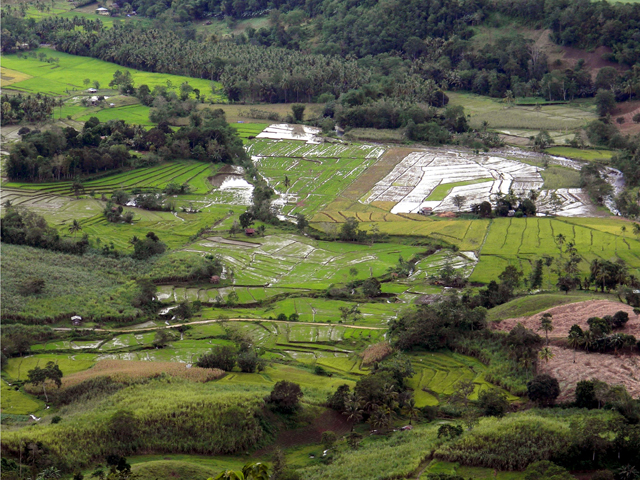
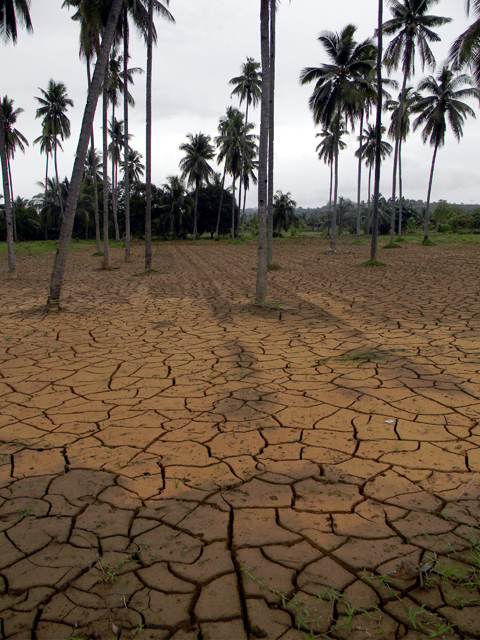
“The fury of El Niño began in the third quarter of 1997,” noted a briefing paper published by the Philippine Council for Agriculture, Forestry, Aquaculture and Natural Resources Research and Development (PCAARRD). “El Niño weather condition struck mostly Southern and Central Philippines.”
Among the provinces badly-hit by the 1998 El Niño were South Cotabato, North Cotabato, Davao del Sur, Sultan Kudarat, Maguindanao, Sarangani, Davao del Norte, Davao Oriental, Davao City, Cotabato City, and General Santos City.
The 1998 El Niño affected almost 74,000 hectares of agricultural lands in 18 provinces. Based on a report released by the Department of Agriculture, the country’s rice and corn production during the first half of 1998 went down by 27% and 44%, respectively.
El Niño did not spare the Visayas region. In fact, Negros Occidental was declared under a state of calamity because of prolonged drought that affected 930,435 people in 267 barangays. In Mindanao, more than 74 people died and about 497,238 agricultural families, including tribal communities, in Northern Mindanao starved because of the drought caused by El Niño.
The El Niño phenomenon also dried up land and sources of potable water in General Santos City and adjacent areas. Davao del Sur also experienced shortage in potable water. Forest fires were reported to affect portions of Mount Apo, Mount Matutum, and forested areas in Maragusan.
El Niño effects, name origins
“El Niño warms and slightly raised the waters off the Peru coasts,” continues the book. “This results in abundant catch of anchovies which lasts for a short time. Afterwhich, there is a decline in fish catch which devastates the local fishing industry.”
Initially, El Niño was a weak, warm current that appeared annually, which lasted for only a few weeks to a month. However, for every 3-7 years recently, an El Niño event can stretch over many months. The phenomenon used to affect only a narrow water strip off Peru, but now it appears as a large-scale oceanic warming that affects most of the tropical Pacific.
The ocean current is characterized as a mysterious, massive pond of warm, nutrient-poor seawater which produces a periodic shift in ocean temperatures and atmospheric conditions in the tropical Pacific. El Niño varies the surface temperature of the central/eastern part of the tropical Pacific by up to 4 degrees Centigrade, with associated changes in the wind and rainfall patterns. This condition disrupts weather around the world, leading to nasty extremes.
No one knows precisely when El Niño first struck. Historians are dating the phenomenon at least as far back as early 1500s, when the Spanish conquistadores entered South America amid raging storms.
The word “Niño” was traditionally associated with the birth of baby Jesus, as it was observed around Christmas. It used to be considered a local event along the coasts of Peru and Ecuador. Through the years, “corriente” was left out, leaving only El Niño.
Long drought is just one of the manifestations of El Niño event, which Spanish fishermen originally named as “Corriente del Niño.” The word “corriente” describes the appearance of warm ocean current flowing from time to time in the eastern equatorial Pacific region, along the South American coasts.
“The cycle begins when eastern Pacific winds head west and plows ocean water in front of them,” the PCARRD-DA book informs. “When these winds ease, the waves return east. The warm current mixes with the upwelling cold water, warms it slightly, and depresses the thermocline.”
Thermocline is a layer of cool water that normally dilutes the warmer ocean surface.
“When the sea-surface temperature rises, the warmer water no longer cools the air above it effectively, producing a cross-ocean differential. Then the wind stops or brings rain and more warm water eastward. The water strikes the coasts and splits into two currents that move toward the poles and empty the basin of warm water. Finally, there is no longer enough warm water to sustain the El Niño cycle, so it decays, and things return to normal,” goes a passage in the book.
Number one force disturbing climate patterns
The El Niño cycle may be simple, yet, the energy reserves it carries is vast, almost unimaginable. Most reports say “it contain more energy than has been procured from all the fossil fuels burned in the United States since the beginning of the century – that’s all the gasoline in all the cars, the coal in all the power plants, the natural gas in all the furnaces. It would take more than a million large power plants, at 1,000 megawatts each, running full tilt for a year, to heat the ocean that much.”
Scientists rank El Niño as the number one force disturbing world climate patterns. It has caused damage worth billions of dollars around the world in droughts, floods, and other livelihood revenues.
Take the case of the 1982-83 El Niño events, which left more than 1,100 dead in its wake. In the United States, it caused an estimated $8.1 billion in damage from flooding, drought, and unusual hurricane activity, according to government estimates. California alone reported some $1.3 billion in damage from a series of heavy storms and flooding.
In the Philippines, the 1982-83 El Niño had a lasting effect on the country’s weather condition. For instance, the Manila area did not have sufficient rainfall until 1985, hence no considerable flooding occurred during the southwest monsoon season before then.
When the normal southwest monsoon rains occurred in 1986, there was a great havoc caused by the floods in the Manila area. The Laguna Lake was also full, leading to the flooding of Taguig for some time in 1986, until the early summer of 1987.
The absence of rain and consequent flooding in Metro Manila in the years preceding 1982 led to the belief that floods would not occur. Hence, the canals and waterways were clogged with dirt and debris of four years of low rain in the metropolis. — VC, GMA News

