

 GMA Brandtalk
 Tracking
 Archives

ADVERTISEMENT
Filtered By: Scitech
SciTech
What do this newly-discovered dinosaur and DC Comics' The Flash have in common?
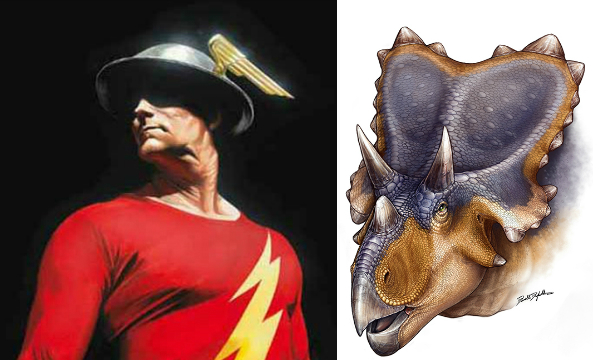
The Roman god Mercury is a rather influential figure – a planet, an element, and even superheroes, such as the Golden Age version of DC’s the Flash, have either been named after or inspired by the fleet-footed messenger deity.
The newest tribute to the mythological god, however, is as unusual as it is remarkable.
Meet Mercuriceratops gemini, a newly named chasmosaurine that lived during the Late Cretaceous period, about 77 million years ago. Believed to have grown up to 6 meters (20 feet) long and estimated to have weighed over 2 tons, its most noteworthy feature was the frill around its head, shaped like the wings on Mercury’s iconic helmet.
Its genus name literally means “Mercury horned-face,” while its species name was chosen because two nearly identical skull specimens belonging to the creature were found in the upper Judith River Formation in Montana and the Dinosaur Provincial Park, a UNESCO World Heritage Site in Alberta, Canada.
Its genus name literally means “Mercury horned-face,” while its species name was chosen because two nearly identical skull specimens belonging to the creature were found in the upper Judith River Formation in Montana and the Dinosaur Provincial Park, a UNESCO World Heritage Site in Alberta, Canada.
"Mercuriceratops took a unique evolutionary path that shaped the large frill on the back of its skull into protruding wings like the decorative fins on classic 1950s cars,” explained Dr. Michael Ryan, curator of vertebrate paleontology at The Cleveland Museum of Natural History and lead author of the study.
Under normal circumstances, it would be reasonable to assume that an odd-shaped ceratopsian skull could either be a one-off genetic anomaly or the result of distortion during the million-year fossilization process. However, the existence of two similar samples in separate locations confirmed that the fossils really did belong to a previously unnamed dinosaur.
"The two fossils -- squamosal bones from the side of the frill -- have all the features you would expect, just presented in a unique shape," according to Dr. Philip Curie, study co-author and University of Alberta’s dinosaur paleobiology research chairperson.
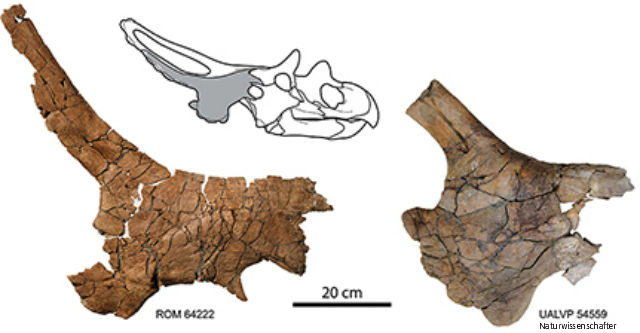
A ceratopsian 'missing link?'
Dr. David Evans, Royal Ontario Museum curator of vertebrate palaeontology and study co-author, further added that Mercuriceratops’ neck frill was unlike anything they’d ever seen before. "Mercuriceratops shows that evolution gave rise to much greater variation in horned dinosaur headgear than we had previously suspected."
The researchers also theorize that Mercuriceratops’ uniquely-shaped frill may have been helpful both in combat and during mating season.
"Horned dinosaurs in North America used their elaborate skull ornamentation to identify each other and to attract mates -- not just for protection from predators,” said Dr. Ryan. “The wing-like protrusions on the sides of its frill may have offered male Mercuriceratops a competitive advantage in attracting mates."
“It definitively would have stood out from the herd during the Late Cretaceous."
More to be discovered
More to be discovered
Mercuriceratops was one of the new dinosaurs discovered during the course of the Southern Alberta Dinosaur Project, a research effort which aims to study Late Cretaceous dinosaurs and track their evolutionary paths by closely examining the oldest dinosaur-bearing rocks in Alberta and northern Montana.
Study co-author Mark Loewen, a research associate at the Natural History Museum of Utah, is optimistic that Mercuriceratops is merely the first of many new dinosaurs just waiting to be unearthed. "This discovery of a previously unknown species in relatively well-studied rocks underscores that we still have many more new species of dinosaurs to left to find.”
Findings about this new ceratopsian were published in the online journal Naturwissenschaften. — TJD, GMA News

