

 GMA Brandtalk
 Tracking
 Archives

ADVERTISEMENT
Filtered By: Scitech
SciTech
King Bluetooth's fortress discovered in Denmark
+
Make this your preferred source to get more updates from this publisher on Google.
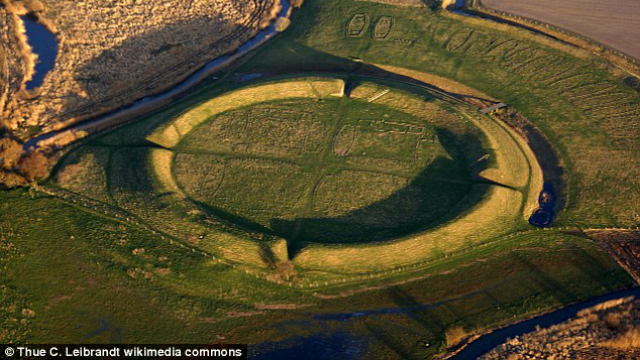
A typical circular Viking fortress.
What could be the fortress of King Bluetooth—yes, the monarch after whom today's handy wireless tech is named—has been discovered in Denmark.
The circular fortress is believed to date back to the 10th century appears to be a likely candidate, according to a report on Archaeology.org.
Viking fortresses
The newly-discovered fortress measured 475 feet in diameter, the third largest known of its kind.
It had a 35-foot-wide circular rampart with a palisade of wooden spikes, appearing to match the design of Denmark’s other ring fortresses.
"The fortresses have four gates facing outward in different compass directions, and an interior courtyard symmetrically divided into four quarters," The Telegraph explained in an earlier report.
The circular fortress, the fifth to be unearthed but the first discovered in the last 60 years, is some 30 miles south of Copenhagen.
"Although there were Vikings in other countries, these circular fortresses are unique to Denmark. Many have given up hope that there were many of them left," said Lasse Sonne, a Viking historian from the Saxo Institute at the University of Copenhagen.
Some historians believe the fortresses may have been built by his son Sweyn Forkbeard as a military training camp or barracks.
Forkbeard may very well have launched his attack on London from there in 1013, a successful campaign that ended with him declaring himself King of England.
Stumbling onto Bluetooth
"We suspected that one fortress was ‘missing’ in the island Zealand. The location at Vallø was quite the right setting in the landscape: in a place where the old main roads met and reached out to Køge river valley, which in the Viking Age was a navigable fjord and one of Zealand’s best natural harbors," said Søren Sindbæk of Aarhus University, who, with Nanna Holm of The Danish Castle Centre, took laser measurements of a field.
From there, Sindbæk said they worked their way forward "step by step.”
After a geophysical survey showed the “ghost image” of the fortress, charred oak posts were found after an excavation at the north gate.
Holm said the burned wood in the gates may allow them to use radiocarbon dating and dendrochronology to determine their age.
“We are eager to establish if the castle will turn out to be from the time of King Harald Bluetooth, like the previously known fortresses, or perhaps a former king’s work. As a military fortification from the Viking Age, the monument may help to unravel the position of Zealand in relation to the oldest Danish kingdom,” she said.
Today's Bluetooth
It was during the late 10th century that Harald Bluetooth ruled as king and Christianized Denmark and Norway. His role in history inspired a small group of wireless technology companies in 1998 to adopt his name for their consortium—the Bluetooth Special Interest Group.
According to their website:
The name "Bluetooth" is taken from the 10th century Danish King Harald Blatand - or Harold Bluetooth in English. During the formative stage of the trade association a code name was needed to name the effort. Over an evening discussing European history and the future of wireless technology several felt it was appropriate to name the technology after King Blatand. He had been instrumental in uniting warring factions in parts of what is now Norway, Sweden, and Denmark - just as the technology is designed to allow collaboration between differing industries such as the computing, mobile phone, and automotive markets. The code name stuck.
— Joel Locsin/TJD, GMA News

