

 GMA Brandtalk
 Tracking
 Archives

ADVERTISEMENT
Filtered By: Scitech
SciTech
The dirty sex secrets of harvester ants
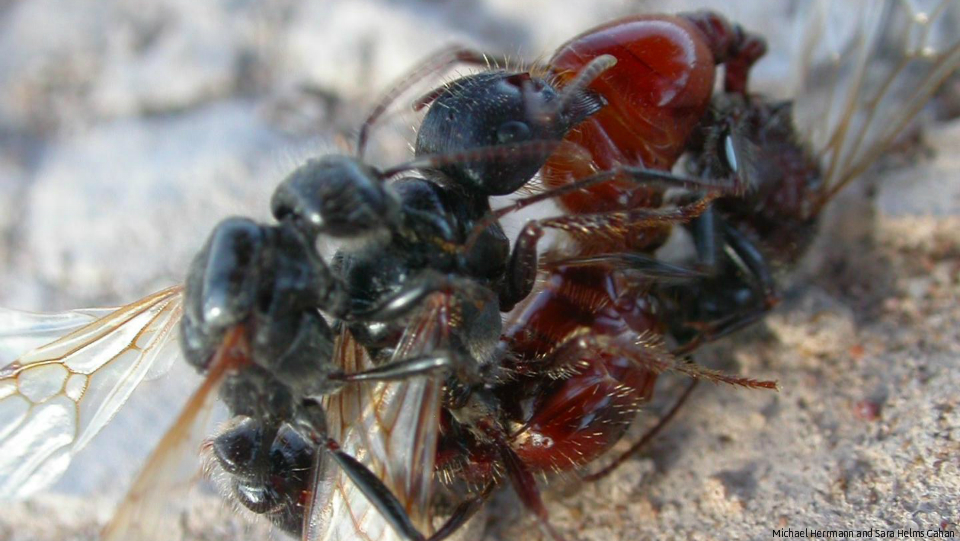
The red queen in the middle is mating with the upside-down male on the right. Their copulatory organs are locked in place, so the male can completely let go of the queen with his legs and still be firmly attached. The ant on the left is a competitor male trying to get in on the action. Michael Herrmann and Sara Helms Cahan
When it comes to sex, harvester ant queens know what they want—and get it.
Biologists from the University of Vermont have discovered that male and female harvester ants (genus Pogonomyrmex) are engaged in a sexual arms race, with males slowing down sperm delivery to the "wrong" females and the "wrong" females not letting the males go until they've finished the job. The study was published in the journal Proceedings of the Royal Society B.
Two guys, one queen
Ants are social animals with a caste system: sterile female worker ants take care of the reproductive queen, who produces all of the ants in the colony. Males only function as mates for the queen.
In Pogonomyrmex ant colonies, the population is composed of two genetically distinct lineages that interbreed with each other. Queens that mate with males of the same lineage produce future queens, while queens that mate with males of the other lineage produce sterile worker ants.
In Pogonomyrmex ant colonies, the population is composed of two genetically distinct lineages that interbreed with each other. Queens that mate with males of the same lineage produce future queens, while queens that mate with males of the other lineage produce sterile worker ants.
With this in mind, males need to mate with queens of the same lineage to ensure that their genes get passed on to the next generation, but queens need to mate with males of both lineages to ensure that she can produce both future queens and workers. This inherent conflict of interest pits the males and females against each other in a battle royale for sexual supremacy.
The answer? Play dirty.
Once males realize that they've mated with the wrong lineage, they slow down their rate of sperm delivery. "They can mate again, so this would preserve their sperm for investment into better mating," explains Sara Helms Cahan, co-leader of the study.
But the queens aren't going to let this go, literally.
Genital locks for queens
Using a genital locking mechanism, queens keep slow-pumping males in place for a longer time compared to males that pump their sperm faster. This results in the males delivering the same amount of sperm as they would to a queen that they actually wanted to mate with.
This stalemate is necessary for the survival of the colony. "If the males actually were able to tell what type of female they were mating with, they would cut off the sperm to the queens that need it," says Michael Herrmann, lead author of the study.
"Females are not just passive players in reproduction," Helms Cahan says. "They have their own distinct evolutionary interests and are just as capable of imposing those interests on their partners when conditions warrant." — TJD, GMA News
Macy Añonuevo earned her MS Marine Science degree from the University of the Philippines. She is a published science and travel writer and was a finalist in the 2013 World Responsible Tourism Awards under the Best Photography for Responsible Tourism category. Her writings and photographs may be found at www.theislandergirl.com.

