

 GMA Brandtalk
 Tracking
 Archives

ADVERTISEMENT
Filtered By: Scitech
SciTech
New seadragon species discovered
+
Make this your preferred source to get more updates from this publisher on Google.
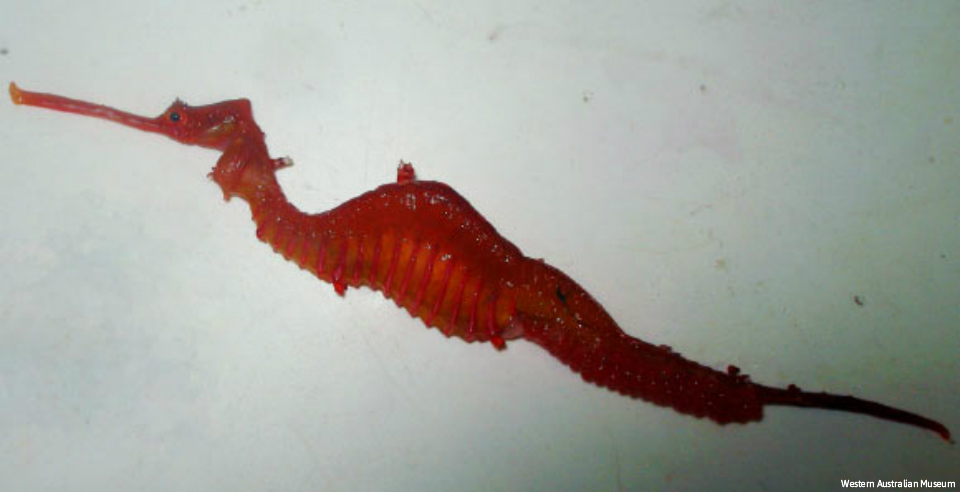
Ruby Seadragon (Phyllopteryx dewysea)
Scientists have discovered a new species of seadragon—the first in 150 years. It is also one of only three known seadragon species.
The newly-found species has been designated the Phyllopteryx dewysea, or the Ruby Seadragon.
The marine biologists, hailing from the Western Australia Museum and the Scripps Institution of Oceanography, found the creature off the Western Australian coast.
The fully-grown specimen is approximately 15cm long.
The fully-grown specimen is approximately 15cm long.
Evidence for its existence first came to light in 2007, after the researchers used cutting edge anatomical and DNA research tools in an examination of a specimen’s tissue samples.
“We’re now in a golden age of taxonomy and these powerful DNA tools are making it possible for more new species than ever to be discovered,” stated senior author Dr. Greg Rouse of Scripps Institution of Oceanography. “That such large charismatic marine species are still being found is evidence that there is still much to be done. This latest finding provides further proof of the value of scientific collections and museum holdings.”
According to the scientists, “the holotype specimen was trawled east of the remote Recherche Archipelago in 51 m, additional specimens extend the distribution west to Perth in 72 m.”
A vivid shade of red, the specimen differs from the Phyllopteryx taeniolatus, or Common Seadragon, which is purple and yellow; and the Phycodurus eques, or Leafy Seadragon, which has an orange tint.
A possible explanation for the new seadragon’s coloring is its habitat, which could be deeper than the Common and Leafy Seadragons’. There, the red shading would provide the animal an effective camouflage from predators.
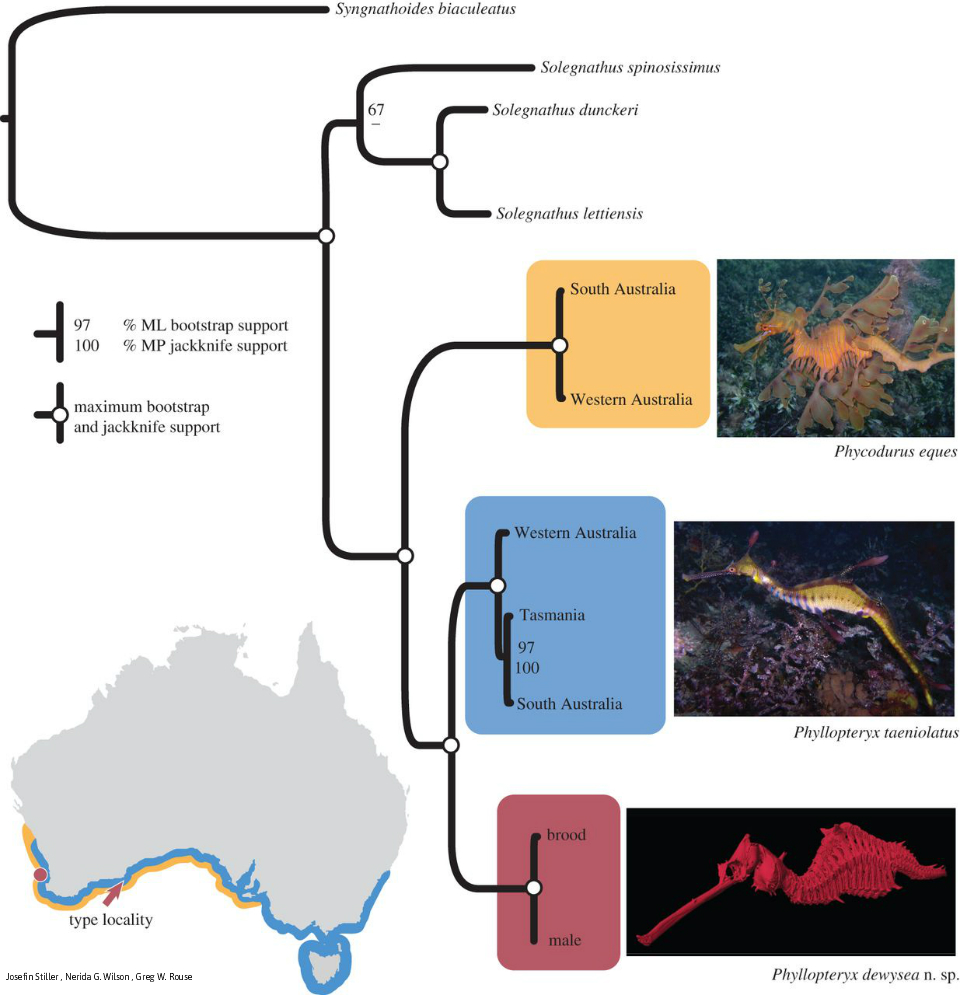
Species and distribution of seadragons.
“A CT scan gave us 5,000 X-ray slices that we were able to assemble into a rotating 3-D model of the new seadragon,” said Josefin Stiller, lead author and a Scripps Institution of Oceanography graduate student. “We could then see several features of the skeleton that were distinct from the other two species, corroborating the genetic evidence.”
“It has been 150 years since the last seadragon was described and all this time we thought that there were only two species,” said the Western Australia Museum ’s Dr. Nerida Wilson, who served as co-author of the study. “Suddenly, there is a third species! If we can overlook such a charismatic new species for so long, we definitely have many more exciting discoveries awaiting us in the oceans.”

