

 GMA Brandtalk
 Tracking
 Archives

ADVERTISEMENT
Filtered By: Scitech
SciTech
Flower species has preference for certain birds as pollinators
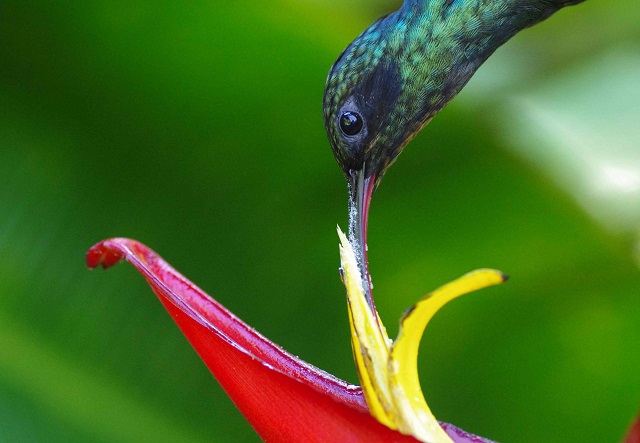
A green hermit hummingbird drinks from a Heliconia tortuosa. Oregon State University
But researchers have identified a tropical plant that’s capable of recognizing what kind of bird has its beak shoved into its flowers. And it’s apparently choosy enough to not accept pollen that doesn’t come from their preferred bird species.
The study, published in the journal Proceedings of the National Academy of Sciences, explains that Heliconia tortuosa’s flowers are slender and tubelike. This means that hummingbirds with long, curved beaks are able to drink more nectar than short-billed birds. When the long-billed birds are the ones drinking from the flower, that’s the only time the plant accepts the pollen.
“The fine tuning of coevolution between plants and pollinators may be greater than we imagined,” said Ethan Temeles, an ecologist from Amherst College in Massachusetts.
An accidental discovery
The research team was actually studying whether H. tortuosa could reproduce in fragmented rainforest areas. During the course of the study, they found that the plants actually reproduced less when they were hand-pollinated, compared to when they were left alone.
They decided to catch different pollinators from different species to see if the type of pollinator had an effect. They found that in aviaries where the plants were being visited by two hummingbird species (the green hermit and the violet sabrewing), H. tortuosa accepted the hand-delivered pollen. Both hummingbird species had long, curved beaks.
Upon further experimentation, it was found that the more nectar was extracted from the flowers, the more the pollen tubes grew. These pollen tubes reach into the flower’s ovaries, fertilizing them.
One benefit of choosing long-billed birds over short-billed birds is that the long-billed hummingbirds travel farther and visit flowers in a larger area compared to the short-billed birds. This means that the chances that the pollen they’re carrying is from an unrelated H. tortuosa flower is higher. Unrelated pollen means that the chances of inbreeding are lower and this keeps the gene pool diverse.
“There’s still a lot of debate about how that gets going,” Matthew Betts, an ecologist from Oregon State University and coauthor of the study said. “How do you end up with these nice tight matches when you’ve got tons of different species visiting the plant?” — Bea Montenegro/BM/TJD, GMA News

