

 GMA Brandtalk
 Tracking
 Archives

ADVERTISEMENT
Filtered By: Scitech
SciTech
Ancient baby woolly rhino discovered in Siberia
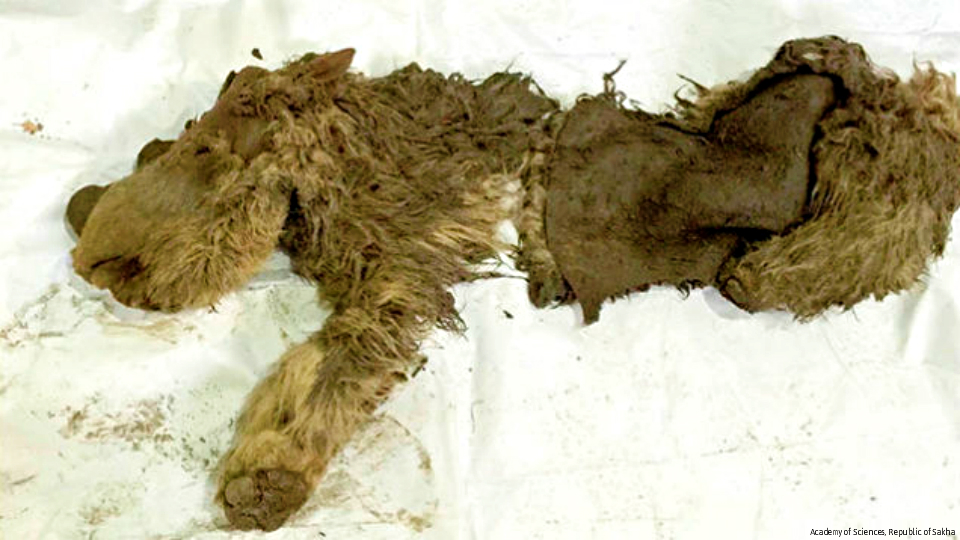
Two Siberian hunters have made a monumental discovery: the well-preserved, 10,000-year-old corpse of a baby woolly rhinoceros. Only a handful of specimens of this long-extinct creature exist, and they’re all adults, making this find extremely special.
Alexander Banderov and Semen Ivanov stumbled upon the animal’s remains on the right bank of a stream connecting to the Semyulyakh River. When they realized they weren’t looking at a dead reindeer but something extraordinary, they contacted the Yakutian Academy of Sciences’ Mammoth Fauna Department.
“We were sailing past a ravine and noticed hair hanging on the top of it,” stated Banderov. “At first we thought it was a reindeer’s carcass, but after it thawed and fell down we saw a horn on its upper jaw and realized it must be a rhino. The part of the carcass that stuck out of the ice was eaten by wild animals, but the rest of it was inside the permafrost and preserved well.”
The rhino cub, which has been dubbed “Sasha,” is now with the Academy of Sciences in Yakutsk, the capital city of the Sakha (Yakutia) Republic, Russia.
Testing will determine at what age Sasha died, but the results won’t be out in six months. In the meantime, we’ll have to content ourselves with the scientists’ estimate: around 3 or 4 years old.
Remarkably well-preserved
“The newly found (calf) is about 1.5 meters long (4.9 feet) and 0.8 meters high (2.6 feet),” stated Albert Protopopov, Head of the Mammoth Fauna Department. In contrast, adult woolly rhinos grew to a length of 15 feet (4.5 m) and a height of 6 feet (1.9 m).
The Siberian permafrost accounts for the excellent condition of the baby rhino. Its wool and soft tissues are remarkably well-preserved. Its entire skull and head, including one eye, an ear, nostrils, mouth, and teeth are still intact. The stubby vestiges of its two horns, each the size of a fist, are clearly visible. The scientists have yet to determine the sex of the calf.
“The find is absolutely unique,” stated Protopopov. “We can count a number of adult woolly rhinos found around the world on fingers of one hand… There was only one case in the 21st century when we found a frozen carcass of a grown-up woolly rhino in Yakutia. It was in 2007 in Kolyma.”
Protopopov explained what makes Sasha so special.
“A baby rhino was never found before,” he said. “Even to find a skull of a baby rhino is very lucky indeed. The possible explanation to it is that rhinos bred very slowly. Mothers protected baby rhinos really well, so that cases of successful attacks on them were extremely rare and the mortality rate was very low.”
Mammoths vs. rhinos
Scientists have had greater success with mammoths than with woolly rhinos.
“Woolly rhinos are less studied than mammoths,” said Protopopov. “We are hoping Sasha the rhino will give us a lot of answers to questions of how they grew and developed, what conditions they lived in, and which of the modern day animals is the closest to them.”
Since the 1700s, researchers have been able to find only a few adult woolly rhino remains. A frozen mummy was discovered in eastern Siberia, while two whole but hairless corpses were located in Ukraine. Scientists also owe their knowledge of the woolly rhinos’ appearance to cave paintings – dating back to the late Paleolithic – found in Western Europe.
Protopopov admitted there is currently a scarcity of information about baby woolly rhinos.
“We know nothing about baby rhinos, while the morphology of adults is better known,” he said. “So far we didn’t have a chance to work even with a tooth of a baby rhino, and now we have the whole skull, the head, soft tissues, and well preserved teeth.”
The paleontologists’ initial focus will on be the extraction of the creature’s DNA . By sequencing its genome, they will be able to figure out its closest relatives, and perhaps even determine if more than two species of woolly rhino existed during the Late Pleistocene.
“First of all we will concentrate on the DNA, because the carcass was kept frozen and chances are high we will get a better preserved DNA,” Protopopov said.
The Russian scientists will be working together with their foreign peers to study the remains of Sasha the baby woolly rhino.
Extinction
Woolly rhinoceroses first emerged around 350,000 years ago. This was during the Pleistocene epoch which began some 2.59 million years ago, and ended 11,700 years ago.
During their time on the planet, northern Asia and Europe were home to woolly rhinos. Humans of the last glacial period hunted them down, which, along with diseases and climate change, possibly led to the species’ extinction some 10,000 years ago.
Sasha was named after its discoverer; in Russia , “Sasha” is short for “Alexander.” — TJD, GMA News

