

 GMA Brandtalk
 Tracking
 Archives

ADVERTISEMENT
Filtered By: Scitech
SciTech
Spanking-new titi monkey species emerges in Brazil
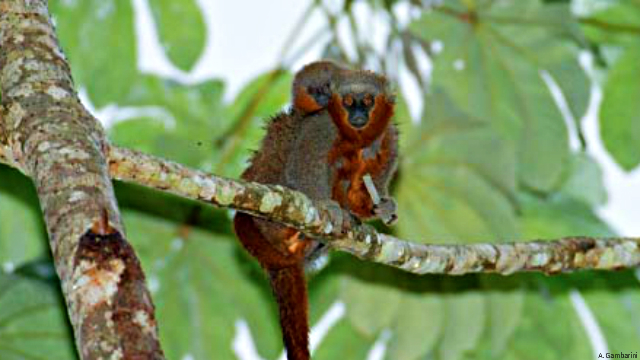
The Brazilian jungle have divulged another one of its secrets: a spanking-new species of the colorful, tree-dwelling titi monkey.
Titi monkeys or just “titis”—so-called by the natives likely in imitation of the creatures' distinctive calls—belong to a diverse group of Neotropical primates, of which 32 species have been found. They are also called “jumping monkeys” by some German scientists because of their ability to leap between branches with ease.
Small but monogamous
Titis measure some 9 to 18 inches tall, and are known for the striking coloration of their soft fur. They subsist mainly on a diet of fruits. A single family unit, which consists of a monogamous couple and their offspring, co-exist with other families to form larger groups. They prefer thick forests located near a water source, and are territorial. They are diurnal, although midday also serves as their nap time.
The new species, which has been dubbed Callicebus miltoni, was described by Dr. Julio Cesar Dalponte of the Institute for the Conservation of Neotropical Carnivores in Atibai and his team of researchers in the journal Papeis Avulsos de Zoologia.
Gathering hard evidence
The unusual titis were first spotted – by Dr. Dalponte and his associates from the Emilio Goeldi Museum and the Institute for the Sustainable Development of Mamiraua (ISDM) – on the Roosevelt River ’s east bank in 2011.
The team immediately realized that the creatures’ markings were unique, setting them apart from known species of titi. To determine they had in fact discovered a new titi species, they returned to the site for a number of years, each time studying their subjects closely.
This resulted in the observation that the titis have tails that are bright orange, foreheads with light grey stripes, and ochre sideburns.
“It goes without saying that we are really excited about this new discovery,” said study co-author Dr. Felipe Ennes Silva of the ISDM. “It is always thrilling to find something new in the Amazon, as it reminds us just how special this rainforest is and how lucky we are to have it on our doorstep.”
The species was named after Dr. Milton Thiago de Mello, a Brazillian primatologist renowned for his contribution to primatology development. The creatures make their home in the following Brazillian states: Amazonas, Mato Grosso, and Rondonia.
In 2013, a species of titi monkey that purrs like a cat was discovered in the Amazon. — TJD, GMA News

