

 GMA Brandtalk
 Tracking
 Archives

ADVERTISEMENT
Filtered By: Scitech
SciTech
SPECIAL MULTIMEDIA FEATURE
The slow death of one of Metro Manila's last forests
Nestled in the heart of bustling Metro Manila is one of the country's last great nature reserves. Perhaps not surprisingly, it’s easy to blame people for its slow and sad demise. Alas, the remedy isn't as simple nor as straightforward as just taking people out of the picture.
What started out as a laboratory for UP’s Biology students is now a full-blown forest containing trees older than the university itself. Located behind PHILCOA and UP Ayala Technohub, the forest is distant enough from the main campus that implementing constant vigilance has been difficult.
In decades past, the Arboretum Forest had only a handful of residents. The forest doubled as a nursery for trees set to be planted inside the campus, so the Campus Maintenance Office (CMO) was once originally located there. The employees were given permission to live there, since caring for the forest was their job.
However, two major events triggered the influx of informal settlers into the man-made forest.
“First was the development of Commonwealth Avenue, which cut across UP. The area became more accessible to outsiders,” recounted Nestor Castro, UP’s Vice Chancellor for Community Affairs, social scientist, and alumnus of the University of the Philippines Diliman. “Tapos, umalis ang CMO. Sa pag-alis ng CMO. Lalo nang lumakas ang loob ng informal settlers dahil walang nagbabantay.”
The buying and selling of rights spurred the expansion of the community. Titles were traded between people who had no real ownership over the land. The university’s records show that only 20 percent of the residents have a semblance of connection to UP. The other 80 percent merely use the area as a living space.
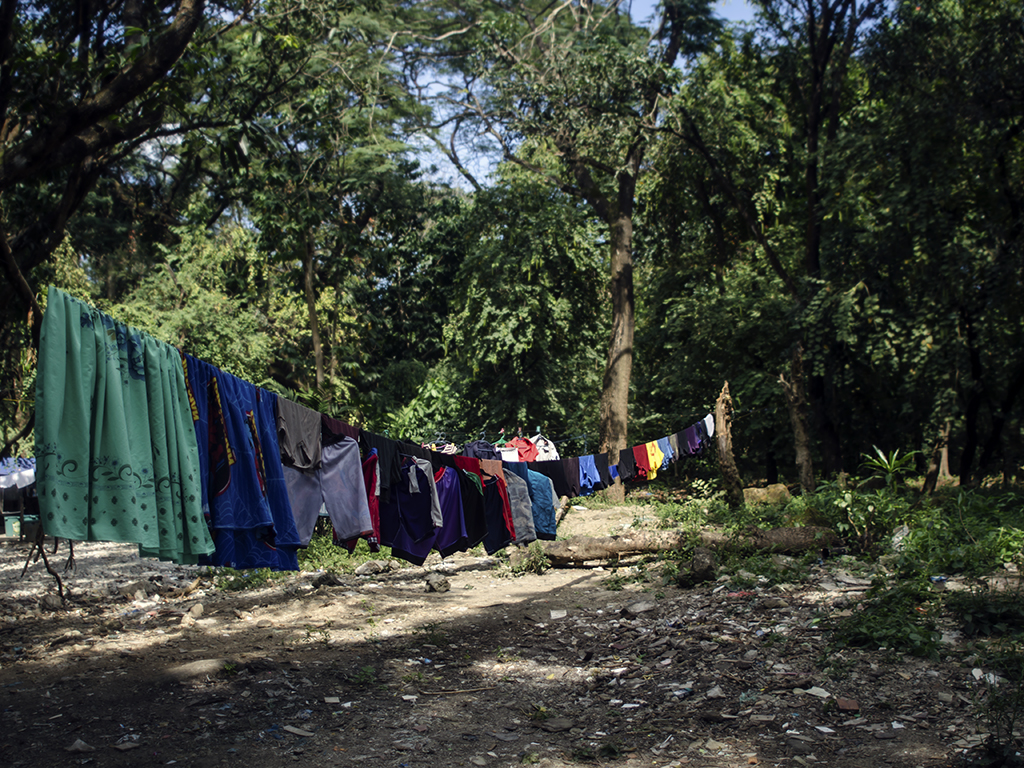
The residents hang their laundry by the trees in the forest.
The most obvious impact of the presence of informal settlers is the Arboretum’s shockingly dwindling size. What used to be a vast 22-hectare forest is now down to 17 hectares as of 2013.
“Five hectares ang nawala dahil sa pagpasok ng informal settlers. The implication? Pagputol ng forest trees,” Castro said. He proceeded to give two reasons why the residents cut down the trees: shelter and livelihood. One of their main sources of income is making charcoal.
“Ako, sa isang inspection ko ng area, nakita ko mismo yung charcoal-making site nila, pero minsan pag dadating yung guards dun, tatakpan nila yan,” Castro lamented.
“Sa aking personal na pagpunta dun, ang ganda-ganda niya (Arboretum),” he continued. “May mga punong malalaki, di mo mayapos sa tanda ng mga puno. Yung canopy nakakatuwa, malilim, malamig. Pero at the same level, ang daming mga bahay kang nakikita, tapos nandun yung mga sampayan nila, nandun yung mga basura nila.”
Plastic bags and wrappers defile the landscape, spilling over even to the waterways. Junk shops are permanent fixtures in the area, teeming with random refuse: mattresses, toys, clip hangers.
But the environmental consequences are just one side of the story. In addition to pollution, the presence of a community and the lack of supervision has allowed the forest to become a platform for political and criminal elements.
The Arboretum Forest straddles the boundaries of three barangays: Barangay UP Campus, Barangay Old Capitol Site, and Barangay Culiat.
Although Barangay UP Campus is inclined to demolish the illegal structures in the forest, Barangay Old Capitol asserts that it is outside their territory and jurisdiction. There is also the suspicion that barangay captains are among those who sell fake rights to informal settlers.
“May political side yung problem,” Castro said. “Bakit ba nila ito ginagawa? Aside from income, of course, mga botante nila ‘to. Meron tayong datos na habang lumalapit ang eleksyon, dumadami ang tao.”
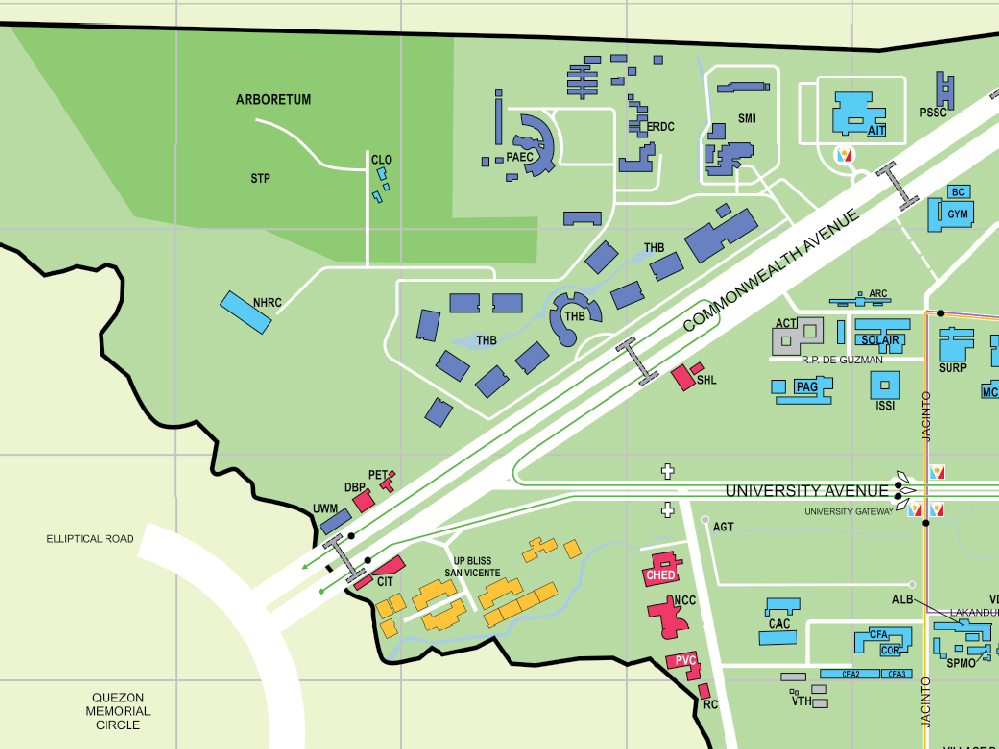
Bird's eye view of the University of the Philippines Diliman campus.
On a darker note, the almost non-existent presence of the university enforcers has led to the place becoming a breeding ground for crime: the forest is not uncommonly a dumping ground for murder victims.
In December 2014 alone, an unidentified body was recovered from the depths of the Arboretum, likely killed elsewhere then dumped in the forest. It was not the first such case, according to Vice Chancellor Castro, nor does he expect it to be the last.
The university also receives reports of child prostitution.
“Sa PHILCOA, dito ang paradahan ng mga jeepney,” Castro reported. “Isa sa mga pinagkakakitaan ng street children ay pagcater ng mga drivers...nagbebenta ng sex. Ito ay linked sa problema ng Arboretum.”
Instances of tupada, or cockfighting, have also been reported to the university. By law, cockfights are illegal.
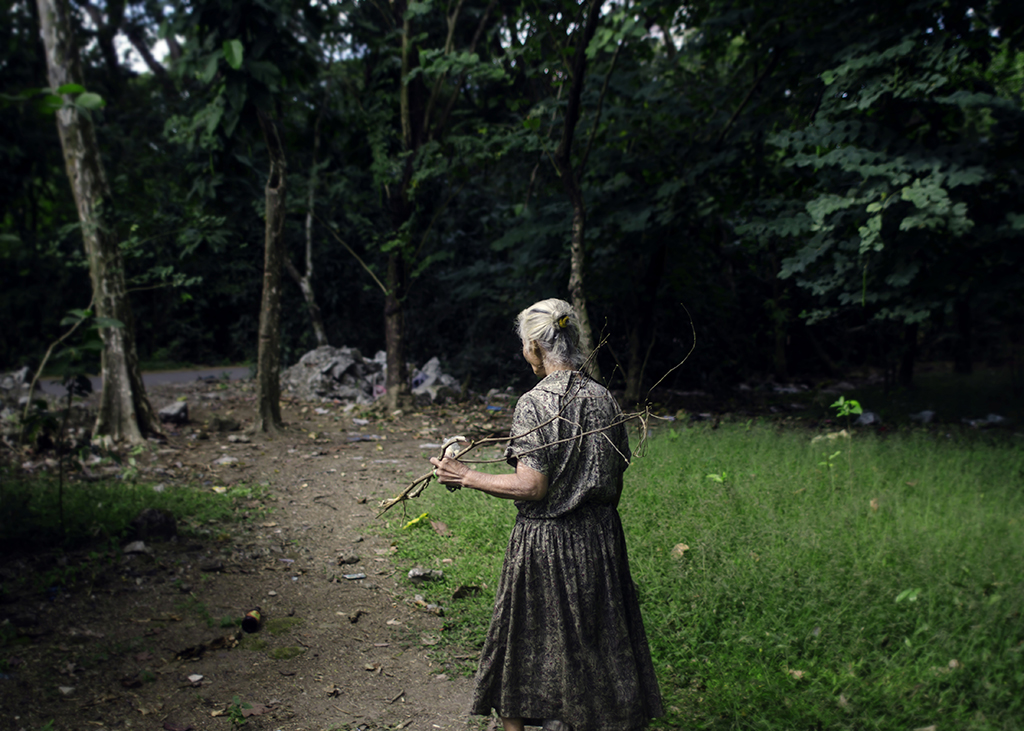
An elderly woman picks up small branches to create small fires for cooking.
“Ilang dekada na kami nakatira dito,” an elderly woman said as she paused from gathering fallen branches in the forest. “Bata pa lang ako, nandito na kami.”
Generations of families have rooted themselves in the soil of the Arboretum. The 2011 census counted over 800 households in the forest, and some of these are high-rise buildings.
“Mayaman at mahirap nag-i-squat sa UP,” remarked Castro. “‘Wag tayo mag-usap na kapag informal settlers, mahirap lang... dilemma ng UP ang paano paalisin 'pag meron nang five-storey buildings.”
Castro believes that the number of households has multiplied exponentially since the last survey. “Lalong dami ng dami. Yung iba dahil nanganganak, yung iba dahil dinadalaw sila ng mga kamaganak nila sa probinsya at nakikitira...napaka-complex eh.”
An entire community thrives in the Arboretum and the university recognizes this fact. Everyday, members of the UP Diliman police make rounds in the forest and report buildings that were constructed after the 2011 census. These buildings are then destroyed by the university’s task force, but the houses that have long been settled in remain untouched.
“Na-re-recognize namin na nandiyan sila, therefore, kailangan naming mag-develop ng program para sa kanila,” Castro said, although he admits that there are no ready solutions available.
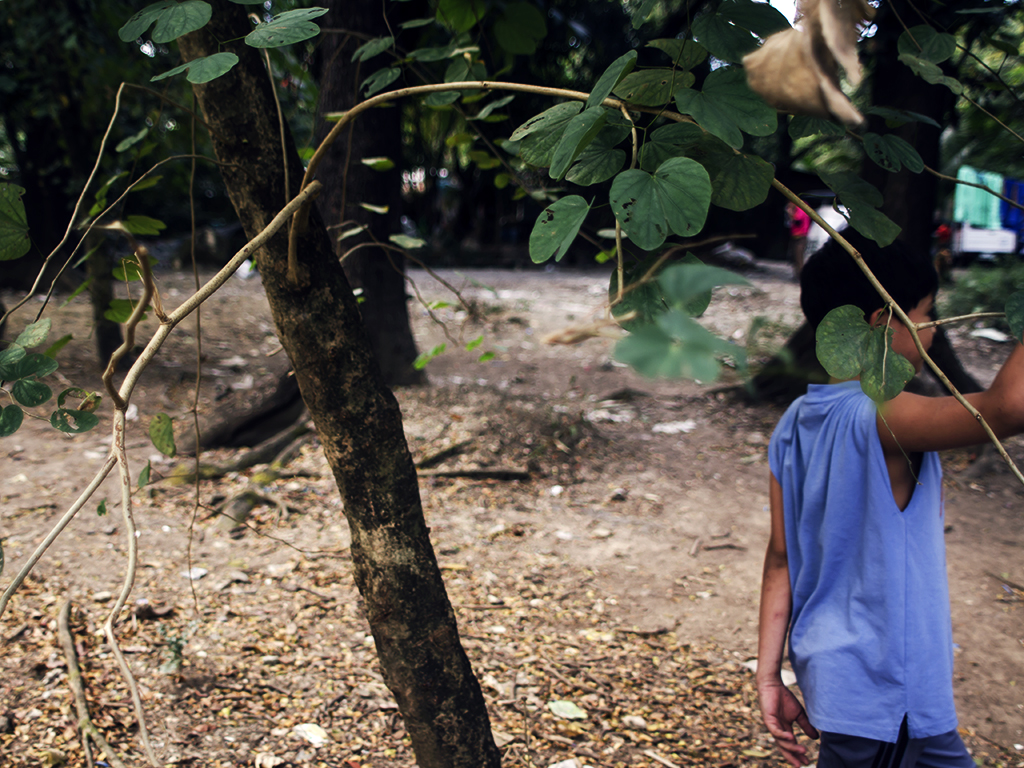
A child loiters by the trees that he said he liked to climb.
And even as the fate of the residents hangs in the air, the university is neverthelss determined to clean up and protect the Arboretum. The 2011 census has yet to be updated; and though UP has been doing its best to demolish new structures that were erected in the past 3 years, they are at a loss with what to do with the community that has settled there.
Although some efforts have been made, no real progress has been observed.
In February 2013, a memorandum of agreement was signed by the University of the Philippines Diliman, the Department of Agriculture, the Department of Environment and Natural Resources, and the Beta Sigma Foundation Incorporated to turn the Arboretum Forest into a National Botanical Garden. In March 2014, a new chancellor was appointed.
Chair of the Environmental Concerns Committee of the Student Council Jethro David shared, “We were having a consultation with the Office of the Vice Chancellor of Community Affairs about environmental issues inside Diliman and an alumna mentioned the informal settlers because it was a threat to the Arboretum. The OVCCA was not fully aware of the things that were happening pala because the turnover of the new administration just happened.”
The terms of the 2013 agreement were coterminous with the previous chancellor’s reign, so the new office had to reconstitute the plans regarding the Arboretum.
It hasn’t all been for naught, however. After the MOA was signed in 2013, DENR geotagged and identified 422 mature trees inside the 17-hectare forest. Most of the 422 trees are endemic; the top species include kupang, mahogany, and narra.
Soil sampling and soil analysis tests were also conducted to learn what types of vegetation can grow there. A topo-map also revealed which parts of the forest are prone to floods.
By March 2015, the OVCCA plans to have a draft presented to the board of regents.
“Meanwhile...medyo reactive,” Castro admitted. “Kapag may problema, pumapasok kami.”
Fortunately, the OVCCA is not alone in its mission. Ugnayan, a group composed of UP students and alumni, have been taking steps to address this issue.
“One of the steps of the group is to create a knowledge, attitudes and practices survey of the campus, in order to collect information about the biodiversity and conservation actions done on the campus,” explained David, who is also a member of the Ugnayan group.
When asked about his stand regarding the informal settlers, David admitted, “Personally I’m torn. Because being an environmentalist, I really feel bad that these people cut very old trees for personal reasons. But at the end of the day, you can't entirely blame them because the resources were there, available for consumption.”
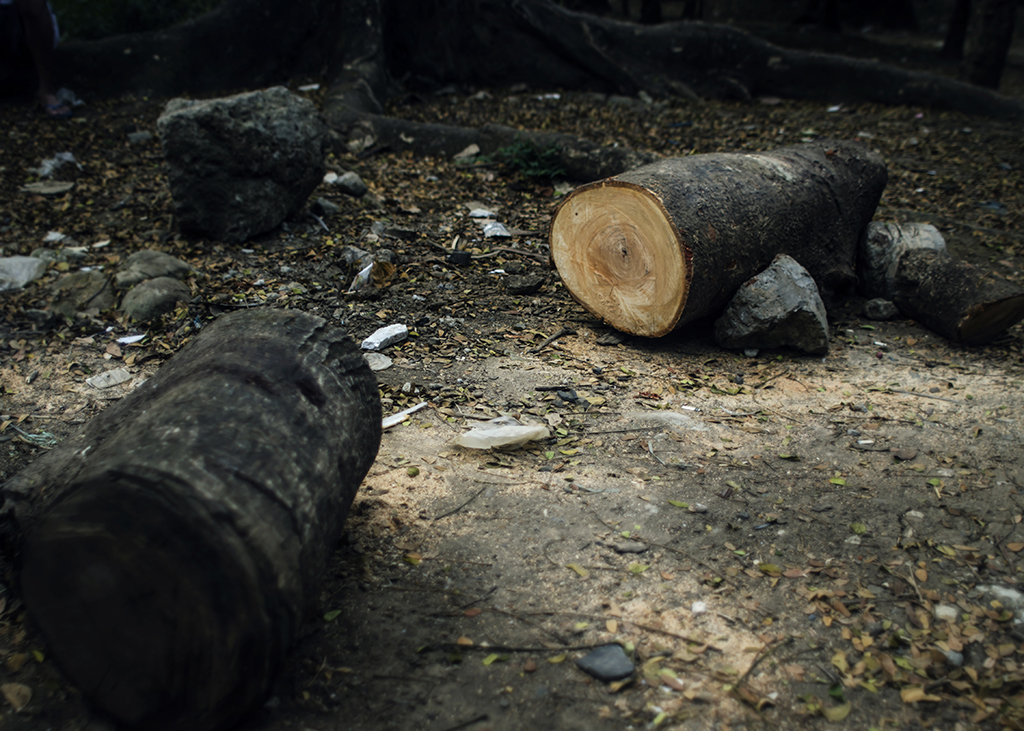
The forest grounds are littered with trash and cut trees.
But while David is conflicted, Vice Chancellor Castro is firm in his resolve.
“Ang mga tao sa Arboretum, gusto nila ay resettlement within UP. Ang UP, no way,” the Vice Chancellor said firmly. “Kailangan humanap ng resettlement site outside of UP. Kasi kung within UP, ganun nanaman...dadami nang dadami. Anyway, the records show na 80 percent sa kanila hindi connected to UP.”
Castro readily admitted that the university is not equipped to handle the resettlement project alone. In a meeting with Mayor Herbert Bautista, Vice Mayor Joy Belmonte, and the Quezon City Management Committee, it was agreed that once UP finalizes a plan, the QC government will implement the relocation of the informal settlers.
“This is not UP's obligation. UP is not a residence area,” Castro insisted. “Ang backlog na nga namin for housing ng faculty and staff...we have 300 applicants. Applicants pa lang ‘to. Paano ang mga hindi nag-apply? Of course, UP as an academic community will prioritize its academic constituents.”
Despite his seemingly harsh stand, Castro believes that the plan to save the Arboretum will also ultimately benefit its residents.
“Yung sitwasyon ng mga bahayan sa Arboretum ngayon, are in no way pwedeng i-classify as decent living. I think it's inhumane na tumitira sila sa ganung conditions. 'Di ko maintindihan ang argument na dapat pumayag kami sa ganito. Kasi inhumane siya,” he said.
“I think this is a national problem,” he continued. “Kahit saan naman eh, nagkataon lang na UP ‘to. Anywhere na may informal settlers, ganyan ang problema. Saan mo ililipat, meron bang bahay na makatarungan para sakanila? Pare-pareho naman eh.”
And therein lies the rub: the Arboretum and its informal residents are locked in opposing struggles to survive, a battle in which the only outcome seems to be a pyrrhic victory at best for either side. — TJD/JST, GMA News

