

 GMA Brandtalk
 Tracking
 Archives

ADVERTISEMENT
Filtered By: Scitech
SciTech
In search of Abel: Scientists discover oldest known murder
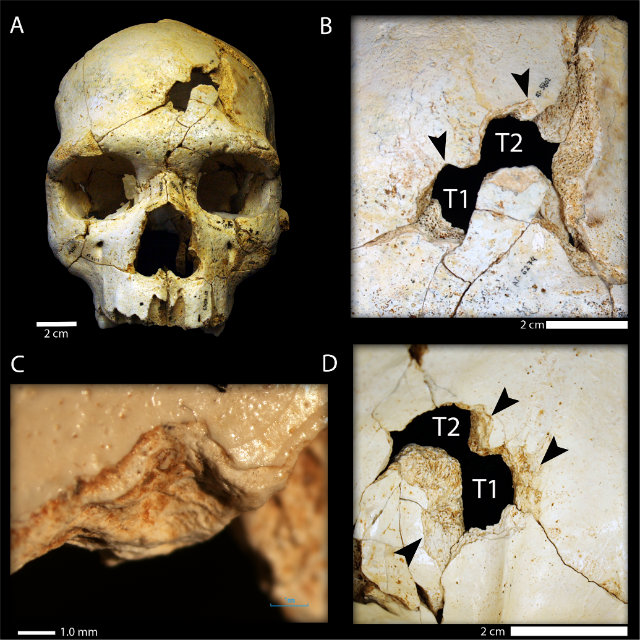
(A) Frontal view of Cranium 17 showing the position of the traumatic events T1 (inferior) and T2 (superior); (B) Detailed ectocranial view of the traumatic fractures showing the two similar notches (black arrows) present along the superior border of the fracture outlines. Note that the orientation of the two traumatic events is different; (C) Detail of the notch in T1 under 2X magnification with a light microscope. (D) Endocranial view of T1 and T2 showing the large cortical delamination of the inner table (black arrows). via PLOSONE
"And Cain talked with Abel his brother: and it came to pass, when they were in the field, that Cain rose up against Abel his brother, and slew him." - Genesis 4:8 (KJV)
The biblical slaying of Abel by his brother Cain symbolizes humanity's ancient horror of—and fascination with—murder. And now, scientists have found what may well be the world's oldest evidence of premeditated killing.
Discovery of Cranium 17
Here is clearly a murder most foul and ancient: researchers in Spain have found the 430,000-year-old skull of a hominin who was apparently struck twice in the head by a spear or axe. According to the study, published in the journal PLOS ONE, this is the earliest evidence discovered so far that shows proof of lethal interpersonal violence within the fossil record of humans and human ancestors.
The fossilized remains of the victim (dubbed Cranium 17) were recovered from the Sima de los Huesos Middle Pleistocene site in Spain, where the bodies of no less than 28 individuals have been unearthed.
There were two holes in the frontal bone of Cranium 17 which, according to forensic analysis, were caused by blunt force trauma.
Intent to kill
Based on the type of injuries, their location, and the similar shape and size, the researchers concluded that they were the end result of a face-to-face fight between two hominins. The blows were also likely lethal, penetrating the bone-brain barrier, and the fact that there were two of them suggests that they were intentional strikes intending to kill the victim.
There were two holes in the frontal bone of Cranium 17 which, according to forensic analysis, were caused by blunt force trauma.
Intent to kill
Based on the type of injuries, their location, and the similar shape and size, the researchers concluded that they were the end result of a face-to-face fight between two hominins. The blows were also likely lethal, penetrating the bone-brain barrier, and the fact that there were two of them suggests that they were intentional strikes intending to kill the victim.
“This finding shows that the lethal interpersonal violence is an ancient human behavior and has important implications for the accumulation of bodies at the site, supporting an anthropic origin,” the study said.
First evidence
The researchers also pointed out that though interpersonal violence has been well-documented, this is the first evidence that traumatic injury directly resulted in death of the injured victim.
“This represents the earliest clear case of deliberate, lethal interpersonal aggression in the hominin fossil record, demonstrating that this is an ancient human behavior,” the study concluded. — GMA News

