

 GMA Brandtalk
 Tracking
 Archives

ADVERTISEMENT
Filtered By: Scitech
SciTech
International Space Station visible across PHL tonight

Short of actually being on the International Space Station (ISS), this might be the next best thing for us Earthbound mortals.
Mankind's home in space will be visible across the Philippines for up to a full 6 minutes tonight, beginning at just before 6:22 p.m. and lasting until 6:28 p.m. It will be at its brightest around 6:25 p.m.
The ISS is moving so fast and so high up that it completes an orbit every 90 minutes—in other words, it goes around the Earth approximately 16 times each day.
Bright spot in the sky
And it shouldn't be be hard to spot: NASA says it's the third brightest object in the night sky, bright enough to be seen even in the middle of a city—where light pollution usually makes it impossible to see all but the brightest stars. It can be seen as a bright white dot zipping across the sky, and can easily be mistaken for an airplane passing overhead.
But orbit patterns are tricky things, so it's only every so often you can catch it in the sky.
According to NASA, the ISS will pass over the Philippines less than a dozen times in October and November this year. Of these sightings, tonight's pass will be one of the longest times the space station will be visible in the night sky.
People in Metro Manila can catch the ISS for a full 6 minutes starting at around 6:22 p.m. It will then be visible for 5 minutes in Cebu City beginning at 6:23 p.m. Finally, the ISS can be seen in Davao City for 4 minutes starting at 6:24 p.m.
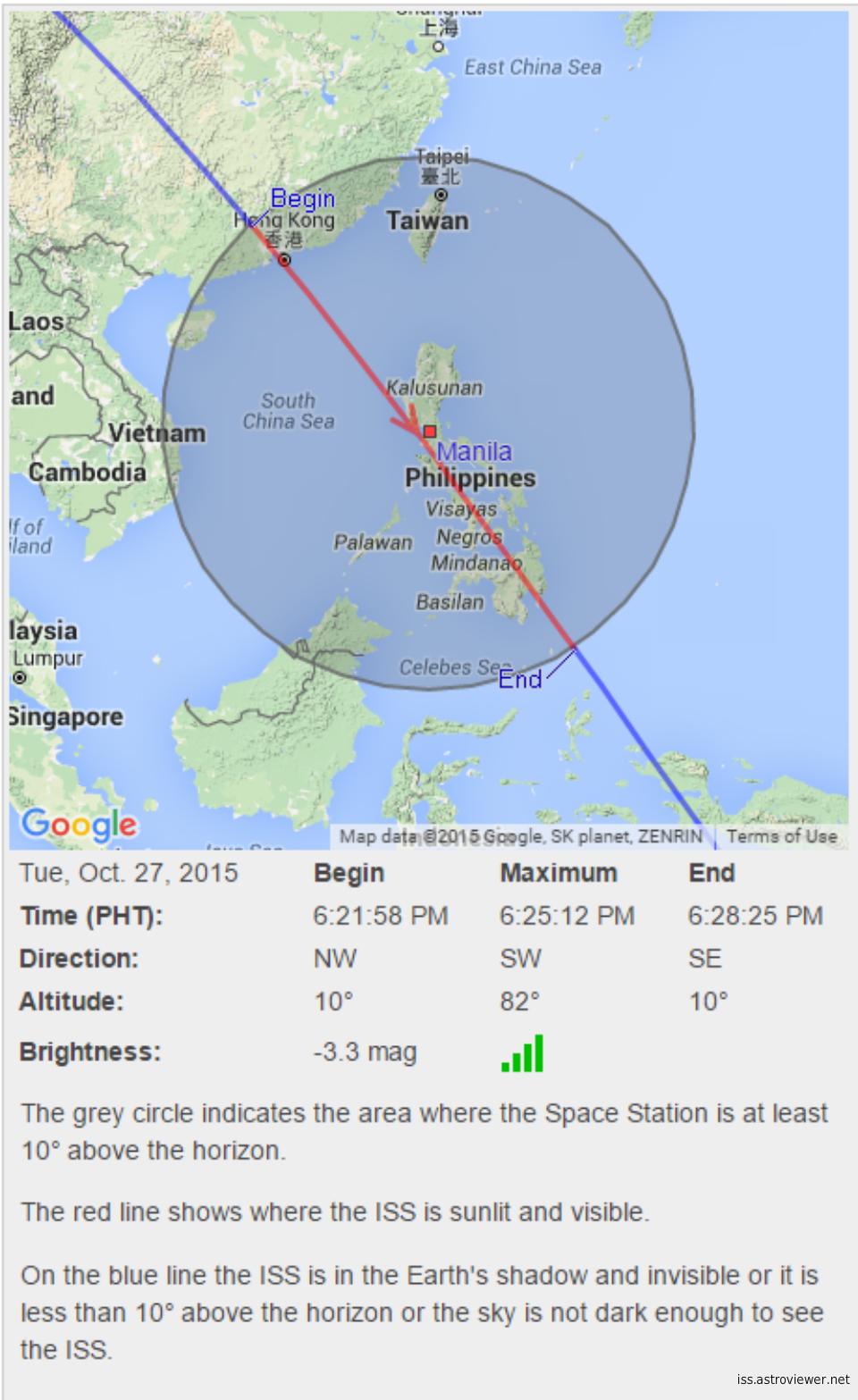
Where to check for future sightings
For a schedule of future sightings, you can visit NASA's "Spot The Station" website, where you can select your home city and can even subscribe for mobile alerts. You can also visit Astroviewer's ISS Observation site for detailed maps of flybys in your area.
If you want to know where the ISS is right this moment in real time, you can head on over to iss.astroviewer.net, which features a Google map showing the station's exact position above the Earth. — GMA News

