

 GMA Brandtalk
 Tracking
 Archives

ADVERTISEMENT
Filtered By: Scitech
SciTech
Interactive health science exhibit tours the PHL
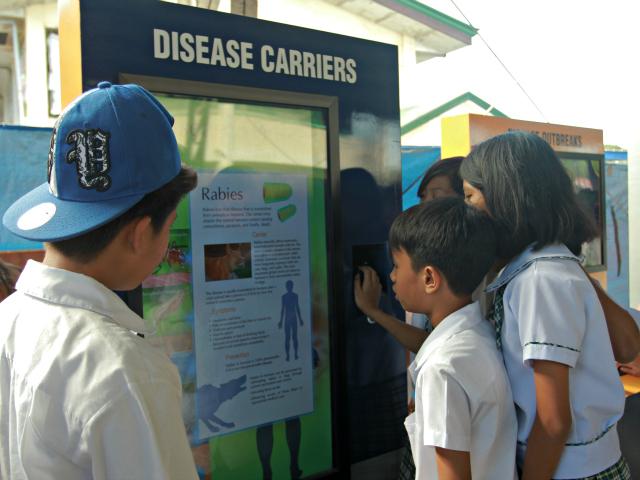
What do elementary students know about over-the-counter drugs? Do high school students understand how diseases spread? How can you make music with light?
Students, teachers and guests found the answers to these and many other questions at the Health Science On The Go-Traveling Science Centrum (HSOTG), recently launched in Rizal province.
On the go
In 2014, the Philippine College of Physicians reported a low health literacy rate among Filipinos. This gap is reflected in the Philippines’ leading causes of morbidity and mortality, which feature mostly preventable infectious diseases. Though science textbooks discuss good nutrition and human anatomy, they gloss over concepts that have direct bearing on children’s health. This exhibit addresses that gap.
The HSOTG-Traveling Science Centrum is a joint project of Unilab Foundation (ULF) and the Philippine Foundation for Science and Technology (PFST).
ULF Executive Director Rhodora Palomar-Fresnedi shared that HSOTG-Traveling Science Centrum leverages fun, interactive exhibits to foster learning among students. “Kids these days are lucky that they can learn about science through an interactive experience. When we were young, we had to read from books, and we had to imagine what a cell looks like, what happens in the digestive system. The closest we could get to something experiential back then was the metamorphosis of the butterfly, because you see it happening.” The exhibits were designed to stimulate children’s curiosity, leading them to learn and retain simple but important health information. “What are the diseases that lead to outbreak? How do you use medicine properly? The answers are right there, easy to grasp and remember.”

The value of health literacy
PFST and ULF hope to improve the health literacy of young people. Palomar-Fresnedi emphasized, “We need to be head-to-toe healthy, and to know science in a way that is applicable to our daily lives.”
PFST Trustee Nicanor Villaseñor added, “If we can contribute, if we can complement some of the major [health] programs, then we’re happy.”
For the HSOTG-Traveling Science Centrum, PFST identified fourteen target locations, in coordination with local government units and the regional offices of the Department of Science and Technology and the Department of Education. ULF developed the content to complement the DepEd health and science curriculum, in consultation with various health experts. ULF also constructed the thirty-one exhibits.
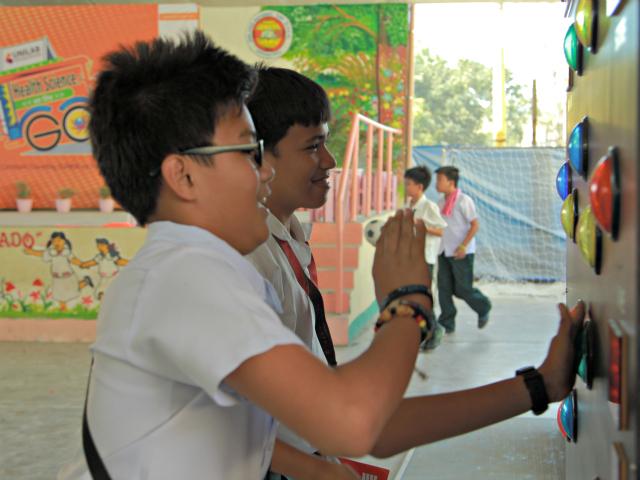
Through the interactive exhibits, students can learn about various health indicators. In ‘Burn Those Calories Away,’ volunteers are invited to pedal the stationary bike, to see how much activity is required to burn the calories of food and drink such as a 330 ml can of soda, three cookies, or one glazed donut. ‘What Happens During Sleep?’ describes the different stages of sleep and the activities of the body, eyes, and brain at each stage. ‘Reaction Time’ tests hand-eye coordination, showing how fast a person reacts to the stimuli.
Traveling the country
PFST built the Philippine Science Centrum (PSC) in Riverbanks, Marikina, to demonstrate general science concepts like space, electricity and Earth science through interactive exhibits. Not all students are able to visit the PSC. With PFST and ULF’s HSOTG-Traveling Science Centrum, more students from around the Philippines can have access to a similar experience.
Palomar-Fresnedi and PFST President Filemon Berba, Jr., formally opened the exhibit on September 23, 2015, at the Mindanao Science and Technology Centrum in Davao City. HSOTG-Traveling Science Centrum was visited by over 6,000 students during its one-month maiden run.
In Davao, Palomar-Fresnedi emphasized the role of community and cooperation in making the exhibit a reality. “All of us together—the local government units, regional offices, congressmen—made the exhibits possible through bayanihan. At Unilab Foundation we work to enable every Filipino to play a role in building a healthier Philippines. Health Science On the Go is one way to make that happen.”
Berba highlighted the importance of bringing exhibit around the country. “If we need to touch the lives of all Filipino youth, we have to go out. Why is this important? Even if we make young kids and teachers aware of and interested in science, we need to be them to be healthy. You have to be healthy to be able to be effective. And therefore I thank Unilab Foundation for putting this together, blending the science of the mind and the science of health.”
From Davao, the exhibit moved to San Jose National High School (SJNHS) in Rodriguez, Rizal. Principal Leandro D. Matusiños talked about how their students would benefit. “Experiential learning is one of the best ways [to learn]. When students are able to touch, see and manipulate materials, they will learn critical thinking, and that’s what we need. Their imagination will thrive.”
Rizal exhibit
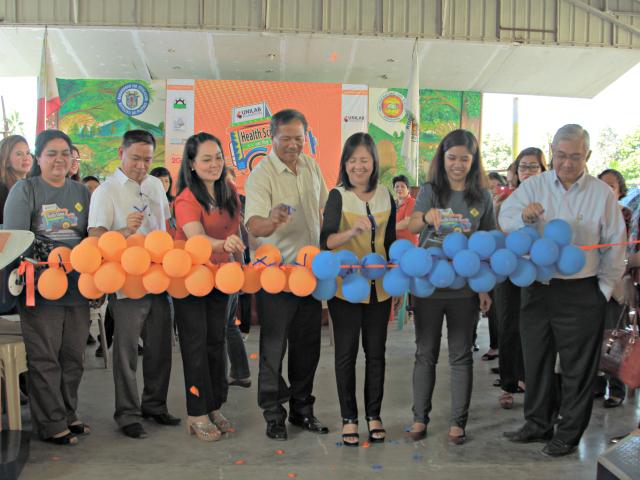
Dr. Aileen Estacio Vocal, Education Program Supervisor 1 for Science and Technology, gave the opening remarks at the Rizal opening ceremonies in January. She said, “We are so lucky that we don’t have to bring the students to Marikina, or to other distant areas. We’re so happy to have exhibits that will enlighten our students, not just on technology but also on health. Thank you so much to our foundations. We look forward to more exhibits.”
The Rizal leg of the exhibit is projected to reach over 10,000 elementary and high school students and teachers from over thirty districts in Rizal. Palomar-Fresnedi shared her hopes, “Some [of them] will become healthcare professionals or doctors, some will be inspired to be nurses, midwives or barangay health workers. They may become science teachers. Even if they do not become healthcare professionals, the important thing is that our students of today—all 23.8 million of them—will be equipped to live healthier lives.”
HSOTG-Traveling Science Centrum remained at SJNHS until February 12, 2016. From there it moved to Tomas Claudio Memorial Elementary School, where it will be open to students until March 4, 2016.
The admission fee is PhP 50 per student. For more information, visit www.unilabfoundation.org and www.science-centrum.ph. — TJD, GMA News

