

 GMA Brandtalk
 Tracking
 Archives

PHL fisheries to decline by up to 50% by 2050 due to climate change –researchers
Philippine fisheries are projected to lose 30-50% of their Maximum Catch Potential (MCP) and 30-50% of their Maximum Revenue Potential (MRP) by the year 2050—relative to their value in the year 2000—due to climate change, if carbon dioxide emissions continue under "business as usual". Global MCP is projected to decrease by 7.7% and MRP by 10.4% by 2050. The study was done by researchers from the University of British Columbia and published in the journal Scientific Reports.
The fisheries sector—including municipal capture, commercial capture, and aquaculture—contributed 1.6% or P197 billion to Philippine GDP in 2014 and employed up to 1.6 million Filipinos as of 2002.
However, climate change and subsequent changes to ocean conditions are predicted to change the current range and distribution of important fishery species. Such changes in distribution are already being observed, with tropical species moving poleward as the oceans warm up. Global marine fisheries landings earn annual gross revenues of around US $100 billion per year.
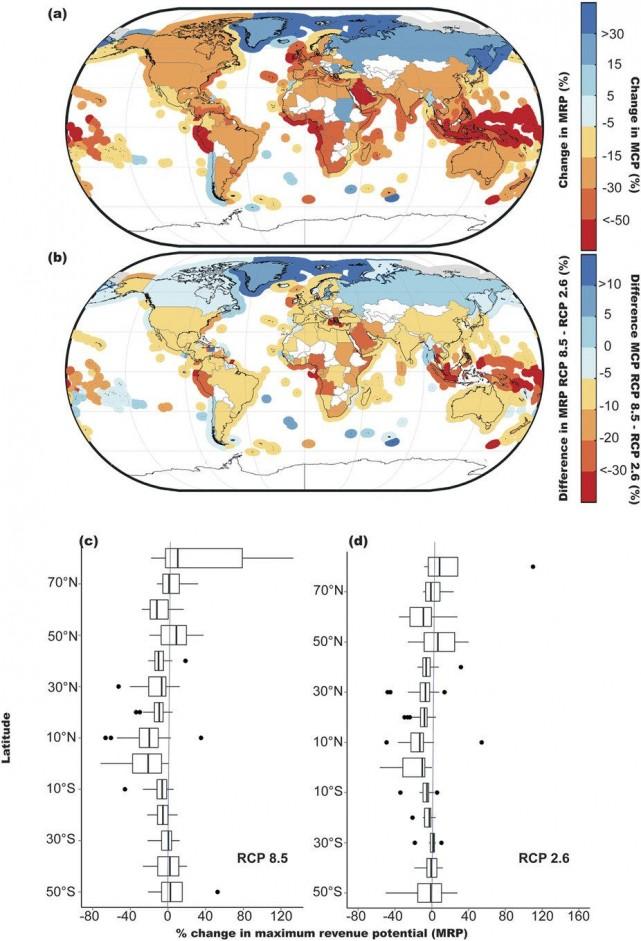 Impacts of climate change on MCP and MRP by the 2050 s (average between 2041–2060) relative to the 2000 s (average between 1991–2010): (a) mean percentage change in projected maximum catch potential (MCP) of 280 Exclusive Economic Zones (EEZs) and mean percentage change in projected MRP of 192 fishing nations in the 2050 s relative to the level in the 2000 s under RCP 8.5 scenario; (b) differences in percentage change in MCP and MRP between RCP 8.5 and RCP 2.6 scenarios in the 2050 s; (c,d) latitudinal zonal average of mean percentage change in fisheries MRP in different fishing countries under RCP 8.5 (c) and RCP 2.6 (d).
To project how global MCP and MRP would change under various climate scenarios, researchers used Dynamic Bioclimate Envelope Models (DBEM) that were subjected to Representative Concentration Pathway (RCP) 8.5, the "high greenhouse gas emissions" scenario; and RCP 2.6, the "low GHG emissions" scenario.
Click here to learn more about the possible scenarios.
DBEMs simulate how populations move in time and space in response to changing ocean conditions, which depend on the species' depth range, latitudinal range, preferred habitat, and regions where the species occurs. The researchers used the distributions of 887 fished marine fish and invertebrate species. The changes in distribution, abundances, and catches by 2050 were then plotted on the exclusive economic zones (EEZs) of 280 countries and international waters. The potential impacts of fisheries policies such as catch quotas and marine protected areas were not included in the study.
Analysis showed that, while global MCP is projected to decrease by 7.7% and MRP by 10.4%—roughly US $10.4 billion, assuming constant prices—by 2050 relative to 2000 under the "high emissions" scenario, this varied greatly among the countries.
Tropical countries are predicted to experience an average MCP decrease of 38% and MRP decrease of 33%, while countries in the Arctic Ocean and Northern Atlantic Ocean are expected to have higher MRPs—a 71% increase and over 100% increase, respectively.
The Philippines is expected to experience a 30-50% decrease in MCP and MRP under "high emissions" and 5 to 20% decrease under "low emissions"—specifically, a 10-20% decrease in the Celebes Sea and a 5-10% decrease in the rest of the Philippines.
Small island nations such as Tuvalu and Kiribati—with a forecast 79% and 70% decrease in MCP, respectively—will bear the brunt of the income loss, as these countries are both heavily dependent on fisheries income and highly vulnerable to climate change.
Despite the large increase in catches for Arctic and Northern Atlantic countries, the increase in revenue is predicted to be relatively low as it is the low-value fish that will increase in abundance, while higher value fish such as Atlantic salmon (Salmo salar) and European plaice (Pleuronectes platessa) will decrease as their populations are dependent on cooler ocean waters. For example, fish catch in the Greenland EEZ is projected to increase by 58% by 2050 under the "business as usual" scenario, but revenues will only increase by 10%.
Some countries not only fish in their own EEZs, but also in the EEZs of other countries and international waters. As such, countries whose Distant Water Fishing (DWF) fleets contribute significantly to total fishery revenue will also be affected if these fleets fish in areas where the catch is expected to drop, such as the Central Pacific and Central Atlantic. — TJD, GMA News

