

 GMA Brandtalk
 Tracking
 Archives

New horny Tyrannosaur species was crocodile-like
Paleontologists have discovered a new species of tyrannosaur, and it was quite horny.
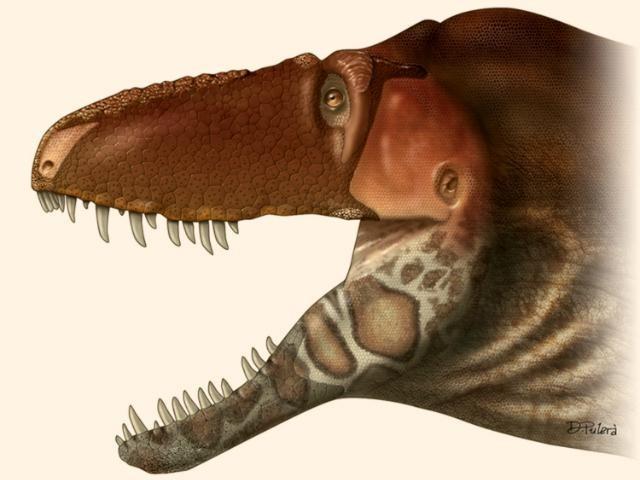
Horner’s frightful lizard, or Daspletosaurus horneri, had a body 9 meters (29.5 feet) long, and 2.2 meters (7.2 feet) tall – making it slightly smaller than its infamous cousin, the Tyrannosaurus rex. Its snout was wide, and large, flat scales covered its face. Some regions on the jaws, snout, and tiny orbital horns were also protected by armor-like skin.
Behind each eye was a large horn covered in keratin, which is the shiny and stiff material human fingernails are composed of. The horn was raised beyond the side of the skull.
Interestingly enough, the flat scales masking its face featured small bumps. These are actually sensory organs (similar to those found on crocodiles) that provided the animal with acute tactile sensitivity.
The creature feasted on ceratopsians (horned dinosaurs), pachycephalosaurs (dinosaurs with domed skull roofs), hadrosaurs (duck-billed, crested dinosaurs) and theropods (small carnivorous dinosaurs).
The beast belonged to the group of massive predatory dinosaurs called tyrannosaur, which lived in the Late Cretaceous period in North America and Asia. Daspletosaurus horneri specifically lived around 75.2 to 74.4 million years ago, in a region in the US that is now Montana.
“Daspletosaurus horneri was the youngest, and last, of its lineage that lived after its closest relative, Daspletosaurus torosus, which is found in Alberta, Canada,” said the study’s lead author and Carthage College paleontologist, Dr. Thomas Carr. “The close evolutionary relationship between the species taken with their geographic proximity and their sequential occurrence suggests that together they represent a single lineage that changed over geological time, where D. torosus has morphed into D. horneri.”
“It’s about 75 million-years-old, so this animal lived about 9 million years before the extinction of the non-avian dinosaurs,” added one of the study co-authors Dr. Eric Roberts of James Cook University. “In geological terms, the beast was the youngest of the Daspletosaurus clan.”
Horny and touchy
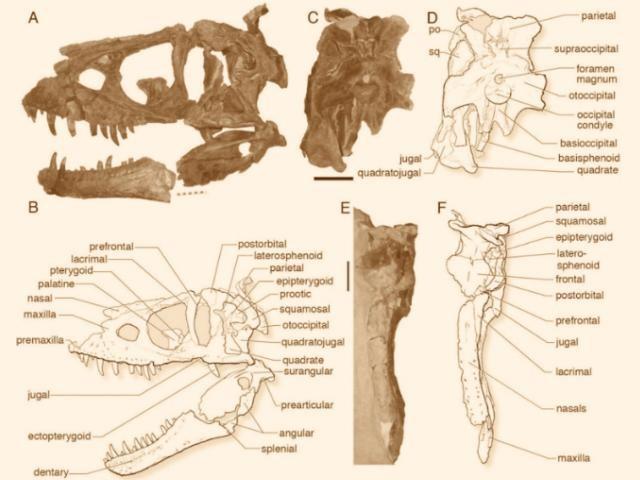
The team examined several well-preserved fossils, including an adult’s skeleton and skull, a subadult’s skeleton and skull, part of a subadult’s lower jaw, and miscellaneous bones belonging to juvenile and subadult specimens.
The research has produced new data about the appearance of tyrannosaurs as lipless, scaly-faced monsters with snouts sensitive to touch.
“It turns out that tyrannosaurs are identical to crocodylians in that the bones of their snouts and jaws are rough, except for a narrow band of smooth bone along the tooth row,” explained Dr. Carr.
“In crocodylians, the rough texture occurs deep to large flat scales; given the identical texture, tyrannosaurs had the same covering. We did not find any evidence for lips in tyrannosaurs, the rough texture covered by scales extends nearly to the tooth row, providing no space for lips.”
He added: “However, we did find evidence for other types of skin on the face, including areas of extremely coarse bone that supported armor-like skin on the snout and on the sides of the lower jaws. The armor-like skin would have protected tyrannosaurs from abrasions, perhaps sustained when hunting and feeding.”
The authors found that, like in crocodylians, the Daspletosaurus horneri’s jaws and snout featured a multitude of tiny nerve openings, which let hundreds of nerve branches innervate its skin. This was what was responsible for the area’s extreme sensitivity, which can be likened to the sensitivity experienced by human fingertips.
“This sensitivity is part of a bigger evolutionary story,” said the Louisiana State University Health Sciences Center New Orleans’ Professor Jayc Sedlmayr, also a study co-author.
“The trigeminal nerve has an extraordinary evolutionary history of developing into wildly different ‘sixth senses’ in different vertebrates, such as sensing magnetic fields for bird migration, electroreception for predation in the platypus bill or the whisker pits of dolphins, sensing infrared in pit vipers to identify prey, guiding movements in mammals through the use of whiskers, sensing vibrations through the water by alligators and turning the elephant trunk into a sensitive ‘hand’ similar to what has been done to the entire face of tyrannosaurs.”
Daspletosaurus horneri is named after John “Jack” R. Horner, the former curator at Bozeman, Montana’s Museum of the Rockies.
The study was published in the journal Scientific Reports. — TJD, GMA News

