

 GMA Brandtalk
 Tracking
 Archives

ADVERTISEMENT
Filtered By: Scitech
SciTech
Icy Earth-like exoplanet discovered near our galactic core
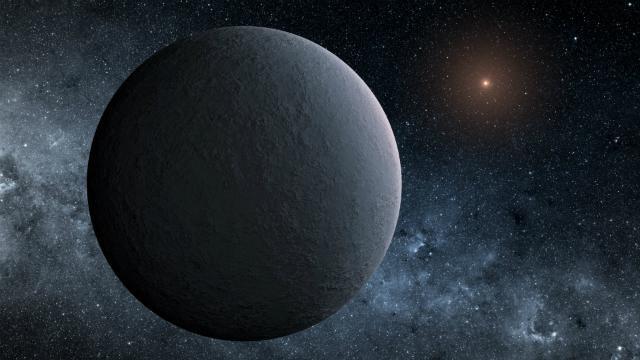
Astronomers have detected an icy exoplanet with a mass comparable to Earth’s, and it orbits a tiny star some 12,750 light-years from us. The frozen world was detected using the gravitational microlensing technique.
The exoplanet has been named OGLE-2016-BLG-1195Lb, and it is extremely cold—even more so than Pluto. Its mass is around 1.4 times planet Earth’s. It is situated at a distance from its star that is similar to the distance between Earth and the Sun.
The star this planet is orbiting is an ultracool dwarf with a mass that is only 7.8% of our Sun’s.
“This ‘iceball’ planet is the lowest-mass planet ever found through microlensing,” said study author and researcher Yossi Shvartzvald of NASA’s Jet Propulsion Laboratory.
Microlensing
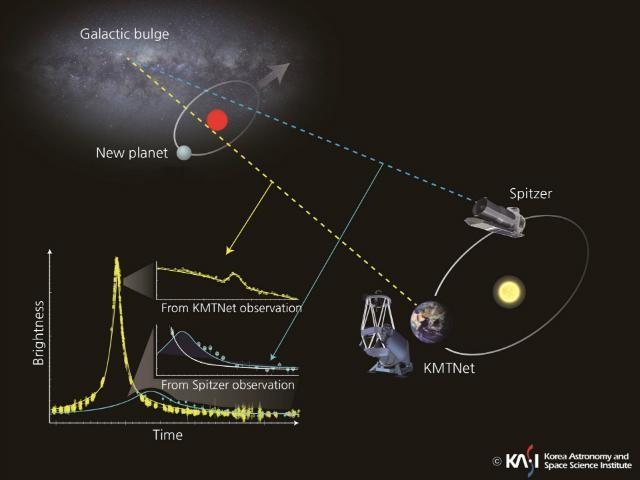
Astronomers often use gravitational microlensing to detect distant planets. When a foreground star passes directly in front of a background star, the former’s gravity amplifies the latter’s light. Any astronomical object in orbit around the foreground star may also intensify the background star’s brightness, but only briefly. This technique has led to the discovery of many distant exoplanets.
In the case of OGLE-2016-BLG-1195Lb, the additional light amplification it caused lasted a couple of hours.
The ground-based Optical Gravitational Lensing Experiment (OGLE) first detected OGLE-2016-BLG-1195b.
Shvartzvald and his team then used the Korea Microlensing Telescope Network (KMTNet) and NASA’s Spitzer Space Telescope to track the microlensing event and locate the iceball planet.
“We are able to know details about this planet because of the synergy between KMTNet and Spitzer,” said study co-author and professor emeritus of astronomy Andrew Gould at Ohio State University, Columbus.
Planetary distribution
OGLE-2016-BLG-1195Lb is found in the Milky Way’s Galactic disk, the pancake-like area around the central bulge. Its discovery will help astronomers determine the planetary distribution in our galaxy.
One question that scientists hope to one day answer is if the distribution of planets in our galaxy’s central bulge is different from the distribution of planets in its disc.
“Although we only have a handful of planetary systems with well-determined distances that are this far outside the Solar System, the lack of Spitzer detections in the bulge suggests that planets may be less common toward the center of our Galaxy than in the disk,” said study co-author Geoff Bryden, also of NASA’s Jet Propulsion Laboratory.
Gravitational microlensing previously discovered terrestrial planets OGLE-2013-BLG-0341Lb and MOA-2007-BLG-192Lb, which also orbit ultracool dwarfs.
“These suggest that the protoplanetary disks of ultracool dwarfs have sufficient mass to form terrestrial planets, as also hinted at by direct imaging of such disks,” said the researchers. “The location of these planets, at about 1 AU (Earth-Sun distance), support planet formation predictions.”
They added: “However, since the sensitivity of current microlensing surveys for systems with such small mass ratios is very narrow, around projected separations of 1 AU, they cannot set strong constraints on the presence of planets elsewhere around ultracool dwarfs, such as the much closer separations seen in the TRAPPIST-1 system.”
This study was published in Astrophysical Journal Letters. — TJD, GMA News

