

 GMA Brandtalk
 Tracking
 Archives

A word on eyeball tattooing
Yesterday, the story about Otomamay Haruki, a Japanese man who traveled to the Philippines to have his right eyeball tattooed at a cheaper price than what he paid in Canada for his left, went viral.
READ: Japanese man gets right eyeball tattooed by a Filipino artist
It's not a new thing, eyeball tattooing. Better known as scleral tattooing, the body art form has actually been gaining popularity in the past decade as a form of extreme body modification, availed by tattoo enthusiasts and thrill-seekers alike.
Just last year, a story went viral about a Canadian model, Catt Gallinger, who lost sight in her eye after a botched scleral tattooing session.
With these stories making the rounds on social media, one has to wonder: How delicate and risky is the process of getting your eyeball tattooed? And why do some people still go for it, in spite of the dangers the process entails?
A clearer picture
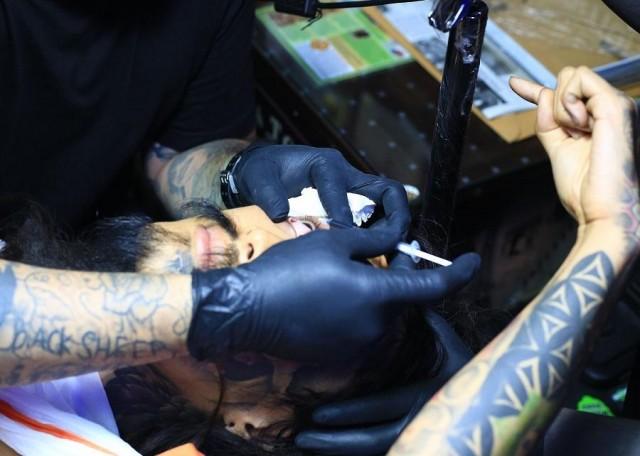
In a nutshell, scleral tattooing involves the permanent coloring of the sclera (the white part of the eye). Using a needle, ink is injected in the tiny space between the eye’s top layer (the conjunctiva) and the sclera, after which it gradually spreads to cover the sclera’s entirety.
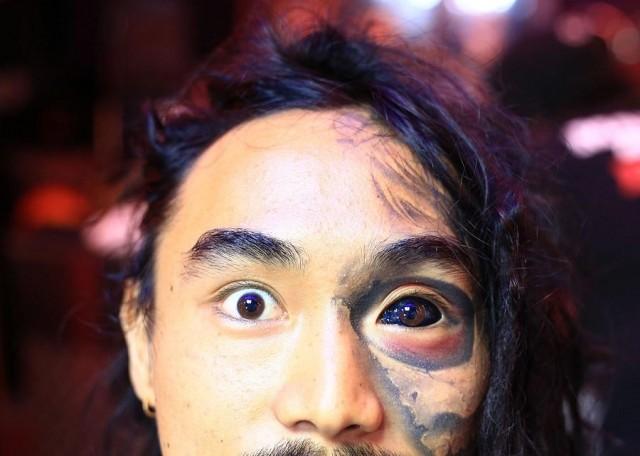
“Scleral tattooing is not an ophthalmic procedure,” clarifies Dr. Sharlene I. Noguera, a comprehensive ophthalmologist and cornea and external disease specialist of Asian Eye Institute.
According to Dr. Noguera, on the rare occasions when ophthalmologists use tattoo ink for medical purposes (such as in corneal tattooing for corneal scars), they cosmetically improve the eye’s appearance using sterile ink and medical instruments under a surgical microscope.
Scleral tattooing is said to have been first performed as a non-medical body modification procedure by tattoo artist Howie Rollins (who goes by the moniker Luna Cobra) on July 1, 2007. Since then, other tattooists have followed suit. Going by existing literature, however, the results are not a pretty sight.
“Literature about [the procedure] is scarce, and if you look up journal articles they’re mostly about things that have gone wrong with the procedure,” shares Dr. Sandy Añover, an ophthalmologist at the Department of Health (DOH) Eye Center.
As Dr. Añover explains, most parts of the eyeball are less than a millimeter in thickness — “thinner than a sheet of paper, to be honest” — thereby necessitating the use of microscopes or surgical loupes during eyeball operations. “From the videos I’ve watched, most of the tattoo artists just use their naked eye.”
Eye, ay, ay!
Identifying the potential risks involved in scleral tattooing is akin to going through a laundry list of things that you absolutely do not want to happen to your eyes.
Dr. Noguera mentions, among other things, decreased vision, increased sensitivity to light, eye pain, and infection from either the needle or the ink.
Complete blindness is also a possibility, but it’s not even the worst one. You could end up completely losing your eye — yep, the whole eyeball, a la Thor in Thor: Ragnarok — should your scleral tattooing session go awry.
Then again, the very idea of a tattoo artist permanently damaging the eye should be more than enough to paint a disturbing (and painful) picture for most people.
“Mabubutas ‘yung mata (The eye will get punctured), to put it simply,” says Dr. Añover. One of the more gut-wrenching cases she read involved ink leaking inside the eyeball, through the resulting hole in the sclera.
“In severe cases, the infection can spread to the entire eyeball and the rest of the body,” Dr. Noguera says. “If the infection reaches the bloodstream, it becomes a systemic infection that may cause death, if left untreated.”
Blindsided?
Some tattooists are apprehensive about the procedure themselves.
Happy Navarro, a tattoo and visual artist from Malabon, shares that while he believes the procedure is safe (provided that it’s done by a professional with properly sterilized instruments), he does not see himself performing the procedure for a client.
“Personally, medyo takot (I’m a bit scared),” admits Navarro. “I don’t have the experience, proper training, or the right process to do it. It’s too risky for me. And I’m not a fan of body modification.”
Interestingly, even Rollins himself has chimed in, expressing concerns that the procedure is now being performed by people who haven’t quite mastered the art yet.
In fact, Rollins advocates banning sclera tattooing to anyone without an eye surgeon’s license, even if that means he would be banned from practicing the art as well. "I think the art is beautiful and it should continue,” says Rollins, “but I think it should continue in a safe manner."
In Otomamay Haruki's case, his scleral tattoo procedure was performed at the tattoo clinic of Ricky Sta. Ana, president of the Philippine Tattoo Artist Guild and arguably Philippines' best tattoo artist.
The Japanese signed a waiver that said it was a voluntary on his part and that he was aware of all the risks involved.
Still eyeing it?
In 2009, the Oklahoma Senate passed Senate Bill 844 officially making scleral tattooing illegal in the state.
According to Dr. Noguera, the continued popularity of scleral tattooing (despite its accompanying health risks) makes it increasingly important to set regulations prohibiting the practice of this procedure. She also recommends a safer alternative: “Talk to your ophthalmologist and get a prescription for cosmetic contact lenses.”
For people who are adamant on getting scleral tattoos, Dr Añover has a simple piece of advice. "Exercise caution. Be aware that this procedure can blind you,” she warns.
“It’s up to [you] to decide if the benefits outweigh the risks.” — LA, GMA News

