

 GMA Brandtalk
 Tracking
 Archives

A Nobel knight: Sir Richard J. Roberts on Pinoy biotechnology, curiosity, and GMOs
There is a very calm and measured way to how Sir Richard J. Roberts delivers his words.
Every syllable the Nobel laureate utters is filled with purpose, every statement backed with confidence and an underlying certainty that he is correct, for the simple and sound reason that science says so.
After an hour or two of listening to him speak in his mellow yet matter-of-fact manner, it's easy to believe he rarely, if ever, loses his temper.
This is especially evident in the way he calls out opponents of genetically modified organisms (GMO), a cause which he is passionate about. “The anti-GMO people continue to tell stories on the basis of science that has already been proven wrong,” he said, coolly and collectedly, at a recent press conference at the Philippine International Convention Center.
“They got the science wrong.”
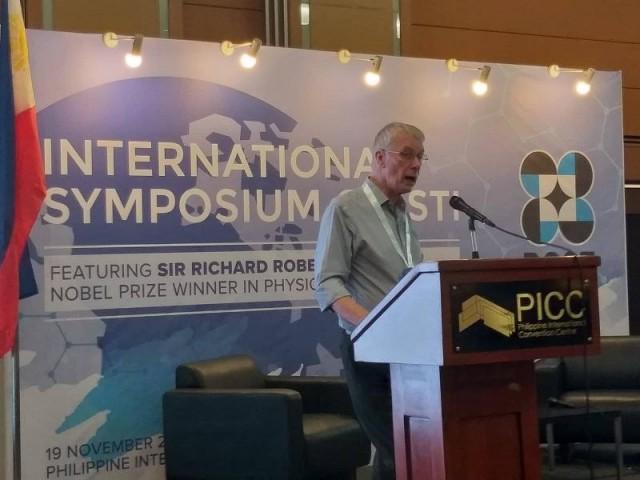
Puzzles, problems, and eukaryotic enigmas
For as long as Sir Roberts can remember, he has been fascinated with math puzzles and logic problems. It’s interesting that a man who appreciates the complexities of sequences and fractals would find comfort in looking at prokaryotes, of all things.
“I like to look at very simple things, which is why I like to look at bacteria so much,” Sir Roberts shared. “Even though bacteria are unbelievably complicated, they’re so simple in comparison to people.”
If solving puzzles was what awakened his love for logic, it was a chemistry set his 11-year-old-self received from his father that sparked a love for science within him.
Almost literally, in fact, as after going through all the experiments in the kit, he realized that he could make gunpowder and explosives from its leftover reagents.
“All kids are natural scientists,” said Sir Roberts. “They have curiosity. They want to know what’s going on. They want to know how things work.”
This fascination with science translated into a lengthy academic journey, one that would take him to Sheffield University, a book on a library shelf called ‘The Thread of Life’, and the decision to become a microbiologist. It was a choice that would change not just his life, but an entire branch of science as well.
Over the course of Sir Roberts’ career from postdoctoral fellowship in Harvard University’s Biological Laboratories to full-time employment at New York’s Cold Spring Harbor Laboratory, he remained curious, ever searching for answers.
With his extensive knowledge and experience, Sir Roberts’ boundless curiosity led him to discovering (independently and coincidentally, around the same time as geneticist Philip A. Sharp) that eukaryotic cells (the kind of cells found in all animals and most plants) weren’t single, continuous strands as previously thought, but were actually made up of smaller sections with genetic information, some of which could be removed or spliced to produce new combinations.
This discovery — split genes — revolutionized genetics, changing how scientists understood the genetic composition of complex organisms and paving the way for gene splicing and GMOs. It also earned Sir Roberts and Sharp the 1993 Nobel Prize in Physiology or Medicine.
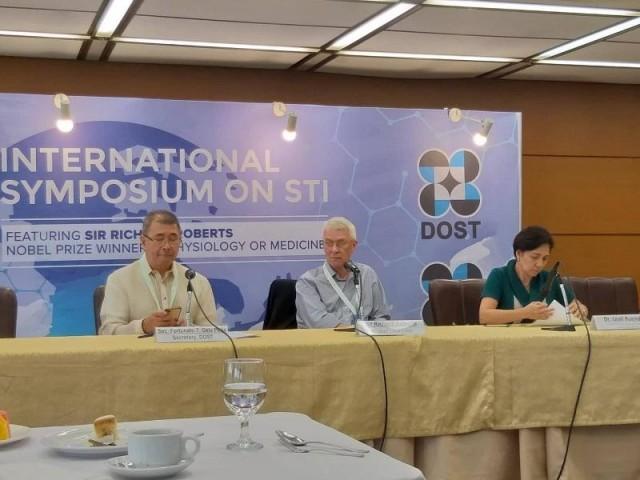
Advice for the Philippines: Beef up with biotech
Aside from being an accomplished microbiologist and an actual knight (he received the honor in 2008), Sir Roberts bears another impressive title: the Chief Scientific Officer of New England Biolabs, a collective founded in 1974 that produces enzymes (for molecular biology applications) and other solutions-oriented products for scientists on a commercial scale.
Sir Roberts believes that establishing a similar organization in the Philippines — albeit one that focuses on collecting and preserving bio-samples — would hit two birds with one stone: it would not only generate income for local research efforts, but also help the global scientific community in the long run.
“You have here in the Philippines vegetation, animals, bacteria, biodiversity. Things that are not available everywhere,” explained sir Roberts. He believes that a “bio-bank” full of materials gathered in the Philippines will prove to be invaluable, especially when the cost of DNA sequencing goes down.
“Start collecting materials now — you don’t have to sequence them, and it doesn’t cost a lot of money necessarily to collect them. It’s something you even can get local citizens involved in.”
According to Sir Roberts, collecting and storing materials for research will allow Philippine scientists to conduct experiments and practice applied science without having to pay for other nations’ samples (and intellectual property). Additionally, it would also open the gates for other countries to pay the Philippines for its genetic materials instead.
“Invest in basic research so you can make the discoveries that everybody else will want to use. You don’t have to do everything. You just find some little niche area, something that you’re interested in here, or something that there’s an individual here in this country with a very good idea of how to do it that no one else is doing.”
Sir Richards also suggested prioritizing the development of drugs that not only treat diseases, but actually eliminate them.
Nurture curiosity, make discoveries
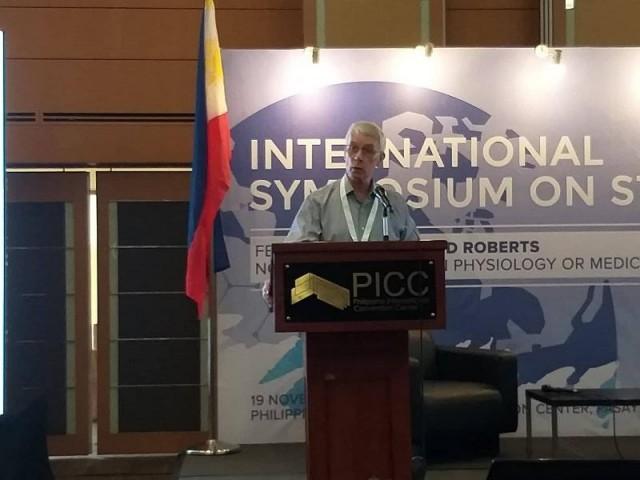
Sir Richards observed that in general, educators could do a better job at teaching children science.
“One of the things we should do is to make sure that kids have many more opportunities when they’re young to play with molecules, with electronics, stuff that they can tackle scientific questions with,” said Sir Richards.
The Nobel laureate also emphasized the importance of investing in the youth. “Let the young people [think of ideas]. Give them money. And very soon, you will discover that they can come up with very creative things that we old people won’t think about, or never thought about.”
Unsurprisingly, Sir Richards often gets asked about how to win a Nobel Prize. And while he did write a rather humorous paper on it, his advice could be summed up in a single sentence: Don’t ever make it a goal to win a Nobel Prize.
“Never make that a goal in life, because you are guaranteed to be disappointed,” he cautioned.
“Winning a Nobel Prize depends on luck. You have to make a discovery. You can’t go out and say, “I’m going to do research that is going to lead to a big discovery. If you could do that, it wouldn’t be a discovery, because you would already know what the answer was.”
Not a two-sided argument?
While it is hard to picture Sir Roberts physically raising his voice, he has no qualms about doing so in the figurative sense, especially when it comes to anti-GMO organizations. And when he does, he certainly does not mince words.
“Oh, I don’t mind antagonizing [them] when they’re telling lies, frankly,” stated Sir Roberts with characteristic pragmatism.
“I know that most of the anti-GMO organizations do good things. But sometimes, people get things wrong. This is one issue they got wrong. Why don’t they just admit it and get on and do all the good stuff?”
“We have to do a better job of educating the kids, of getting out the word on television and in newspapers and on social media, pointing out what is factually wrong about what the anti-GMO people are saying,” he continued.
Sir Richards also believes that while the media does ask the right questions, it doesn’t always seem to be listening to the answers.
“I think one of the problems that I have with the media is that if they’re telling a story, they very often like to pretend there are two sides to it. Climate science is a good example. Is climate changing? Very often you read an article in the newspaper by a journalist who will pretend, ‘Well, you know, there are some scientists who say it is and some who say it isn’t, some say we’re responsible, some say we’re not.” They like to pretend it’s a balanced argument. In fact, 98% of scientists know that we are changing the climate.”
The Nobel laureate cited the infamous study by French molecular biologist Gilles-Éric Séralini claiming that genetically modified maize induced tumors in rats. Despite the fact that this study has been soundly debunked numerous times, Sir Roberts said that it remains the go-to scientific reference for GMO critics.
“The GMO argument is not two-sided. You have one side telling lies and the other side presenting facts.”
Power and responsibility
Sir Roberts is leading a campaign to educate the public on GMOs, signed and backed by over 130 of his fellow Nobel laureates. “All [the signatories] think GMOs are a wonderful thing. There’s not a single case of an accident that’s come from [GMOs] so far.”
So why did Sir Roberts, a man who prefers the complexities of bacteria to the eccentricities of humanity, willingly take up the responsibility of spearheading this mission — one that involves reaching out to people with vastly different agendas and ideologies? According to him, it was a simple realization: That now, to raise his voice, he no longer needs to speak louder.
“I’m saying exactly what I said before I got the Nobel Prize, and they didn’t listen,” mused Sir Roberts. “And so, what the Nobel Prize does is it gives you an opportunity to talk to people and have them listen. And if two, three, five, ten Nobel laureates say the same thing, people tend to listen harder. The more we can get Nobel laureates involved in campaigns that are good for humanity in some way, then we can actually use our prize in a way that a lot of people never had.
“I almost feel an obligation to do that.” — LA, GMA News

