

 GMA Brandtalk
 Tracking
 Archives

Stone-eating tamilok shipworm discovered in Bohol
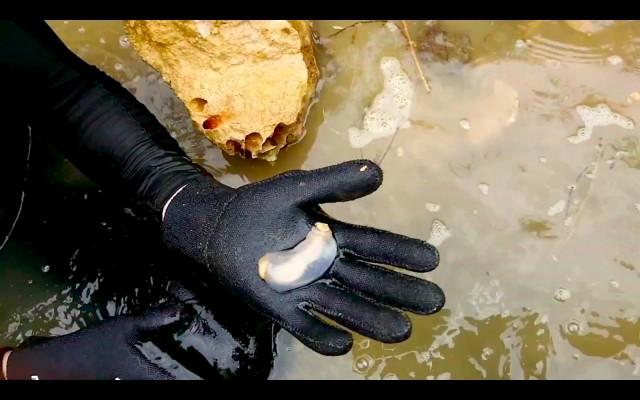
The humble shipworm is so abundant in Philippine waters that it is a common delicacy across the archipelago, known locally as “tamilok.”
But scientists are quickly learning that the Philippines is home to a bizarre array of these creatures, with features and abilities previously unknown to science.
Shipworms are so named because they usually eat wood, and sailors the world over have regarded them as pests for centuries.
But recently, a joint team of scientists from the US and the Philippines discovered a shipworm that eats solid rock.
The creature, found exclusively in the Abatan River in Bohol, is so unique that it has been classified into an entirely new genus and species: Lithoredo abatanica.
This new tamilok species is the only known shipworm that boasts the ability to eat its way through limestone.
“It’s not only burrowing in the stone, it actually eats the stone,” said Dan Distel, the director of Northeastern University’s Ocean Genome Legacy project, in a YouTube video.
Lithoredo abatanica follows on the heels of the recent discovery of another new tamilok genus and species in Batangas, Tamilokus mabinia.
Science Institute professor Dr. Gisela Concepcion had the honor of giving the shipworm its uniquely Filipino name.
“Tamilok is a very Filipino name! And who better to name the species after than the ‘sublime paralytic,’ Apolinario Mabini, an intellectual Filipino?” Concepcion told GMA News Online in an interview.
In 2017, GMA News and Public Affairs inadvertently led international scientists to the first ever live specimen of the world’s largest shipworm, Kuphus polythamia.
According to Concepcion, scientists had long known about the creature because of its tubular shells but no living samples had ever been caught—until they had serendipitously stumbled onto a video of a live K. polythamia from GMA Network, Kapuso Mo Jessica Soho (KMJS).
The episode in question, which aired in 2010, focused on the popular consumption of shipworms in the southern Philippines.
The discovery and description of Lithoredo abatanica was published in a recent paper in the Proceedings of the Royal Society B.
The holotype specimen used to describe the new genus and species is set to be turned over to the Philippine Natural History Museum. — BAP, GMA News

