

 GMA Brandtalk
 Tracking
 Archives

After H. luzonensis discovery, Australian archeologist notes broad distribution of early humans near PHL
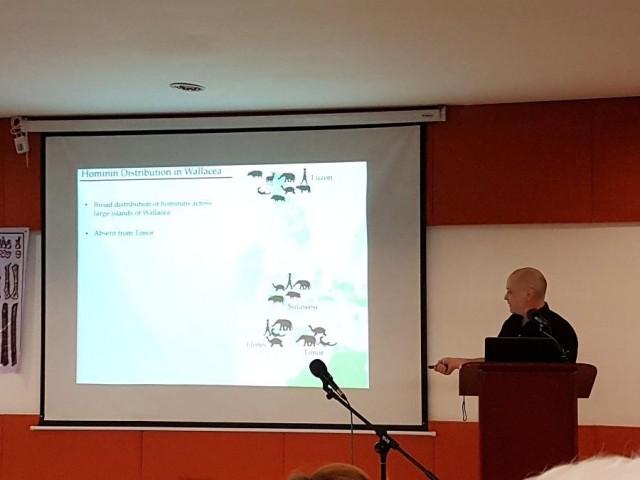
Australian archeologist and professor Dr. Philip Piper said on Monday that there is a broad distribution of early humans near the Philippines, particularly across large islands in Indonesia, and these hominins had the ability to establish themselves on new land.
Remains of these early humans were found in the Flores and Sulawesi islands in the central part of Indonesia. The fossils were found among relatively large bone assemblages of other animals. He emphasized, however, that there was no hominin that was found in the Timor area, as of present.
"Many of the mammals and reptiles found [on the Indonesia islands] are disproportionately those with good dispersal abilities. Hominins should probably now be grouped with these animals as excellent colonizers of islands and archipelagos," said Piper during a conference talk during the first day of the International Homo luzonensis Conference at UP Diliman on Monday.
In one of his slides, he presented an infographic detailing the distribution of early human and animal fossils found in the Indonesia and Philippine areas.
Dr. Philip Piper, a professor from the Australian National University, talks about the broad distribution of hominins in the Wallacea area, namely Luzon, Sulawesi and Flores during the International Conference on H. luzonensis on Monday. | @gmanews pic.twitter.com/v9Ioi383QX
— Angelica Y. Yang (@angelicayyang) February 3, 2020
In April 2019, the discovery of the Homo luzonensis- the remains of which were discovered in Callao Cave in Cagayan- was announced to the public. The excavation projects, which were led by Pinoy archeologist and UP professor Dr. Armand Mijares, unveiled a new family member to the Homo genus.
Dr. Armand Mijares, the Pinoy archaeologist who led the team that discovered the Homo luzonensis, said on Monday that its discovery adds a new member to the genus Homo.
— Angelica Y. Yang (@angelicayyang) February 3, 2020
He added that it also makes the Southeast Asia an important evolutionary research region. | @gmanews
READ: Pinoy archaeologists discover new human species, Homo luzonensis
The bones and teeth of the H. luzonensis were dated to be over 50,000-67,000 years old. The fossils predate those from the Homo sapiens found in Palawan which were estimated to be 30,000-40,000 years old.
The H. luzonensis lived during the late Pleistocene epoch.
The Australian National University professor noted that the evidence of Pleistocene hominins in Luzon provided "time-depth for island evolution."
"In Mindanao, for example, there's already known [animal] fossils. What we don't have yet, is we don't actually have a hominin. Since the Mindanao region is actually really quite close to Luzon...I think it's just a matter of time. There's really good dispersal across barriers," Piper said.
He concluded that there was "every chance that numerous species of hominin inhabited the archipelago during the Middle and possibly Late Pleistocene ages."
RELATED: Was Homo luzonensis a seafarer?
— LA, GMA News

