

 GMA Brandtalk
 Tracking
 Archives

Gamma Normids meteor shower to brighten Philippine skies — PAGASA
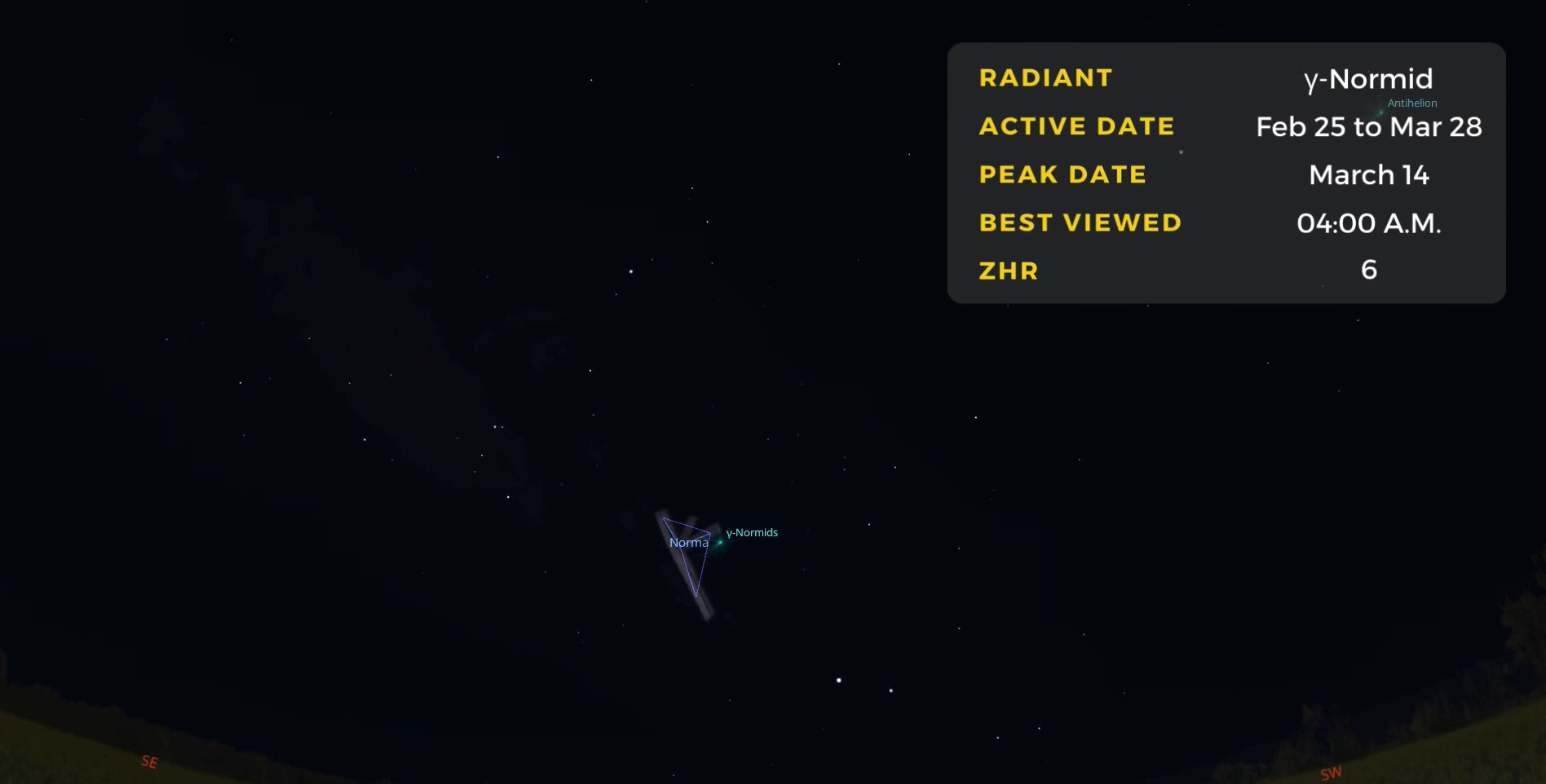
Heads up, stargazers! The Gamma Normids (γ-Normid) meteor shower will be observable over Philippine skies from February 25 to March 28, according to state weather bureau PAGASA.
PAGASA said the meteor shower will peak on March 14 and be best viewed before dawn at around 4 a.m.
“The view of the meteor shower may be observed as soon as the constellation Norma comes into view, with the shower’s radiant rising over the horizon around 11:32 p.m.,” said PAGASA.
“The shower is predicted to peak in activity at approximately 7 p.m., but the finest views may occur before or after 4 a.m. when the radiant is already at its highest point in the sky,” it added.
Meteor showers may be seen with the naked eye, but PAGASA advised the public to “select a dark observing spot far from city lights under clear, moonless skies to maximize the viewing experience.”
''With up to six visible meteors per hour, the shower will therefore offer its best show just before dawn,'' it said. ''The shower will remain active until before sunrise. The shower will peak after the new moon, and so moonlight will present minimal interference.''
PAGASA also said the March Equinox or the Vernal Equinox will occur on March 20 at around 11:06 a.m. The equinox marks the first day of spring for those in the northern hemisphere and the first day of autumn for those in the southern hemisphere.
The sun directly points over the Earth’s equator during equinoxes, creating nearly equal day and night.
The sun likewise exactly rises due east and sets due west.
Other astronomical events for March are as follows:
March 8 — Conjunction of the Moon and Mars
March 9 — Conjunction of the Moon and Venus
March 14 — Close approach of the Moon and Jupiter
March 14 — Conjunction of the Moon and Jupiter
March 22 — Close approach of Venus and Saturn
March 23 — Mercury at Dichotomy
March 24 — Mercury at the Highest Altitude in the Evening Sky
March 25 — Mercury at the Greatest Elongation East
PAGASA further said March is the ideal month to gaze at faint and elusive constellations such as Cancer, Canis Minor, Lynx, Carina, Pyxis, and Vela, as well as well-known deep-sky objects in these constellations, including the Carina Nebula, the Pencil Nebula, and Praesepe. — VBL, GMA Integrated News

