

 GMA Brandtalk
 Tracking
 Archives

Total lunar eclipse visible across PH on Sept. 8 - PAGASA
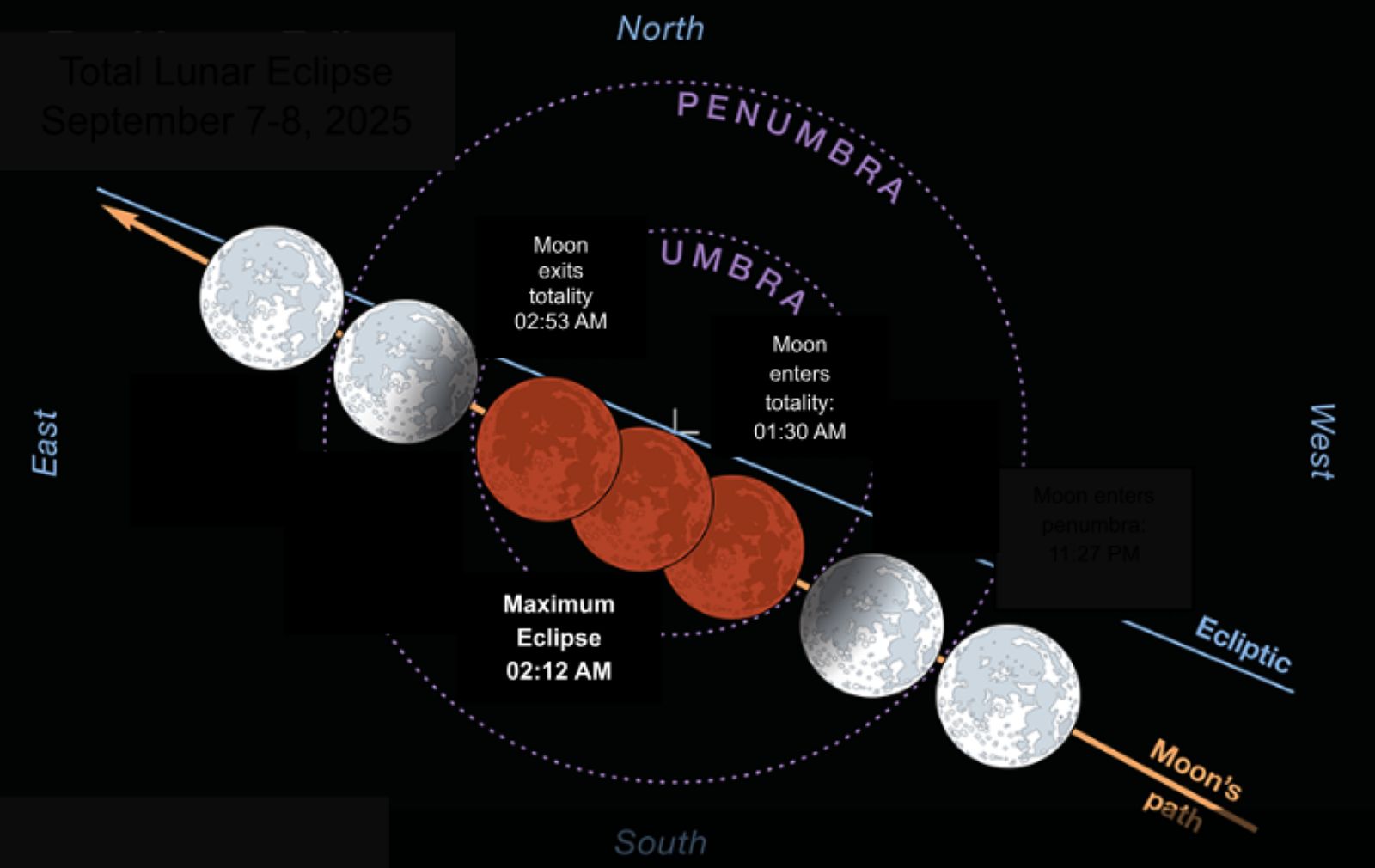
Filipinos will have an opportunity to witness a total lunar eclipse next week.
Set to occur in the early hours of September 8, the total lunar eclipse will also be visible in East Africa, other parts of Asia, and Australia, PAGASA said on Tuesday.
The celestial event will begin at 11:27 p.m. on September 7. However, totality will not take place until 1:30 a.m. on September 8, with the maximum phase occurring at 2:12 a.m., when the Earth's shadow completely envelops the Moon.
"During the maximum eclipse, the umbral shadow cast by the Earth will obscure 100% of the Moon's disk. This phenomenon is commonly referred to as a 'Blood Moon' due to the reddish hue the Moon adopts. This coloration occurs as Earth’s atmosphere filters and scatters sunlight, allowing only the red wavelengths to reach and illuminate the lunar surface," PAGASA said.
Totality will last for one hour, 22 minutes, and 54 seconds or until the partial lunar eclipse phase ends at 2:53 a.m.
"A total lunar eclipse is very easy to observe. A modest pair of binoculars will provide an excellent view of the Moon's surface, but it is not required. Unlike solar eclipses, observing a lunar eclipse is completely safe and does not require protective eyewear," PAGASA said.
According to the US National Aeronautics and Space Administration, a lunar eclipse happens during the full moon phase.
"When Earth is positioned precisely between the Moon and Sun, Earth’s shadow falls upon the surface of the Moon, dimming it and sometimes turning the lunar surface a striking red over the course of a few hours. Each lunar eclipse is visible from half of Earth," NASA said.
Aside from the total lunar eclipse, the planetary parade of Saturn, Neptune, Uranus, Jupiter, Venus, and Mercury continues to adorn the dawn sky until September 7. —VBL, GMA Integrated News

