

 GMA Brandtalk
 Tracking
 Archives

DENR-EMB NCR air quality shows some cities as 'very unhealthy,' 'unhealthy'
Two weeks since the Navotas Sanitary Landfill fire began, the Environmental Management Bureau (EMB) released the ambient air quality or the condition of outdoor air report in Metro Manila.
The Air Quality Index reported by DENR-EMB include PM 2.5 pollution and PM10 pollution showed Valenzuela City under PM 2.5 pollution was classified as "very unhealthy" while for PM10 pollution "fair" air quality.
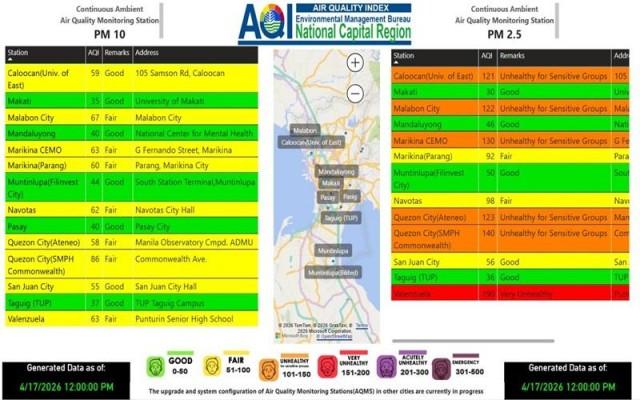
The air quality was recorded by EMB, a line bureau of the Department of Environment and Natural Resources (DENR) and posted at 12 noon on Friday, April 17, 2026.
The Air Quality Index reported by DENR-EMB include PM 2.5 pollution and PM10 pollution.
PM 2.5 or fine particulate matter that measures about less than 2.5 micrometers pollution is caused by vehicle exhaust (especially diesel), industrial emissions, power plants, wildfires, agricultural burning, and residential heating.
PM10 or particulate matter that are more or less 10 micrometers in size and caused by a mix of natural and human-made (anthropogenic) sources, primarily involving dust, smoke, and industrial combustion.
In NCR, Valenzuela City recorded the highest reading with 190 Air Quality Index (AQI), classified as "very unhealthy" or 150 - 200 AQI.
Based on the EMB website, this means pedestrians should avoid heavy traffic areas. People with heart or respiratory disease, such as asthma, should stay indoors and rest as much as possible. Unnecessary trips should be postponed. People should voluntarily restrict the use of vehicles.
GMA News' Raffy Tima reported that there is no direct link between the quality of air in Metro Manila and the smoke coming from the landfill.
But there is a possibility that the air quality and smoke from the landfill may be somehow connected.
The Department of Health, meanwhile, visited Obando in Bulacan that is directly affected by the smoke from the landfill and gave away hygience kits and N95 face masks.
Health officials will also collect blood specimen from some of the residents to determine whether they have been affected by the smoke.
Four cities recorded a reading of between 101 - 150 AQI or classified as “unhealthy for sensitive groups” or people with respiratory disease, such as asthma, should limit outdoor exertion.
These areas are: Quezon City (recorded in Ateneo and SMPH Commonwealth), Marikina (CEMO), Malabon City, and Caloocan City (University of the East).
The cities under yellow classification or “fair” with 51 to 100 AQI in which air quality is mostly good, although a few highly sensitive people may experience health effects.
The cities rated as “fair” are: Marikina (Parang), Navotas, and San Juan City.
“Green” cities or areas with “good” air quality record 0 - 50 AQI and air quality is considered satisfactory and air pollution poses little or no risk.
These are: Makati, Mandaluyong, Muntinlupa (Filinvest), and Taguig (TUP).
For PM10 pollution ambient air, five cities are considered “good” air quality and these are: Makati, Mandaluyong, Muntinlupa (Filinvest), Pasay, and Taguig (TUP).
Cities with “fair” air quality are: Valenzuela, Caloocan City (University of the East), Malabon City, Marikina (Parang), Marikina (CEMO), Navotas, Quezon City (recorded in Ateneo and SMPH Commonwealth), San Juan City. — BAP, GMA News

