

 GMA Brandtalk
 Tracking
 Archives

Parañaque air quality 'acutely unhealthy'; 10 cities 'very unhealthy' —DENR-EMB
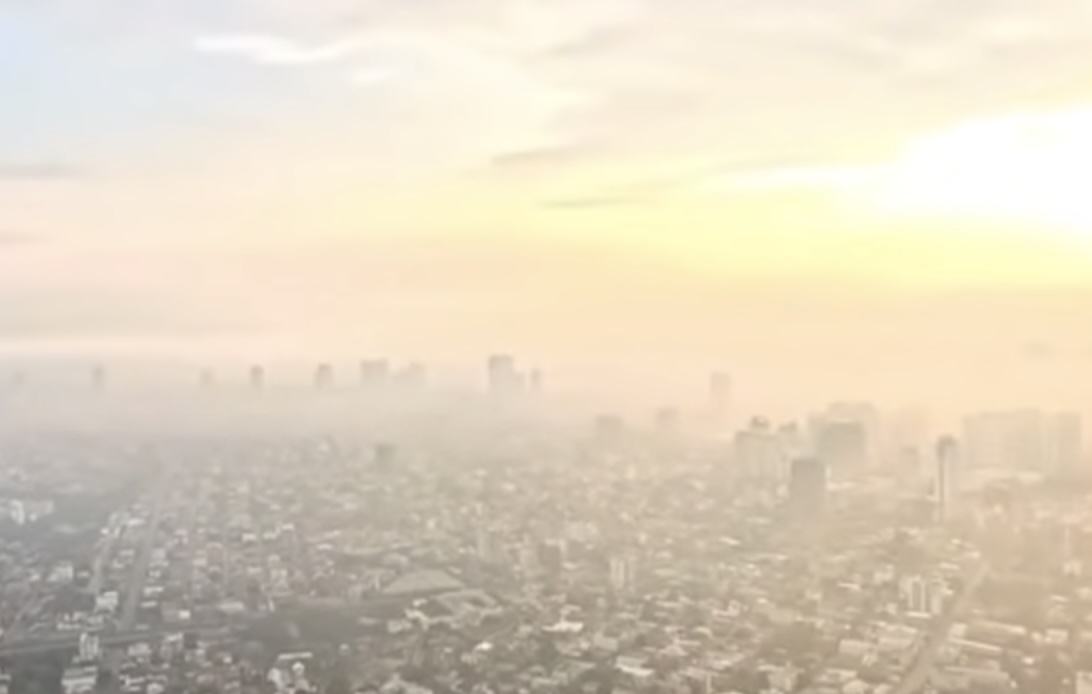
The Environmental Management Bureau (EMB) in the National Capital Region, in its Air Quality Monitoring Report on outdoor air conditions, classified 10 cities as having “very unhealthy” PM2.5 levels, while Parañaque City was classified as “acutely unhealthy.”
The Quezon City government has issued an "Air Quality Advisory" for residents, especially those who belong to vulnerable groups such as children, senior citizens, pregnant women, and those with lung and heart ailments, to wear face masks.
Residents are also advised to remain indoors and, for emergency concerns, may call Helpline 122.
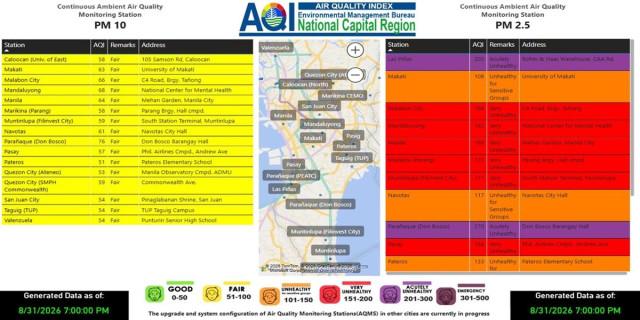
The Air Quality Index reported by EMB, an attached agency of the Department of Environment and Natural Resources (DENR), includes PM2.5 pollution and PM10 pollution.
The cities classified under "very unhealthy" air quality with 150 - 200 Air Quality Index (AQI) are:
- Quezon City (Ateneo)
- Malabon
- Mandaluyong
- Manila
- Marikina
- Muntinlupa
- Pasay
- San Juan City
- Taguig
- Valenzuela
Based on the EMB website, this means pedestrians should avoid heavy traffic areas. People with heart or respiratory disease, such as asthma, should stay indoors and rest as much as possible. Unnecessary trips should be postponed. People should voluntarily restrict the use of vehicles.
The cities under "unhealthy for sensitive groups" with 101-150 AQI are as follows:
- Makati
- Navotas
- Pateros
Meanwhile, Parañaque City air quality registered the highest AQI and was classified as "acutely unhealthy" at 201 to 300 AQI.
The cities under the yellow, or “fair,” classification recorded AQI levels of 51 to 100, indicating generally good air quality, although some highly sensitive individuals may experience health effects.
The Air Quality Index reported by DENR-EMB includes PM 2.5 pollution and PM10 pollution.
PM 2.5, or fine particulate matter that measures about less than 2.5 micrometers pollution is caused by vehicle exhaust (especially diesel), industrial emissions, power plants, wildfires, agricultural burning, and residential heating.
PM10 is particulate matter that is about 10 micrometers in size and caused by a mix of natural and human-made (anthropogenic) sources, primarily involving dust, smoke, and industrial combustion.—BAP, GMA News

