

 GMA Brandtalk
 Tracking
 Archives

Filipino scientist urges PH to adopt net-zero emissions pledge
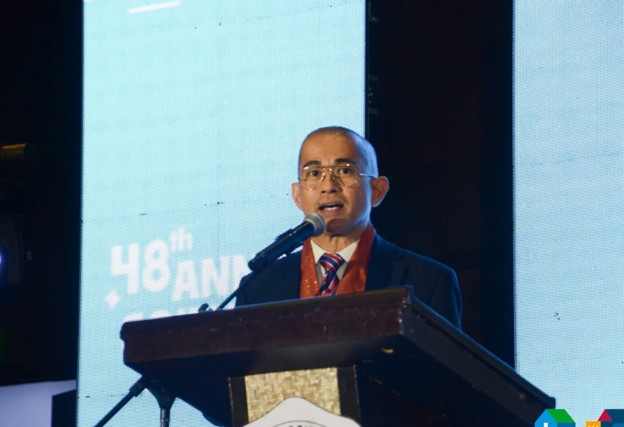
A Filipino scientist on Wednesday urged the Philippines to commit to net-zero emissions, saying a formal pledge would provide long-term direction for the country's decarbonization and greenhouse gas reduction efforts.
Academician Dr. Raymond Girard Tan made the call during the 48th Annual Scientific Meeting of the National Academy of Science and Technology Philippines (NAST), according to a Department of Science and Technology (DOST) news release.
Tan said such a pledge is achievable, citing one of his simulations for the Luzon power grid.
"What the Philippines needs is a net-zero pledge. Such a pledge will be a north star that we can use to guide different policy actions to decouple the past of the Philippine economy from its future," Tan said during a plenary session.
Citing the World Resources Institute, the DOST said a net-zero emissions pledge is a formal commitment by governments, companies, or organizations to balance the greenhouse gases they emit with the amount removed from the atmosphere.
The agency also noted that the Philippines and Timor-Leste are the only Southeast Asian countries that have yet to adopt net-zero pledges.
The DOST cited a 2024 report showing that the Philippines emitted 204.33 million metric tons of carbon dioxide equivalent in 2020, including methane, nitrous oxide, and fluorinated gases.
"In the Philippines, as in most developing countries, it's still not well understood that the ultimate solution that will come, perhaps decades from now, is the phase-out of fossil fuels," Tan said.
"This doesn't need to happen in the next 10 years, but we need to get the ball rolling. And fortunately, we have actually gotten the ball rolling by having a reasonably ambitious energy plan," he added.
The DOST said that while the Philippines has yet to make a formal net-zero commitment, it has submitted its Nationally Determined Contribution (NDC) under the 2015 Paris Agreement, outlining its target to reduce or avoid greenhouse gas emissions by up to 75% from 2020 to 2030, subject to international support.
During the meeting, Tan also presented the results of a collaborative project involving researchers from Malaysia, Japan, and the United Kingdom to demonstrate the feasibility of achieving net-zero emissions in the Philippines.
"We looked at the Philippines. Actually, we looked at just Luzon as a subset of the Philippines. But we considered two scenarios, which were calibrated based on the Philippine energy plan," he said.
"What we demonstrated with the model, with whatever constraints and assumptions we used, net zero is achievable for the Luzon grid with a mix of different technologies that include renewables, while keeping some of the existing power plants in operation for some time through carbon capture and storage," he added.
According to Tan, the initiative, combined with a systems engineering approach, offers a scientifically credible decarbonization pathway that could significantly reduce emissions while ensuring universal access to safe, reliable, and affordable energy.
For his part, DOST Secretary Renato Solidum Jr. reaffirmed the agency's commitment to ensuring that the benefits of science, technology, and innovation reach both growth centers and underserved communities.
Tan is a NAST Academician and a Fellow of the World Academy of Sciences specializing in process systems engineering and process integration. He is best known as the co-developer of carbon emissions pinch analysis.
NAST, an attached agency of the DOST, provides science-based, innovative, and inclusive policy advice anchored on four strategic pillars: human well-being, wealth creation, wealth protection, and sustainability.— MCG, GMA News

