

 GMA Brandtalk
 Tracking
 Archives

ADVERTISEMENT
Filtered By: Scitech
SciTech
PHL 'extremely resistant' to Internet takedown – study
Filipino netizens need not worry about having their Internet cut off like in Syria and Egypt, an online research company said.
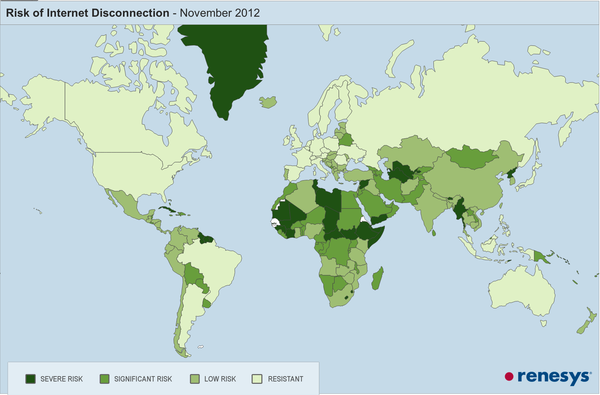
Renesys.com said the Philippines is among the countries that are "extremely resistant" to Internet disconnection due to its high number of Internet providers.
"There are just too many paths into and out of the country, too many independent providers who would have to be coerced or damaged, to make a rapid countrywide shutdown plausible to execute. A government might significantly impair Internet connectivity by shutting down large providers, but there would still be a deep pool of persistent paths to the global Internet," it said.
In this category are some 32 Internet economies such as Canada, the United States, and the Netherlands.
A map drawn by Renesys.com showed the Philippines to be among the countries resistant to Internet takedowns:
On the other hand, Renesys.com said governments that want to encourage direct foreign investment in ICT have another disincentive for shutting down the Web.
"Next to Internet performance and stability, the political risks of Internet disconnection are starting to appear on due diligence checklists, as companies consider where to make their investments in global cloud infrastructure," it said.
Renesys.com said that while the Internet is decentralized, it can be prone to takedown in areas where international access to data and telecommunications services is heavily regulated.
This is particularly true in countries where "only one or two companies hold official licenses to carry voice and Internet traffic to and from the outside world, and they are required by law to mediate access for everyone else."
"Under those circumstances, it's almost trivial for a government to issue an order that would take down the Internet. Make a few phone calls, or turn off power in a couple of central facilities, and you've (legally) disconnected the domestic Internet from the global Internet. Of course, this level of centralization also makes it much harder for the government to defend the nation's Internet infrastructure against a determined opponent, who knows they can do a lot of damage by hitting just a few targets," it added.
Problem with diversity
Renesys said the problem lies with increased diversity at the international frontier is that it often spells less money for the national incumbent provider —usually the old telephone company, often owned by the government itself.
"Without some strong legal prodding and guidance from the telecoms regulator, significant diversification in smaller markets with a strong incumbent can take a long, long time," it said.
Census
Renesys said 61 countries are at severe risk of Internet disconnection. These include those with only one or two companies at the international frontier.
"Those 61 countries include places like Syria, Tunisia, Algeria, Turkmenistan, Libya, Ethiopia, Uzbekistan, Myanmar, and Yemen," it said.
A second category involves significant risk of Internet disconnection, where there are fewer than 10 service providers at a country's international frontier.
"Ten providers also seems to be the threshold below which one finds significant additional risks from infrastructure sharing — there may be a single cable, or a single physical-layer provider who actually owns most of the infrastructure on which the various providers offer their services," it said.
Under this category are 72 countries including Oman, Benin, Botswana, Rwanda, Pakistan, Kyrgyzstan, Uganda, Armenia, and Iran.
"Egypt falls into this category as well; it took the Mubarak government several days to hunt down and kill the last connections, but in the end, the blackout succeeded," it said.
Another category is a "fairly low" chance of Internet disconnection if a country has more than 10 internationally-connected service providers, but fewer than about 40.
Under this category are 58 countries including Bahrain (at the small end) to Mexico (at the largest end).
India, Israel, Ecuador, Chile, Vietnam, and (perhaps surprisingly) China are all in this category, as well as Afghanistan. — TJD, GMA News

