

 GMA Brandtalk
 Tracking
 Archives

Huawei launches P9 smartphone in South Pacific
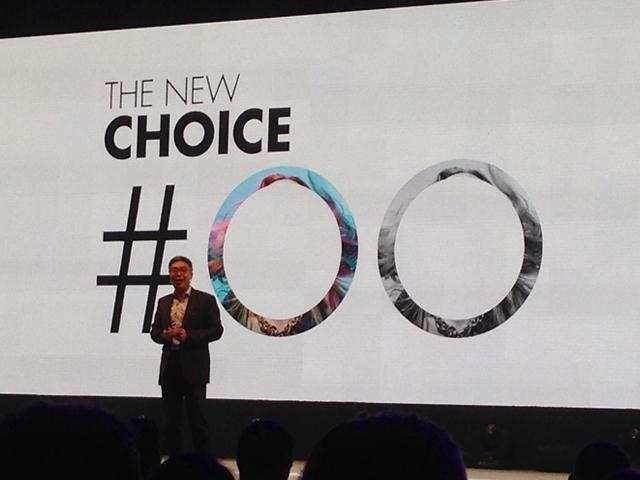 Peter Tong, President of Huawei Consumer Business Group Southern Pacific
 In its push to become the world’s leading mobile device developer, Chinese tech behemoth Huawei recently unveiled its latest luxury gadget on May 5 in Bali, Indonesia.
The firm’s flagship smartphone P9 was revealed at the May 5 Huawei Consumer Business Group 2016 Southern Pacific Conference in Bali. The smartphone was previously launched in London early April; its introduction in Indonesia marks its launch in the country, as well as other Southern Pacific regions including Malaysia, Thailand, Australia, New Zealand, and Singapore. The P9 will also be available in the Philippines around June.
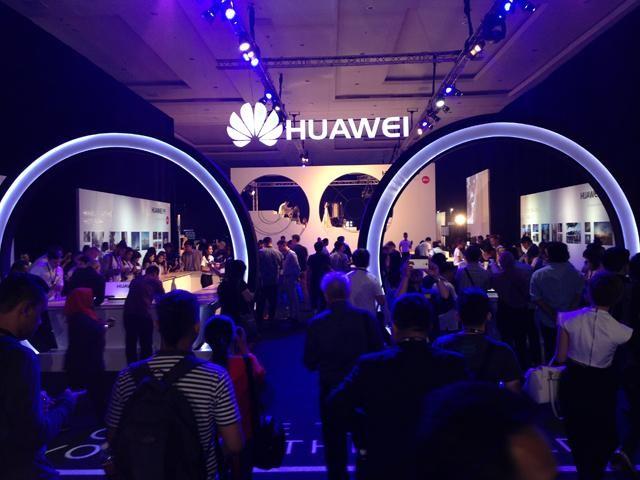 Huawei P9 product exhibit at Bali Nusa Dua Conference Centre, Bali Indonesia
 A premium smartphone, the Huawei P9 boasts a variety of high tech features. The event showcased the product’s said features.
It takes two
P9’s chief feature is its dual-lens camera, which was co-engineered with renowned German luxury camera manufacturer, Leica. Each 12-megapixel sensor has an aperture size of F2.2. One sensor, which is RGB, specializes in capturing intense colors. The other, which is monochrome, focuses on acquiring crisp details. Combined, the sensors are able to produce clear, vivid images. Because this set-up also allows for the capturing of more light, users will be able to take good pictures even in low light conditions.
The Huawei P9 has a professional DSP and dual-core ISP built in, making for heightened image focusing, processing, and speeds.
As for those who love taking selfies, the P9 also comes with a front-facing 8-megapixel camera with an aperture of F2.4.
Images are produced in RAW format. Professional Mode allows users to edit said images, as well as adjust a host of camera settings, from shutter speed to white balance.
Other camera-related features include Hybrid Focus, which utilizes laser focusing and precise depth focusing to allow for faster, blur-free focusing; and various camera effects, such as the option to give an image an artistic Bokeh quality.
Huawei’s decision to focus on the enhancement of the smartphone camera couldn’t come at a more opportune time. According to the company’s research, in 2015, over 1 trillion photos were taken. By 2017, nearly 80% of photos will be taken using mobile phones. With its powerful Leica camera, Huawei will therefore have an advantage over the competition.
Form and function
The P9’s body measures 145 x 70.9 x 7 mm – making it one of the thinnest smartphones around. It weighs 144g. It is “sculpted using aerospace-class unibody aluminum and a superior-grade 2.5D glass” and features smooth, curved edges.
The P9 features a 5.2-inch LCD touchscreen display, with a resolution of 1080 x 1920 pixels, or 423ppi. It produces 16.7 million colors, and a color saturation of 96%.
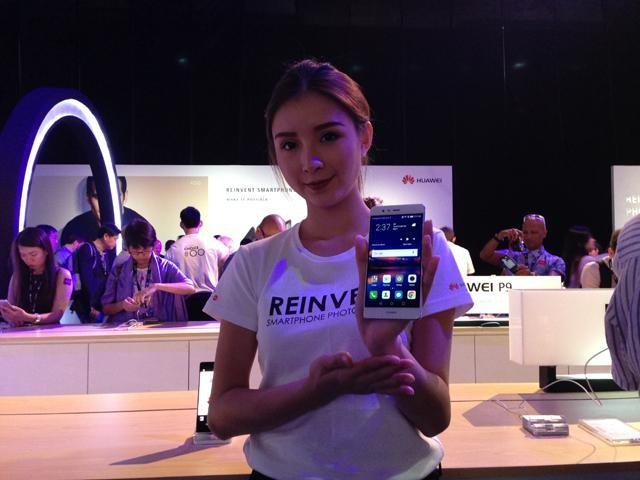 Huawei's flagship smartphone P9 showcased at the Huawei Consumer Business Group 2016 Southern Pacific Conference.
 The device has a non-removable, fast-charging 3,000mAh battery.
The P9 runs on Android 6.0 Marshmallow. It comes with 3 GB of RAM, 32 GB of internal storage, and a mircoSD card slot. It is powered by a Kirin 955 chipset, and boasts 8 cores (Quad-core 2.5 GHz A72 cores, and Quad-core 1.8 GHz A53 cores).
The device comes with a virtual Triple antenna. It searches for Wi-Fi hotspots, ranks them according to strength, then automatically chooses the best connection available.
For security purposes, the P9 has a built-in fingerprint biometric sensor.
The smartphone will come in a variety of colors, including haze gold, ceramic white, rose gold, prestige gold, titanium grey, and mystic silver.
In addition to the P9, Huawei is also releasing the P9 Plus and P9 Lite. As the higher-end version of the product, the P9 Plus boasts a larger, 5.5-inch screen, and a couple of extra features that should make it the best choice for professionals and those who take photography seriously. It has a longer-lasting 3400mAh battery, which allows users to watch over 14 hours of HD video, or listen to 65 hours of music. Consequently, it is the most expensive of the three P9 models. The cheapest, the P9 Lite, does not include the Leica camera, and is aimed at the mass market.
Huawei has yet to reveal the price of each P9 type.
Taking the world by storm
Founded in 1987 by Ren Zhengfei, Huawei has grown to become one of the world’s leading network infrastructure providers. While its consumer products are less recognized outside of China, the company has been improving the quality of those products to surpass stiff competition. In fact, the last ten years saw Huawei spending over $37 billion on research and development.
Just this January, Huawei unveiled three products aimed at the premium segment. The Mate 8 flagship smartphone boasts a six-inch display, augmented camera microphone and audio systems, fingerprint identification, and a battery life lasting over two days. The second product revealed was the MediaPad M210, which is a 10-inch tablet. The third item unveiled was a new luxury smartwatch, which comes in two versions: Elegant, and Jewel, which was developed with Swarovski.
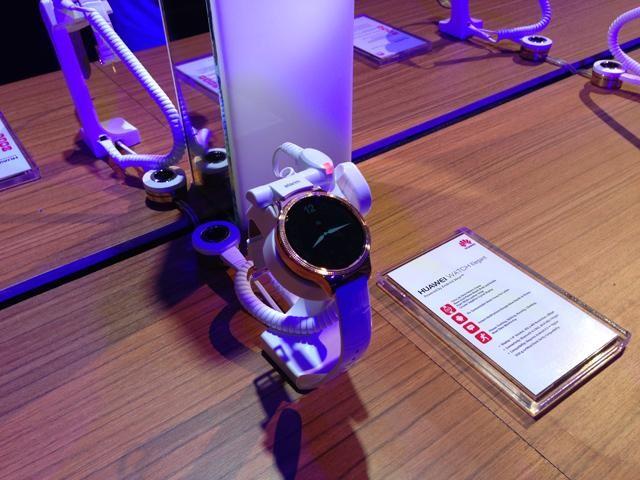 A Huawei smartwatch on display at the Huawei Consumer Business Group 2016 Southern Pacific Conference.
 Then, in February of this year, Huawei introduced its first personal computer to the world. The device, the convertible tablet MateBook, is the firm’s answer to the Microsoft Surface and Apple’s iPad Pro. The MateBook boasts a 12-inch pixel display, 128 GB of storage, a battery that lasts ten hours, and a keyboard that comes with a fingerprint reader, and that fastens to the tablet using magnets. Without the keyboard, the tablet weighs only 640 grams.
Many of Huawei’s most recent products – such as the MateBook and the smartwatch – were not only on display at the Huawei Consumer Business Group 2016 Southern Pacific Conference; the event attendees were also given the opportunity to test said products for themselves.
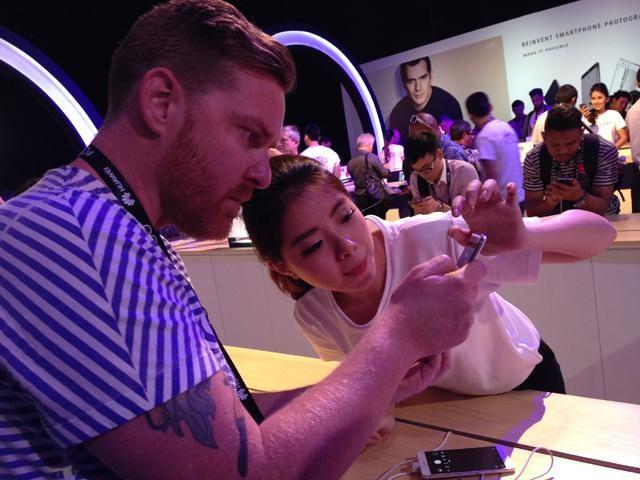 Attendees at the Huawei Consumer Business Group 2016 Southern Pacific Conference were invited to test the P9 for themselves
 According to Peter Tong, the President of Huawei Consumer Business Group Southern Pacific, Huawei’s 2-year ambition for the Southern Pacific entails the company becoming a consumer-loved brand, increasing its win-win partnerships, and growing its market share target to 15%. Tong also stressed Huawei’s dedication to enhancing consumer experience and developing the best possible product.
Bearing fruit
So far, Huawei’s efforts have proven fruitful.
Ever since the 2013 launch of the P6, the first in the Huawei P series, the smartphones have been the recipients of several awards from the European Imaging and Sound Association (EISA) and other award-giving bodies.
According to Peter Tong, 2015’s said revenue was over $60 billion – a 37 percent rise year-on-year. Huawei also saw a 73% increase in consumer growth. In total, Huawei sold over 100 million smartphones in 2015 – becoming the first Chinese telecommunications equipment vendor to do so. Its year-on-year net profit rose 33 percent, climbing to 36.9 billion yuan, or $5.7 billion. — TJD, GMA News

