

 GMA Brandtalk
 Tracking
 Archives

DOST-backed irrigation, fertilizer technologies help Tarlac sugarcane farmers boost yields ahead of El Niño
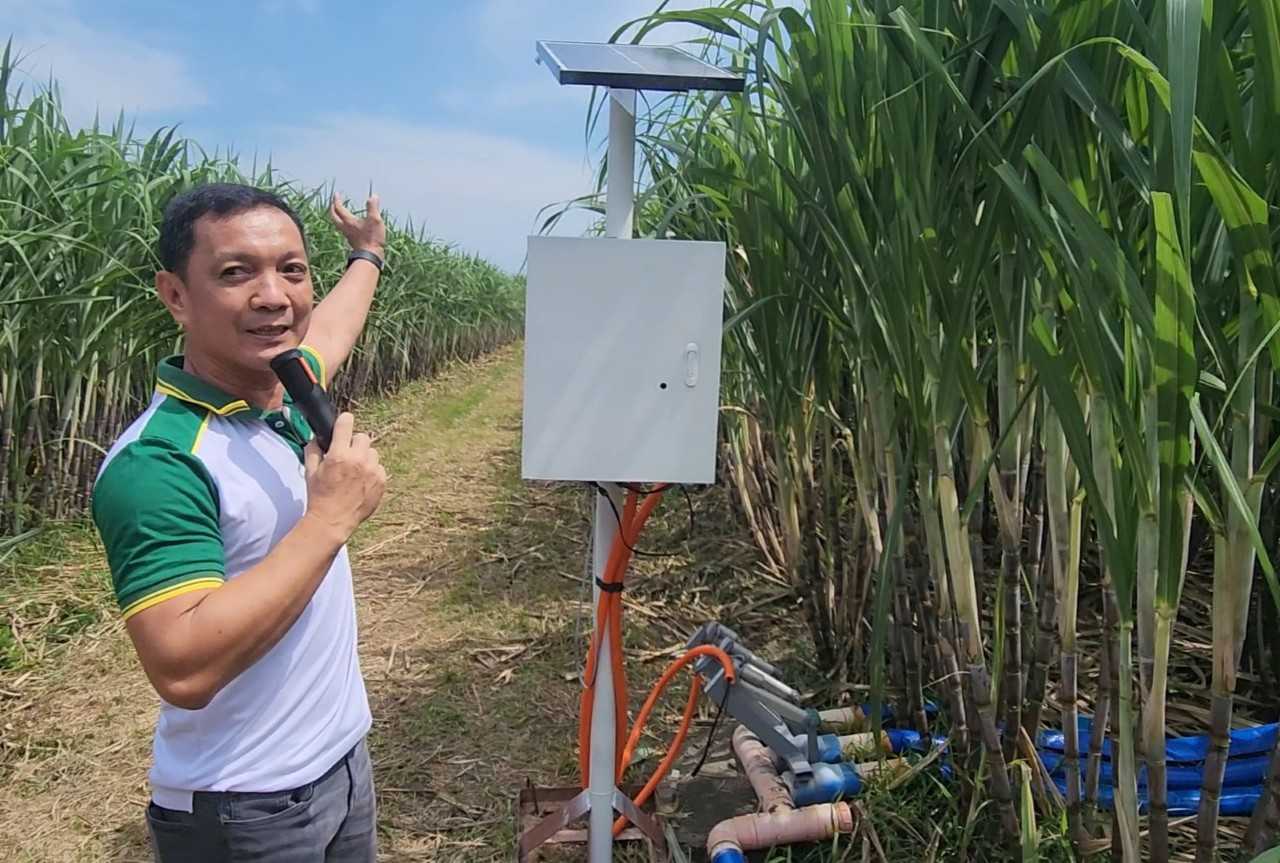
PANIQUI, Tarlac — With the country expected to experience a very strong El Niño as early as October 2026, the government is promoting locally developed farming technologies that could help farmers cope with drought while lowering production costs.
Developed through research funded by the Department of Science and Technology (DOST), the Automated Furrow Irrigation System (AFIS) and Nutrio, a microbial-based foliar fertilizer, have enabled sugarcane farmers in Paniqui, Tarlac, to more than double their yields while reducing water and fertilizer use.
Automated Furrow Irrigation System
The Automated Furrow Irrigation System (AFIS) uses soil moisture sensors, irrigation flow models, and automated controls to deliver the amount of water crops need.
Unlike conventional furrow irrigation, where a significant portion of the water is lost before reaching crops, AFIS continuously monitors soil moisture and automatically starts and stops irrigation when needed.
Marvin Cinense, director of the Philippine-Sino Center for Agricultural Technology (PhilSCAT) at Central Luzon State University, said conventional irrigation wastes around 50% to 60% of the water applied and relies on diesel-powered generators, increasing production costs.
"Almost 47% of the water applied was saved compared with the conventional irrigation system that uses a power generator," Cinense said.
AFIS is powered by either electricity or solar energy.
Installed in 2024, each AFIS unit uses a three-horsepower pump capable of irrigating three to five hectares of farmland.
Five units have already been established in Tarlac, Negros Occidental, Cotabato, and Batangas.
Nutrio
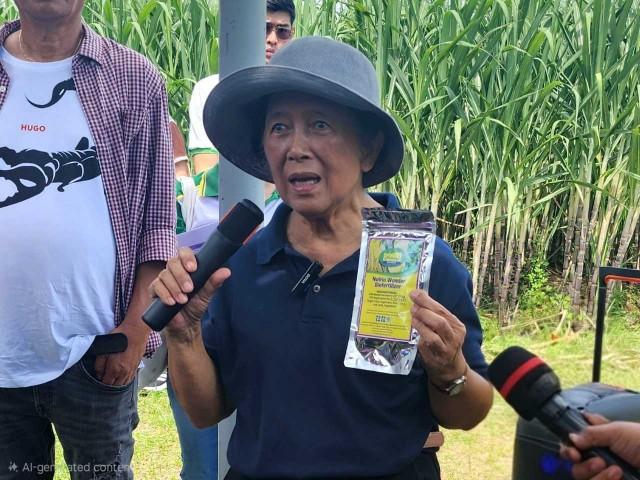
Developed by researcher Virginia Padilla, Nutrio is a microbial-based foliar fertilizer containing beneficial microorganisms that improve soil fertility, stimulate plant growth, and reduce dependence on inorganic fertilizers.
A 100-gram pack costs P350, with about 20 packs mixed with 1,000 liters of water recommended for every hectare.
Aside from sugarcane, Nutrio can also be applied to rice, corn, vegetables, and other crops.
Marlon Gamboa, chairperson of the North Cluster Producers Cooperative and a sugarcane farmer, said the technology immediately reduced fertilizer costs.
"Urea now costs around P3,000 per sack. I spend much less using Nutrio," he said.
Instead of applying eight bags of synthetic fertilizer per hectare, Gamboa now uses only four bags supplemented with Nutrio.
"We didn't completely eliminate synthetic fertilizers, but we reduced our use from eight bags to just four per hectare," he said.
The cooperative has more than 100 members, and Gamboa said nearly all have adopted Nutrio, with some also using it on rice and other crops.
Higher yields
Before adopting the technologies, sugarcane yields averaged 40 to 50 tonnes per hectare, according to Gamboa. They have since increased to around 125 tonnes per hectare.
He said combining Nutrio with the solar-powered irrigation system could help farmers better withstand the effects of El Niño.
"I believe the combination of Nutrio and solar-powered irrigation will make farming easier for many farmers," Gamboa said.
He also encouraged fellow farmers to embrace innovations that can improve productivity and reduce production costs.
Developed under DOST's Industry Level Collaborative Research and Development to Leverage Philippine Economy (iCRADLE) Program, the combined use of AFIS and Nutrio produced sugarcane yields of up to 178 tonnes of cane per hectare (TC/ha) and 1.86 LKg/TC sugar yield.
The technologies also improved crop growth, with average sugarcane height increasing from 327.87 centimeters to 362.53 centimeters.
Average stalk weight rose from 14.22 kilograms to 18.23 kilograms per 10 stalks, while average stalk diameter increased from 26.44 millimeters to 40.94 millimeters.
Researchers estimate the technologies can increase farmers' production by 20% to 30%. –VBL, GMA News

