For actor Cesar Montano, the late director Marilou Diaz-Abaya was a sincere person whose love for others was so intense it was unforgettable. “Hindi ko makakalimutan ‘yun, sabi ko, grabe magmahal, kung ganito magmahal ang lahat ng tao, napakasaya ng buhay,” said Montano, who had worked with Abaya on three critically acclaimed films: Jose Rizal (1998), Muro-ami (1999) and Bagong Buwan (2001). Montano was referring to how Abaya consoled him when his son, Christian Angelo, died in 2010.
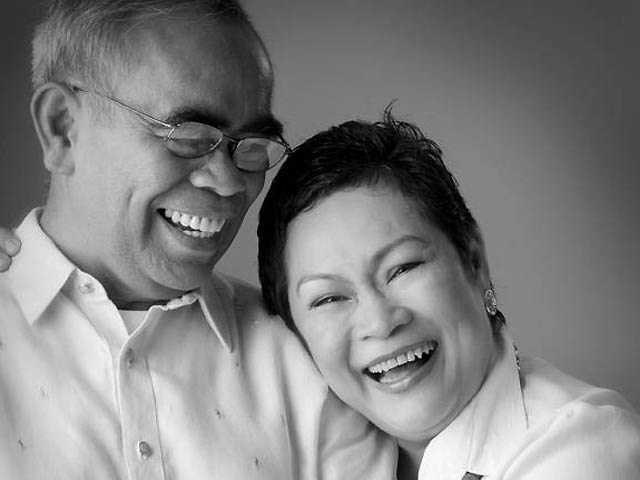
Marilou Diaz-Abaya with her friend and doctor, Dr. Joven Cuanang of St. Luke's. Abaya died Monday after a long battle with breast cancer. Photo by Wig Tysmans
“Talagang inasikaso niya lahat... siya ‘yung nagpapa-compose sa akin na... 'Easy ka lang, akong bahala rito.' Siya ‘yung nagmamando sa akin, parang dinidirek pa rin niya ako,” Montano said in an interview on GMA News TV’s State of the Nation on Monday night. "Ang hindi ko makakalimutan sa kanya ‘yung ugali niya, kung papaano siya magmahal, o kung papaano ‘yung init ng kanyang pagmamahal at sinseridad as a person," Montano added. Abaya, a multi-awarded film and TV director, died Monday night after a long battle with breast cancer. She was 57.
Love in all its forms In an
interview with "Kapuso Mo, Jessica Soho" aired last January, Abaya, who was by then already on medication due to cancer, said her greatest lesson in life was "love in all its forms." "You tend to take love for granted. We don't show it enough. And most of the time it's because we don't have time enough. What cancer has given me as I mentioned, first thing is time. It has given me time to think about my mortality and what my life is worth and what I can make it pa," she told the show's host, Jessica Soho.
Known for her fierce passion, Abaya, a 2001 laureate of the Fukuoka Prize for Culture and the Arts, produced 24 feature films, the most notable of which was
Jose Rizal, which won numerous awards in the 1998 Metro Manila Film Festival, including Best Picture. Born in Quezon City in 1955, Abaya studied communication arts at Assumption College before studying film at the Loyola Marymount University in Los Angeles, U.S.A., and the London International Film School in England. Since releasing her first film,
Tanikala, in 1980, Abaya received numerous awards both locally and internationally. Her early films
Brutal (1980),
Karnal (1983) and
Baby Tsina (1985) were described in the award citation as "sharp condemnations of the oppressive social system of the Marcos era." "These and the works of the master Lino Brocka brought Philippine cinema to worldwide attention," the
Fukuoka Prize citation read. Abaya left filmmaking for several years after
Baby Tsina, and returned 10 years later with the release of
Ipaglaban Mo. "In the films that followed, including
May Nagmamahal sa Iyo,
Sa Pusod ng Dagat,
Jose Rizal, and
Muro-ami, she has consistently maintained an uncompromising stance in her examination of difficult social problems. At the same time, her work became richer, suffused with affection for the people of the underclass, women, and children who struggle to survive harsh conditions. Ms. Diaz-Abaya’s films contain an even greater generosity of spirit and human warmth," the Fukuoka citation read. Abaya was one of the most-awarded female directors in the history of the Filipino Academy of Movie Arts and Sciences, with four FAMAS Best Director trophies. She was also recognized by award-giving bodies such as the Metro Manila Film Festival, the Urian Awards, the Film Academy of the Philippines, the Star Awards, the Catholic Mass Media Awards, the British Film Institute Award, the International Federation of Film Critics Award, FIPRESCI, and the Network of Pan Asian Cinema Award.
Film Institute and Arts Center Among Abaya’s legacies is the Marilou Diaz-Abaya Film Institute and Arts Center (MDAFI), which she founded in 2007, the same year she was diagnosed with breast cancer. In the "Kapuso Mo, Jessica Soho" interview, Abaya explained her motivation in establishing the MDAFI. "The tendency is give away, give away, give away. Kaya nga ako nagtuturo. Ang dami ng estudyanteng tinuruan ko, yung nakikilig talaga ako pag nakikita ko yung pangalan nila sa OBB, CBB at saka kung kumukuha na sila ng trophies nila," she said. Abaya also taught film courses at Ateneo de Manila University for 27 years, admitting only a few students each year to ensure maximum mentorship per student. Last July, she
donated books, scripts, films and other memorabilia collected over her 32 years in Philippine Cinema to Ateneo de Manila University's Jesuit Communications, of which Abaya was also a trustee. Even during her illness, Abaya continued to share herself with others, mentoring students via the telephone and Internet. "Death is so inconvenient and illness is so inconvenient especially in our fast-paced life. Ironically it's what people miss out on that in reflecting about your mortality you actually can find quiet, a kind of grace, na puwede mong isaalang-alang yung sarili mo," she said in the January interview.
Online sympathies Filipinos, meanwhile, mourned Abaya's death online, and expressed their gratitude for the films she left behind. "Moral, Karnal, Brutal. Mga malulupet na pelikula tungkol sa kababaihan. Salamat po Direk Marilou Diaz-Abaya," filmmaker, producer, and UP film professor Ramon Bautista
said on Twitter. "One of our legendary Assumptionists passed away today. RIP Director Marilou Diaz Abaya. Thank you for inspiring generations of AC girls!" the Assumption Student Council
said also on Twitter. Actress Bianca Gonzales, for her part,
tweeted: "Rest in peace Direk Marilou Diaz-Abaya. :( Your beautiful films made me take up film in college. You are an inspiration," Bianca Gonzalez said. Abaya's remains will be brought to the Loyola Chapel in ADMU in Quezon City for public viewing on October 9.
— KBK, GMA News 

 GMA Brandtalk
 Tracking
 Archives


