

 GMA Brandtalk
 Tracking
 Archives

Former 'Twilight' actor Justin Chon directs, writes, produces, acts on his passion project 'Blue Bayou'

LOS ANGELES — Unknown to many, Justin Chon, the former "The Twilight Saga" actor who portrayed Eric Yorkie in the vampire-themed romance fantasy films, is a prolific and award-winning auteur.
The 40-year-old Korean-American actor who was born in Garden Grove, raised in Irvine, California and an alum of the University of Southern California, has won awards in Deauville Film Festival (Audience Award, 2021), Dallas International Film Festival ("Ms. Purple," 2019), Film Independent Spirit Awards (Someone to Watch Award, 2018), Seattle International Film Festival (Golden Space Needle Award, Best Director for "Gook," Second Place, 2017), Sundance Film Festival (Audience Award, "Gook," 2017), VC FilmFest - Los Angeles Asian Pacific Film Festival (Best Director, "Gook" and Best Narrative Feature, "Gook," 2017), and VC FilmFest – Los Angeles Asian Pacific Film Festival (Special Jury Prize, Best Animation in a Non-Animated Film, "Man Up," 2015).
The son of Sang Chon, a former child actor in South Korea and Kyung, a pianist, Justin told us that he grew up watching his father's films. Now an acclaimed director-writer, Justin is proud of his latest passion project, "Blue Bayou," where he directs, writes, produces, and acts.
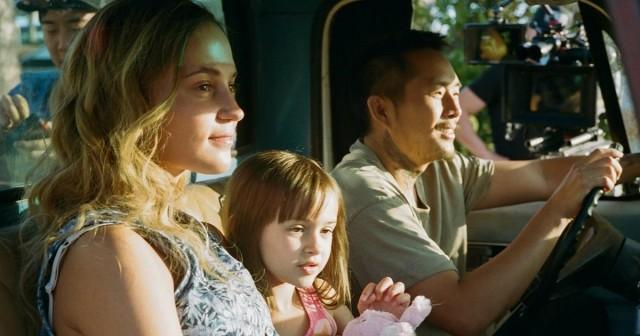
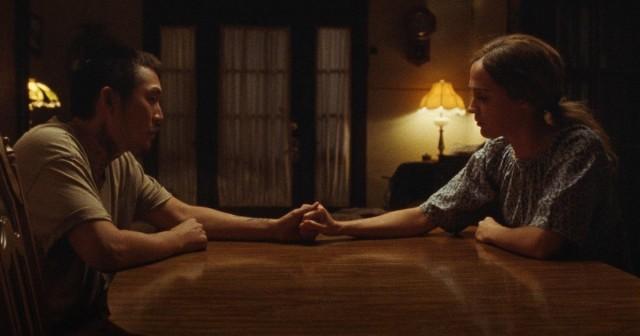
The drama tells of the story of Antonio LeBlanc (Chon), a Korean-American adopted immigrant living outside New Orleans with his pregnant wife Kathy (Alicia Vikander) and her biological daughter Jesse (Sydney Kowalske) and the travails he encounters due to his criminal record, his inability to find additional employment, and his encounters with ICE (U.S. Immigration and Customs Enforcement).
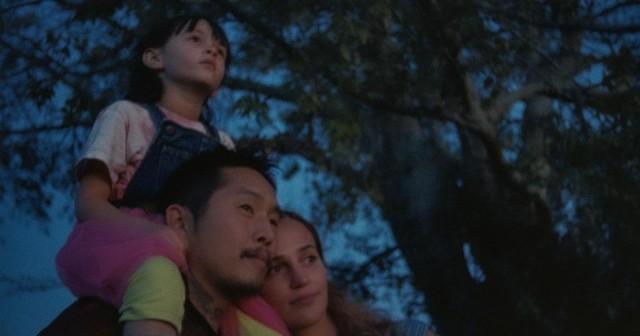
Justin, who worked on the movie for four years, revealed that the story is based on true stories he has heard from Korean adoptee friends and his research as well of adopted children from South Korea who are given up by their adoptive parents, abused, and then deported when they turn 18.
Below are excerpts of our exclusive conversation with Justin.
You're a producer, director, writer, actor. Can you talk about why is this a passion project for you?
Because I'm Korean American and the idea of international adoption originated from Korea, it's then spread to all other countries. And I feel like it's a part of our Asian-American experience. I feel like it's an experience amongst us that needs to be told and represented. And I just feel like this whole issue of adoptees being deported is just incredibly unjust. And I feel that when a child is brought by US citizens and the US government is acknowledging and making this legal for a child to be brought overseas, no amount of loopholes should allow for the government then to turn around after 30 years to say you were never a citizen.
How hard was it for you as an Asian-American to establish yourself in Hollywood? What kind of challenges did you encounter?
Well, I've been doing this for 20 years. I think there was much less opportunities. I had to do everything. I filed head shots at a C-level agency. I crossed auditions. I snuck into offices trying to talk to managers to get them to try to represent me. I did extra work to get my SAG card. I catered food. I did everything. And I worked my way up the ladder in terms of even just the acting world. I started off with commercials and one-liners on shows and slowly made my way. As a director, for my first film, I had to put my own money in, and lost a lot of money on that film. Second, third film, I had to make micro budget films slowly just to build my way back up again in a different discipline.
Most of your films are social-political commentaries. Why are you so attracted to this genre? And are you planning to try other genres?
I just feel that I want to make social commentary about the things around me, and the things that I feel are important to talk about, and that I feel that are important. But yeah, I'm interested in a lot of things. I just shot a television show for Apple based off the book, "Pachinko." And that's a book adaptation. And then I just finished a film two days ago, shooting, that's about the Indonesian father and son, that I think is also important because I think we should, in a respectful manner, tell each other's stories, because I think we'll become stronger as a community.
Can you please talk about your choice of Alicia Vikander?
Alicia Vikander is an incredible actress. It would've been my dream to work with her. And I'm just so fortunate that she said yes. I always thought it was interesting that she was Swedish and she was going to play an American, because every choice she would make would be very intentional. It would be a choice, like what she wants to show about an American woman. So, it was a very inspired, interesting choice that I thought could be very effective. She's incredible.
How did you get to know Sydney Kowalske, little girl actress? Did she go through auditions with you?
Yeah. We looked at many, many children and we've found her. And the moment I saw her tape, I knew she was absolutely perfect for this film. She's very much a real girl, not a trained stage kid that we often see.
As a writer, what is your writing process? Do you have all your subject matters in a drawer? And then you choose one? Do you have a specific time of day that you write better or are more productive?
I wake up very early in the morning, about 4:00 AM, and I write from four to about eight or nine until my daughter gets up, and then I'll write some more until about noon. And then the rest of the day, I'll usually just think about whatever and reread stuff and edit stuff, is what I typically do.
As an American of Korean descent, did you ever get bullied when you were a kid? Did you experience that as well?
Oh, yeah, I got bullied, but not excessively. I got bullied. But me personally, my own experience is I fought back. I definitely didn't take it. And I was a pretty gnarly, feisty kid. So, the bully didn't last long, at least in my own life.
Do you think the US still has a lot to improve on when it comes to treatment of immigrants? Or has there been a lot of improvement?
I hope that the US as a whole can really consider immigrants and know that they are an integral part of this country. That's what this country was founded upon is people who have immigrated here. And I think we can embrace, we should embrace, and we shouldn't necessarily, I think, try to make everyone assimilate to the idea of an American. Because who knows what that actually is? I think in its diversity and multitude of cultures is what gives the country a beautiful glow. I hope that we can just have empathy for one another and love and compassion for one another, I think is something that we can all aspire to in the way we consider one another.
What was your reaction when we had those series of Asian hate crimes?
Like everybody else, it's absolutely appalling. It's unacceptable. I think maybe this stuff was underneath brewing, but we cannot take those small number of instances and just put blanket ideas over certain type of groups or people. We have to continue to love one another and not let those instances overshadow the good things that are happening in our communities. I think that stuff needs to stop. It just needs to stop ASAP and it should not be tolerated. If you see something like that, it should be intervened and it needs to be stopped right away, because it should not be tolerated whatsoever.
So, you were raised by a mother who's a pianist and a father who's a former child actor. So how was that growing up in a Hollywood or entertainment setting in the family? Was that easy for you to go into Hollywood? Or did you have to prove yourself to your parents?
Both of my parents left their arts when they immigrated. My mom became a house mom and my dad became a businessman trying to just make ends meet. In the beginning, very, very, just low income, and then moving up and becoming middle class. It didn't help me, other than the belief that it's possible. I grew up watching my dad's black and whites. But my parents never pressured me to do one thing or the other, so I felt the freedom to be able to choose what I wanted to do. So, in that way, maybe they did benefit me, but it's not because we had an artistic household, because they had no connections into Hollywood as Korean immigrants.
Have you ever been to South Korea?
Yes, many times.
And what do you usually do first when you are in Korea?
Eat.
And your favorite Korean food?
I love Korean barbecue, but in Korea, like pork. And I love just traditional Korean food as well.
And if your daughter wants to go also into Hollywood and entertainment, would you allow her?
She can do whatever she wants when she turns 18. In the meantime, she can study acting if she wants to, but she's going to have to take it seriously. I don't want her to be acting professionally until she's an adult.
How was your Cannes experience this year for this movie?
Fantastic. Cannes is a beautiful festival. It's a pinnacle of film showcasing, and I hope to be back there someday.
And your next project?
It’s "Pachinko" that's coming out on Apple TV at the end of the year, and a film I just finished shooting, which is the story about the Indonesian father and son that I'm editing now. And obviously, my film, "Blue Bayou," that comes out in theaters on September 17th. That's the most important one right now.
—MGP, GMA News

