

 GMA Brandtalk
 Tracking
 Archives

Alana Haim and Paul Thomas Anderson on their comedy-drama, 'Licorice Pizza'
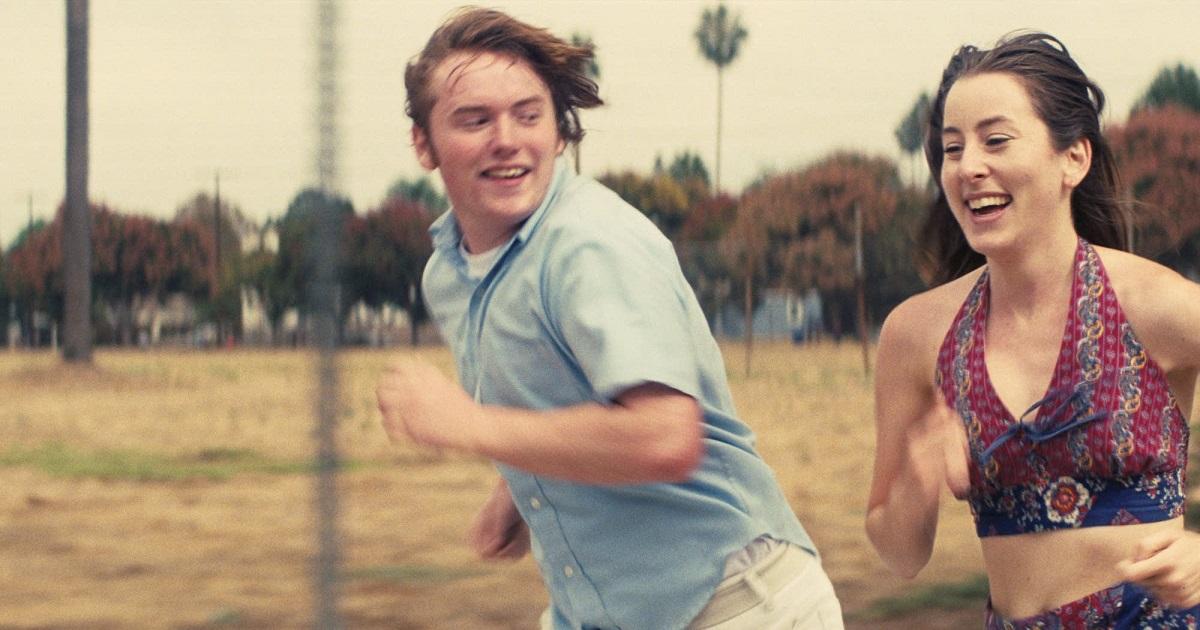
LOS ANGELES — One of the delightful coming-of-age films that came out last year is Paul Thomas Anderson's comedy-drama "Licorice Pizza."
It stars 30-year-old musician-actress Alana Haim as Alana Kane, a photographer's assistant, and the late Philip Hoffman's 18-year-old son Cooper Hoffman in his debut feature performance as Gary Valentine, a young actor who falls in love with Alana, based on film producer and former child actor Gary Goetzman.
Written and directed by Anderson, who also serves as one of the film's producers and cinematographers, the film also stars Sean Penn as Jack Holden, an actor based on William Holden, Bradley Cooper (Jon Peters, a film producer), Benny Safdie (Joel Wachs, a politician running for office), John C. Reilly (Fred Gwynne, an actor who portrayed Herman Munster) and Maya Rudolph (Gale).
Haim, who is a pianist-guitarist-vocalist of the American pop rock band Haim which consists of her two older sisters, Este and Danielle, also finds her two sisters and her father Moti and mother Donne in the movie appearing as Alana Kane's family.
Below are excerpts from a Q&A with 79th Golden Globe nominees Haim and Anderson at the Hollywood American Legion Post 43.
Paul Thomas Anderson

What was the genesis of this movie for you?
About 20 so years ago, I was taking a walk around my neighborhood. I just moved into this house that I bought, and I passport to a little middle school, which is Tarzana. It must have been October because it was picture day, and there was a blacktop full of kids all in line. I saw this one kid nagging at this girl who worked for the company, clearly trying to get a date or get her phone number, something like that, and it was a terrific premise. What would happen if he actually got the phone number, or what would happen if against all her better judgment, she turned up at the date?
It was a very classic screwball comedy idea. In many ways, I used to think about Gloria into that great John Cassavete's movie. He was a little Puerto Rican boy, and he's always screaming at Gena Rowlands. "I am the man. I am the man. You must listen to me." So, I imagined it much more extreme in the age difference. I'd have that kicking around for many years, and I would think about it from time to time like that's a really good idea for a movie. That, I should not forget that one.
Mix that in with my relationship with a Gary Goetzman, who some people might know as Tom Hanks' producing partner. He worked with Jonathan Demme for many years. That's how I first met Gary, but Gary is from the same part of town that Alana and I are from.
Gary started his life as a child actor. He was in "Yours, Mine, Ours" with Lucille Ball. One of the first great stories that Gary told me, he says, "Oh, did I ever tell you about the time I went to Ed Sullivan with Lucille Ball? My mom couldn't take me, so I needed a chaperone." I said, "No." He said, "Well, I got this woman, Kiki Paige, who was a burlesque dancer who lived in Sherman Oaks," to be his chaperone. I was like that's really good. That's an older woman bringing this pre-pubescent teenager to New York. That's pretty good. Then, I met and started working with Alana about six or seven years ago. Maybe more now. Feels like longer because I've known her mom for 50 years but knowing her and knowing her work. I also worked with her sisters. They have a band. We make music videos. I had this magical alignment of three different elements, this kernel of a story, these wonderful stories that Gary told me who would then say, "Did I ever tell you about the time I was arrested for murder?" Like, "No, you didn't."
All of these episodes, this episodic story. It was right in front of my face. So, knowing Alana and having this stuff just became this burst of energy that seemed impossible to not write or to stop writing once I started. I just enjoyed these people so much, and so mixed in with just taking a lot of things from my life, from my childhood.
Alana's real family is also in the movie. How did that part come together?
That's easy because you can't have one without all three really. But it also created a really nice story situation to help understand Alana. She's the baby of the family, and it was amazing to shoot the scenes because we had been shooting for probably 30, 35, 40 days, and when we shot the scenes at her house, we were probably about halfway through. Alana had gained an enormous amount of confidence. She was doing so well, but the second we were shooting those scenes, she just changed into the baby of the family. You might blossom or get out of the typecasting that your family might put you in, but when your family's around, there is a role that you play.
You are the youngest. You stay quiet, and this is the middle child, and this is this and so on. As a selfish writer would like, to have all of them in the same room, is going to be very dynamic and exciting to watch. They play music so well together that there's no way they won't be able to just make the music of what it means to do a movie scene. Her dad is a different story because he has never acted before.
We would do scenes like the first time because mostly, they were improvised, those scenes, and he would think that he had to come off as an American sitcom father or something who was like, "Listen, don't come home so late at night next time. Otherwise, you'll be in trouble," like lesson learned and everybody's happy.
I said, "I definitely don't think this is quite right because this is not how you act in real life. I've seen it," and so I just encouraged him to scream at Alana in the way that he would normally scream at her if she was late. Then, he loosened up, and he's just magnetic to watch in the film.
Cooper Hoffman is just terrific in this movie as Gary Valentine. He's, of course, the son of the late and very great Philip Seymour Hoffman with whom you have worked with so brilliantly. When did he come in? Was it obvious that he was going to play Gary from the start?
He came into the process probably about halfway through the writing. Anytime you write a child or anything that isn't a proper adult actor, get nervous at a certain point because it's a tall order. You have to find somebody to fill this. At its best, you're looking for somebody who doesn't have training, who just has a natural ability.
I've worked with this beautiful kid named Dillon Freasier, who was HW in "There Will Be Blood." And he's just a boy from Texas that we found. So, you start to size up that this is a sizable part that we need to find somebody for. I thought about Cooper about halfway through writing, but I quickly put that away, that thought. I'm not quite sure. Maybe it was because that I thought I needed to follow a more traditional route towards reading young actors, which I did. I read them with Alana. Nothing was quite right. I can remember sitting in my living room with all the sisters there actually. I said, "What about Cooper?"
You know something's going well with the three Haim sisters when they all turn, and they stop talking because they're always all talking at the same time. I thought, "Oh, this seems like a good idea." If not just one of them thinks it's a good idea, but three of them think it's a good idea, you follow through on that.
So, I called Cooper and I pretended that I was coming to New York, but I was actually going to New York to read some other actors. But I pretended that it would be helpful to me if he would just read the script out loud with Alana. I don't know why I created this elaborate cover story because he saw right through it immediately. He was like, "He would never ask me to do this. Something is weird." But we read it with Alana and Cooper. It was so bad, but it was magical because it was bad in all the best ways.
It was bad because he had never read the script before, she had only read it a few times. As a director, in a way, you don't want it to be perfect. You want this joy of just seeing how they interact and to know that that's the only thing that matters, that the fucking words don't matter. We'll get the words. That's going to be the easy part. But there was this incredible connection between the two of them. It made her feel younger. It made him feel older. Something just really wonderful happened. Yeah. It was like that. Then we did it again the next day, and it got better. Then we did it the next day. And on and on and on. Just like that.
How was it working with Alana in music videos?
For anybody that's seen the music videos that we've done together, you have to understand it's a little bit of a reverse scenario. We were making these music videos where we had no time and no money. They were absolutely the best experiences that I've had doing anything ever. It was just so loose, so fun, quick and improvisational. We would think of an idea on a Monday, and we would get a bunch of people together by Thursday. We would shoot them over two days because that's what we had. So, in writing the movie and imagining it, it was trying to take some of that looseness and immediacy and put it into 65 days.
It was like the work that we had done informed how we were going in to make the film. There was a shorthand. Ron Howard told me one of the best stories. I think I told this to Alana. He was directing “Parenthood”. It was a huge cast of characters and the most intimidated he was by the great Jason Robards. And Jason Robards came on for a day and he had a very intimate scene with Tom Hulce. Jason Robards played it beautifully, intimately and very emotionally, which was entirely wrong for what he needed. Ron Howard thought long and hard about, "How am I going to go to Jason Robards and tell him that he's misplayed this scene." He walked to Jason Robards, and he said, "Mr. Robards, I really feel like because you haven't seen your son in a long time... " and he started to go on this very long, convoluted explanation of what he wanted. Jason Robards said, "You mean too much with the boo-hoo?" He said, "Yeah, it's too much with the boo-hoo." Then they did it again and he did it perfectly.
We had a shorthand that was like sometimes "Too much with the boo-hoo.” We have to know that we're doing this wrong. Sometimes the business of making movies is not this elaborate, endless dialogue and serious talking. You have a day to make. You've got stuff to do. You want to try something. If it doesn't work, it doesn't work. Then you find things that do work, and you move on. We'd gotten used to that way of working. The shorthand was too much with the boo-hoo, you know?
Alana Haim

When Paul first asked you to be in the movie and to be in the movie to such an extent, what did you think? What was your reaction?
I immediately said yes obviously, and then I didn't know what I got myself into. I had no idea what I was doing. I had never acted anything before. Not even close. Even in the music videos, I feel like I was just a side character most of the time, but Paul reassured me. I always go back to the fact that Paul and I trust each other so deeply, and he only had to say, "I got you. Don't worry about it," and I was hooked. That was it, and that's where it all began.
You mentioned being directed by Paul in music videos and feeling like kind of the side character. And so, what is it like going from that to being thrust into the spotlight? What is Paul like as a director? You mentioned very supportive and having your back, but what did that look like and feel like?
He's the best. I think the thing that I love the most about Paul is that he really did let me, and Cooper run free. Talking about the script, there were many funny times that I was supposed to do something, and I just physically couldn't do it because it just wasn't me. There were times where Paul was just like, "That's not Alana Kane. You can't do it if you're not Alana Kane." But he really did let me run free and improv a lot. A lot of the things that I improved are in the movie, which is insane to me. It was just a lot of trying things and, "Go over there and do this and go... " it was just every day was a new adventure. Paul trusted two people that have never done this before, which is crazy. Crazy but genius. It was the best.
You and Cooper have this chemistry in this movie. You have this fascinating push-pull dynamic. It's like you're these particles that keep attracting and repelling each other throughout. This bond that you have feels so real and it's special because this was his first time acting as well. Did that really bond you two?
Totally. Yes. I had read the script out loud with a bunch of kids, and it didn't feel right, which obviously terrified me because I knew there couldn't be an Alana without a Gary. When we went to New York this fateful night that we read the script, and I didn't know it was terrible, but good to know. Funny. That's great. But when I read with Cooper, it felt immediately, I knew he was my Gary. I don't know if it was the universe. I don't know if it was just energy. I knew that if I had him with me and I was by his side, we could take on the world together. That is Gary and Alana. That's the definition of them is they take on the world together. They're better when they're together and they're fighting on the same team. That was me and Coop the whole time we were shooting.
We had never done this before, so every day we called each other and were like, "What are we doing? We're terrible. What are we doing? How are we going to do this?" But we were a great team. You can tell. We became best friends. I consider him my best friend. I wouldn't have been able to do this without him. There's no way.
What was it like acting against this backdrop of an older time capsule version of the Valley that you grew up in?
It was great. I grew up in the San Fernando Valley. I am a Valley girl through and through. It was one of the things that brought me and Paul together, was our love for the Valley because I feel like growing up in the Valley, for some reason you get hate. People don't like the Valley. I've always loved it, but it bonds Valley kids. When you see a Valley kid at a party, you're like, "Okay, great one. Hey, I see you."
But it was even going back to the '70s. I've always loved the '70s because that was when my mother was in her twenties. She would tell me all these stories about going out and dancing and her whole life revolved around where she was going to dance and where she was going to go. The fights she would get in with my dad later in the '70s where he couldn't reach her because there were no cell phones and there was no technology that kept them together.
You had to be accountable. You had to say, "I'm going to be at this place at this time." You have to show up there. If you don't show up, something probably bad happened and just transporting into this time it felt so great to be a part of it. I feel like everybody on set was like, "Why isn't this just how it is?"
—MGP, GMA News

