

 GMA Brandtalk
 Tracking
 Archives

Ansel Elgort, Ken Watanabe, JT Rogers on new crime drama series 'Tokyo Vice'
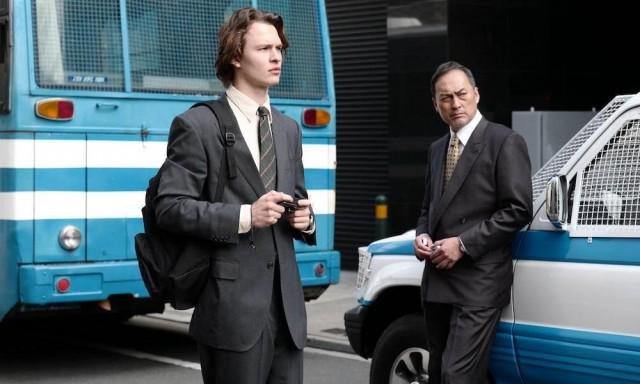
The world of the yakuza is once again explored in HBO's new crime drama series "Tokyo Vice."
Starring Ansel Elgort and Ken Watanabe, the series is loosely inspired by American journalist Jake Adelstein's account of the Tokyo Metropolitan Police beat.
"Tokyo Vice" is created by JT Rogers and runs for eight episodes on HBO GO.
Ansel, Ken, and JT sat down with GMA Digital Specials and talked about their experience in doing the series.
Below are excerpts from the interview.
I imagine it's not easy playing a role that's loosely based on a real person, and on top of that, talking and writing in Japanese! But what was the most challenging and memorable part for you, about taking on such a compelling character?
Ansel: Most challenging part is doing Aikido, the martial art. At first I did this course where every day we were doing three hours for five days straight. You weren't allowed to leave the mat for water or even to blow your nose or anything. Couldn’t say anything other than [ ] whenever they told you to do something.
Some of the days after hour number 2 I was so lightheaded I was fainting. But you just kinda kept pushing through, and learned a lot about just giving it your all, doing things with tremendous spirit.
It's a Japanese cultural thing with ki, ki wo kubaru. Doing things with spirt.
"Okay, now it's time for you to learn Japanese, you should do nine hours a day of Japanese." And I was like, "Okay I’ll do it!" And the producer was like maybe you should just do four hours a day of Japanese.
Hi Ken, in contrast to some of your iconic roles like in "Last Samurai" and "Letters from Iwo Jima," here you show a different and dark side of Japan. With this in mind, what preparations did you have to make for the role of Katagiri Hiroto?
Ken: 1990 in Japan is a really big change of the society. About the technology, it's analog to digital. But it's not just a change in technology. It's the feeling of the society. Most of the society felt a big change just before the turn of the century.
It's about this really usual piece about cops and gangs and the underground, but the most important theme is about this newspaper writer, progressive to the underground, and he is American. It's a very unique point of that theme.
So JT, You and Jake are lifelong friends, he had immersed in that world for 12 years and that's a lot of material—did you guys agree on some ground rules? Were there topics that were off-limits?
JT: No there were no topics. To his credit. He really gave me carte blanche and said, "I trust you, I've written the book, now you write the series, I wrote the book the way I wanted, now you make the series you want." And that trust, which I was very grateful for, became a charge for me to make sure that I didn't mess it up. But also that I would be able to take parts of the book and invent parts and combine parts to make it more dense and dramatic in a narrative, almost novel-like television series as opposed to a memoir which spans 25 years.
But he was incredibly helpful while standing back and saying "Do whatever you want," but then was there whenever I had questions.
"What was it like on your third day on the job? When you sat down with this Yakuza and he had tea, what kind of tea was it? What was the brand of the tea, where did you put the glass?" So he was incredibly supportive and a great resource.
The yakuza and this world is still a little bit taboo or a sensitive topic for a lot of Japanese people. Were there things you were careful about in portraying your character?
Ken: Yeah unfortunately the book has not been published in Japan because it's so dangerous. It's a true history.
Ken (in Japanese): They were mindful to the yakuza because the original book used real names, but they succeeded in changing the names and fictionalizing it, but still making it relevant and real to 1990s Tokyo.
JT: My rule always when writing and creating a work of art is you go wherever your story needs to go but you do it with respect. That everybody on the screen in this series is a three-dimensional character with heart, with ideas, with complexity. Things are good, things are bad. Be they the heroic detective father figure that’s so beautifully played by Ken Watanabe who guides and teaches Jake, or be it Ishida. One of the two Yakuza bosses that struggle against each other, who through all these violence and troubles is a complicated, morally interesting person.
So I find, if you put people in their humanity onscreen, then you really can show pretty much anything because you're not insulting it, you're not making fun of it but you're celebrating it.
What are the things that amazed you the most, unforgettable moments for you?
Ansel: Being able to do scenes in another language with Ken Watanabe and then have him give me the advice as an actor who’s also bilingual.
He said, "When I did 'Memoirs of a Geisha,' sometimes right before I would do this scene where I'd speak in English, I'd say my lines in Japanese just so that way, I can remember, just feel the emotion of it. You know, just to be able to get that kind of advice from such a master and legend.
Ken: Between Jake and I is a very sensitive distance. We need to keep the distance.
Time by time, episode by episode, we get closer, form a friendship. In the first episode, we really kept the distance. Off-camera also.
Ansel: Being able to have that kind of support to help me become this character and helping me be comfortable in immersing myself in this world was like a dream come true and I loved doing this job.
Ken: For the last episode, when I read the script, it's just, "Wow! What is that?! What will we be doing? I couldn't wait for the next episodes, totally."
—MGP, GMA News

