The Supreme Court has denied the Department of Justice (DOJ) and Bureau of Immigration’s (BI) bid to conduct summary deportation proceedings against Filipino-Australian cager Michael Alfio "Mick" Pennisi.
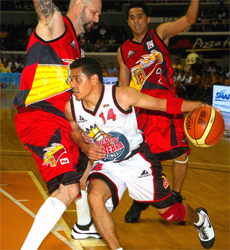
San Miguel's Mick Pennisi, left, tries to block the path of Ginebra's Johnny Abarirentos in this file photo taken during their game in the PBA Philippine Cup. Mike Taboy
a 16-page decision penned by Senior Associate Justice Antonio Carpio, the SC’s Second Division affirmed the Court of (CA) Appeals’ September 30, 2005 ruling that declared Pennisi as a Filipino citizen making him eligible as a professional player in the Philippine Basketball Association (PBA). Then DOJ Secretary Raul Gonzalez ordered the crackdown of the so-called "Fil-shams" following complaints from other homegrown Filipino basketball players. The SC gave merit on the documents and evidences submitted by Pennisi, such as the certification issued by the Commonwealth of Australia attesting that his mother, Anita Tomedas-Quintos, is a a Filipino citizen. Pennisi, who now plays for San Miguel as a center/forward, was born on March 13, 1965 in Queensland, Australia. He presented as evidence, during the trial at CA, the certified true copy of his birth certificate indicating the Philippines as the birth place of his mother. The SC also did not give credence to the DOJ and BI’s claim that Pennisi’s citizenship issue has been rendered moot by his voluntary departure from the country. The SC said that Pennisi, prior to his departure, was recognized as a Filipino citizen and that he manifested his intent to return to the country since his Filipino wife and children lives in the Philippines. "The filing of the petitions before the CA and before this Court showed his intention to prove his Filipino lineage and citizenship, as well as the error committed by petitioners in causing his deportation from the country. He was precisely questioning the DOJ’s revocation of his certificate of recognition and his summary deportation by the BI," the SC said. The SC agreed with the CA that the affidavits of Barangay Captain Ramon Soliman and barangay treasurer Conrado Peralta stating that there were no Quintoses or Tomedas in San Antonio, Nueva Ecija, the birthplace of his mother, have not overcome “the presumption that the entries in the certificate of live birth of Quintos are prima facie evidence of the facts stated therein." "We sustain the CA that there could be reasons why the Quintoses and Tomedas were not included in the census, such as they could have been mere transients in the place. As for their absence in the master’s list of voters, they could have failed to register themselves as voters," the SC said. It said that the late registration of Quintos’ certificate of live birth was made 10 years after her birth and not anytime near the filing of respondent’s (Pennisi) petition for recognition as Filipino citizen. "As such, it could not be presumed that the certificate’s late filing was meant to use it fraudulently," the SC added. The SC further noted that the Australian Department of Immigration and Multicultural Affairs has attested that as of July 14, 1999, Quintos has not been granted Australian citizenship. Records showed that Pennisi filed his petition for recognition as Filipino citizen before the BI that was granted the following year. The DOJ subsequently disapproved the order, prompting the former to submit additional documents, resulting to the confirmation of his Filipino citizenship. Pennisi was then drafted and played for Red Bull and was later traded to San Miguel. However, in 2003, the Senate committees on Games, Amusement and Sports, and Constitutional Amendments submitted their respective reports recommending the summary deportation of Pennisi and several other PBA players due to lack of record to prove that they are Filipino citizens. The BI later issued deportation orders against several Filipino-foreign players, including Pennisi, prompting the cager’s lawyers to elevate the case at the SC.
– GMANews.TV 

 GMA Brandtalk
 Tracking
 Archives


