The Quick Brown Fox and the Big J in Ginebra’s starting backcourt? “I just love the sound of it, the Big J and the Quick Brown Fox in Ginebra’s starting line up," said Brown. “I know the fans would have loved us and I believe we would have been a major dilemma for opposing teams." When Francis Arnaiz, Jaworski’s long-time backcourt partner in Meralco, Toyota, Gilbey’s and Ginebra, left for the United States and unofficially retired at the end of the 1986 season, the idea of Brown joining the most popular player in the league’s most popular team was brought up.
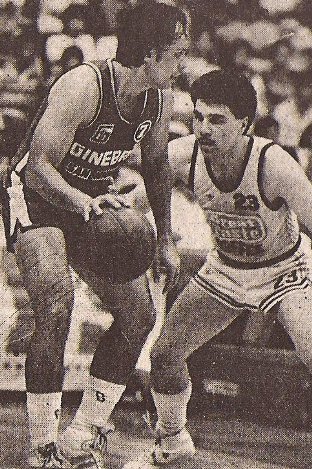
Playing coach Robert Jaworski (left) and Ricardo Brown could have form up Ginebra's explosive backcourt combo. Ricardo Brown Facebook account
But Brown stayed with the Coffee Makers, who by then had traded the pieces of their champion squads the past two years. Before the start of the 1987 season, changes were made. Gone were Manny Victorino, Jimmy Manansala and Willie Pearson. Those who were taken in were Philip Cezar, Atoy Co and Bernie Fabiosa, three notable players who played for coach Baby Dalupan's Crispa squad for a long time. Great Taste’s lone future investment turned out to be Allan Caidic, the top overall pick, who would play for the franchise for the next seven seasons. The arrival of Caidic coupled by the inclusion of the ex-Redmanizers — Cezar, Co and Fabiosa — gave the Gokongwei franchise every reason to put Brown on the trading table, a thing that didn’t surprise Brown. “In between 1986-1987, team manager Ignacio Gotao wanted to initiate a trade and send me to other teams, but I’m always out of the country during the off seasons, so the trade didn’t push through," said Brown. Basketball historian Jay P. Mercado has a different analysis as to why Brown was being put on the trading block. “During that time, it was reported that Brown’s salary was three times bigger than any player," said Mercado, a resident writer of sports forum MYPBA.com and Pinoy Exchange. “That’s the reason why Great Taste wanted to trade him, to free up some space from its salary cap. And with Caidic already in the line up, Brown has become more disposable." Sensing that Great Taste is doing everything to trade him, the 1985 Most Valuable Player was hoping he could get a chance to play for Jaworski’s Ginebra squad. “Jaworski was a once-in-a-lifetime PBA player. He was one of the most charismatic and dynamic athletes I’ve ever competed against in my athletic career. There was no ‘in between’ with Sonny, the fans either loved him or despised him, and he could electrify a crowd like no other player in the PBA," said Brown. “The Big J wasn’t the most talented or physically gifted player I ever played against, but he was like a pit bulldog — there was no quit in him regardless of the circumstance. Sonny gave 100% at all times and he expected his teammates to do the same. His game was not sugar and spice, but was all about blue collar with a ‘never say die’ attitude," added Brown. On the thought that Jaworski was a dirty player, Brown has its own observation. “Many fans thought the Big J was a ‘dirty’ player. I can tell you on a personal level that he was not shy in giving up a hard foul to prevent you from getting a shot off or to make you think twice about taking the ball to the basket, but he never deliberately tried to hurt me or give me what I thought was a cheap shot," added Brown. But the projected Brown-Jaworski allegiance at Ginebra wasn’t meant to be. “Brown would have been Jawo’s preference to replicate Arnaiz’s previous role with Ginebra. But salary issues were the main concern," added Mercado, a business development manager of a popular fast-food chain and writer/historian of a cable network that shows some of the PBA’s greatest games. Instead, Brown found himself regretting not playing alongside Jaworski. “There are a few regrets I have in my PBA career and one of them is that I did not pursue the opportunity to play alongside Jaworski," said Brown. Instead, the 1983 Rookie of the Year and one of the PBA’s 25 Greatest Players, found a team that will welcome him with an open arms – and an open wallet.
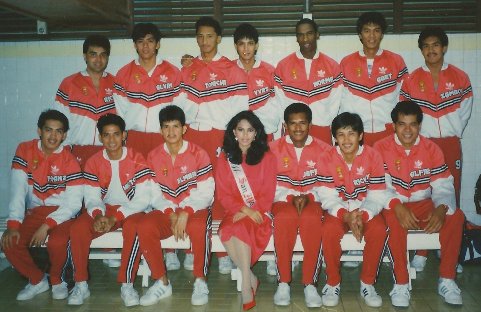
Brown becomes a welcome addition to the star-studded San Miguel Beer team in 1988. Ricardo Brown Facebook account
San Miguel Beer, owner of the largest beverage company in the country, was more than willing to add Brown to its already star-studded roster. By the end of the 1987 season, the sweet-shooting guard joined the Beermen and quickly added firepower to its fully-loaded squad. Brown’s inclusion gave more depth to the Beermen’s backcourt that also has Hector Calma, Samboy Lim, Elmer Reyes and Franz Pumaren, among others. In only his first season with the Beermen, Brown played an integral part in the team’s success. He played for the 1988 San Miguel champion squad that battled a Purefoods team bannered by playing coach Mon Fernandez and young turks Jojo Lastimosa, Jerry Codiñera, Jack Tanauan and some of the holdovers of the old Tanduay franchise to a seven-game series. In the 1988 Third Conference, Brown was again part of the Beermen’s fruitful campaign. He helped lead his team to another Finals entry, but his performance paid a heavy price. His career was shortened by an ailment that caused him to miss some of the games spreading three years, including the Beermen's next three Finals series. “In 1989, I was involved in rehab for six months in Los Angeles due to a life-threatening heart ailment initially caused by a severe blow to the chest during a PBA game at the latter portion of the 1988 3rd Conference. This injury and subsequent heart failure caused me to spend 19 days in Makati Medical Center and miss the 1988 3rd Conference Championship Series that I had worked so hard to help our team win," said Brown. “Consequently, I missed the first two conferences of the ’89 season and was able to return to the 3rd conference to help San Miguel win the 3rd leg of the Grand Slam. That was an electrifying time for me as I felt I had regained my form on the basketball court and was able to contribute to our great SMB team," added Brown. One of the key contributions given by Brown in capping San Miguel’s Grand Slam happened in their Finals showdown against Añejo. “Brown played a pivotal role and was in fact asked to defend the high-scoring Carlos Briggs. While Briggs continue to get big points, Brown was able to limit his production, which proved to be costly to the 65ers team that didn’t have much local support," added Mercado.
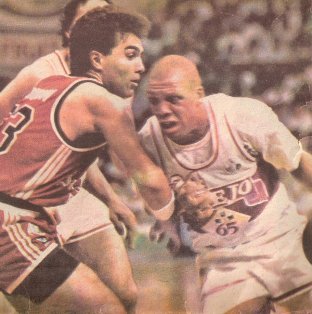
Brown played a pivotal role in the 1989 Third Conference Finals series by shackling down the high-scoring Carlos Briggs of Añejo. Ricardo Brown Facebook account.
But just when Brown thought he was about to regain his second wind, personal and family matters started to distract his playing career. With situations getting worse, he made a tough decision of leaving the game he loves. “Just when I thought I was back on track, my father had a serious heart attack, which caused me to remain in the States for a prolonged period of time to assist my family. I returned for the 1990 3rd conference in September and after one game, I had to undergo an emergency hernia surgery. I was extremely frustrated and it seemed I could not remain healthy. I started to ask myself, “What’s Next?" Right before Christmas in 1990, while in Los Angeles, my father took a turn for the worse causing me to once again delay reporting back to the SMB camp. I did not want to ask San Miguel if I could report late again, which would have been the third year in a row, and it is then that I made the painful decision to retire from the game I had been playing since the age of four. That decision haunted me for many years," added Brown. In his early years with San Miguel, Brown has already contemplated on preparing life after basketball. “I had several conversations with San Miguel management in 1988 and 1989 about my desire to begin preparing for life after basketball. Unfortunately, for a variety of reasons, the hope to begin preparation for a transitional career off the basketball court did not happen. At one time, I never imagined leaving Manila as I wanted to make that my home and raise my family there," said Brown. So how's life after basketball for Brown?
(To be continued) -
GMA News 

 GMA Brandtalk
 Tracking
 Archives


