Marlon Stockinger usually wakes up in Europe these days, thousands of miles away from his hometown and family. He has to wait hours on freezing February mornings in northern England until the ice melts on the track so that he can start testing cars. After which, he has conditioning exercises before doing laps on Formula One race tracks. Maybe he even has a party with the F1 grid girls at night. That’s the life of Marlon, a Filipino-Swiss racecar driver who is well on his way to becoming the first ever Filipino to compete in Formula One. After months of testing with different teams over the winter break, he finally signed with Status Grand Prix this month for the 2012 Grand Prix 3 season. The GP3 is an avenue for young drivers to develop their skills, being only two levels lower than F1. He will be one of 30 drivers competing from 10 different teams this season. With Marlon’s accolades, it would be surprising to know that he actually started his fascination with speed and wheels right here in the Philippines – a country not even remotely concerned with racing (unless we’re talking about horse racing, if you know what I mean).

Photos courtesy of Marlon Stockinger.
IT ALL STARTED WITH GO KARTS “My dad used to race go karts in the Philippines with his friends. One day of course they sat me in one of these...and that was it!” retells Marlon. He was only about nine-years-old when he started karting, competing for the first time in Carmona against now-big names Matteo Guidicelli and Michele Bumgarner. He did this for eight years, first in the Philippines and then in Asia and Europe. In 2006, he was even named Asian Karting Champion. While he was scared at first to race, he knew he wanted to be more than just some poster boy. He wanted to make a name where it matters most in the racing community – Europe. FORMULA RACING Aside from being a 20-year-old who has traveled the world, Marlon takes pride in being the first Filipino to win a Formula race in Europe. “It is natural to progress from karting into Formula cars. Some people are good at it, others like to stay in karting,” says Marlon. He, personally, ventured into real cars. He first tried a Formula car with the Eurasia team and competed in the 2008 Formula BMW Pacific series where he won a BMW junior driver sponsorship. Funding is probably one of the biggest, if not the biggest, issues a racer has to address. Without money, you can’t go abroad to race. If you don’t go abroad to race, you can be sure that your F1 dreams will remain just dreams. “It's hard to start out because it's hard to find sponsors. You have to rely on family to support your racing. Until you are in a category like Formula One, hardly anybody notices you,” he says. In the couple of years that he has spent with cars, he has also learned that racing isn’t just about speed. Your position on the grid affects your final standing immensely. “Qualifying is very important in car racing. If you start in front, you most probably are going to stay there, if nothing goes wrong. In karting, you can start all the way in the back and still make it to the front. It's much harder to do that in race cars. This is why it is very important for me to improve my qualifying speed,” he explains. Luckily for Marlon, things fell into place after his BMW sponsorship. He won the prestigious Formula Renault UK race in Croft in 2010 from pole position, a historic feat for a Filipino driver. Later on he also got accepted into the Lotus F1 Team junior drivers program, another step towards the F1. GP3 AND A STRING OF BAD LUCK “Motorsport is always competitive. You cannot drive slowly. So from karting in the Philippines and Asia to the racing tracks in Europe, it was all about competition,” says Marlon. The GP3 grid last year was probably the most competitive in the world, with 20 of the best young drivers competing. Some were already F1 reserve drivers, like Valtteri Bottas from Finland, who eventually won the series. His first season in the GP3 didn’t go quite well. For starters, his car stalled on the starting grid in several races. In Barcelona, he qualified for third place but was later disqualified for a minor technical infringement (the clearance between the car's floor and the road surface was 5mm too low). He was also in a sensational crash where he hit Swiss driver Nico Muller who had stalled on the grid. “Coming from the back I couldn't see him, since several drivers were dicing in front of me. Insult to injury was the comment of a German TV journalist on the Eurosport channel saying that I had already been noticed as a driver with bad habits, which was absolutely not true,” he sighs. NEXT STOP: MONACO Always the optimist, Marlon knows better than to dwell on past mistakes and critics. “I am now with a new race-winning team, Status Grand Prix, and our testing last October/November went very well. I was always up there in the top five. I am looking forward to the pre-season testing which is about to start,” he says. “Marlon showed well in testing, and we fully expect him to be challenging at the front of the field this year. Experience also counts in the GP3 Series, and going into his second year Marlon is consistent and knows how to get the best out of the car and tires,” says Status GP team principal Teddy Yip. The GP3 follows the European F1 calendar and will run from May 12 to September 9. The series is comprised of eight Formula One Grands Prix to be held in Spain, United Kingdom, Germany, Hungary, Italy, Belgium and for the first time, Monaco. “I am going to be the first Filipino race driver to ever run a race car through the narrow streets of Monaco. It has a little bit of a Hollywood feel to it,” says Marlon excitedly.
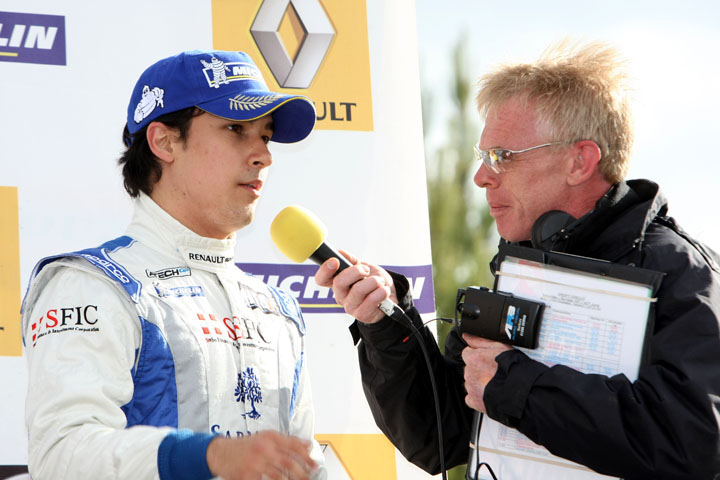
FIRST FILIPINO IN FORMULA ONE? After the GP3, Marlon can move to GP2 or World Series by Renault to get to F1. Either way, he wants to make the sport more popular among Filipinos. “When I came first to Europe, they asked me ‘Where do you come from?’ and I said ‘From the Philippines.’ A lot of people asked, ‘Where is that?’ Success in motorsport on a high level can put the Philippines on the world map in terms of sports achievements. Manny Pacquiao has done that with his bare fists. I would love to do the same in motorsport. Man and machine! Often during race events it happens to me that Filipinos living and working abroad come by our paddock and are amazed to see one of their kababayans racing in some foreign country. That always made me proud,” he shares. While he’s confident he can reach F1 in three to five years, he’s concentrating on the 2012 GP3 title now. And his priority is fitness. When you see him in person, he looks like the gym is his second home since he has to be extremely fit, not just to win, but to survive motorsport. He has a personal trainer who “puts him through hell” with fitness programs and boxing sparring sessions (even his neck has special exercises, he mentions). Mental fitness also takes center stage especially, when you have cars zooming around you during races. As Marlon puts it, “You have to be absolutely empty in your head because there is so much going on! Full concentration. Nothing else matters. Like a kung fu fighter or a boxer.” The sport requires a lot of sacrifice and dedication, he repeatedly says. “But then again there is the Porsche party every year after the Monza race where you can mingle with all the beautiful F1 grid girls! And yes you share the pit lane with the F1 teams,” he ends with a grin.
- AMD, GMA News 

 GMA Brandtalk
 Tracking
 Archives


