

 GMA Brandtalk
 Tracking
 Archives

Philippine football in 2012 - the rebirth of the Azkals
As it turned out the world didn’t end this year. In fact, 2012 turned out to be the most successful in all of Philippine history, with regards to football. Here, we take a look at the major competitions and contributions to Philippine football this calendar year, with the country at the end of the year having reached its highest-ever FIFA rank and being the most-improved nation in the world again in terms of ELO ratings.
Challenge Cup
Prediction: Third place group finish
Actual: Third place overall
Being the only team to knockout a higher-ranked opponent at the time to reach the group stage of qualification, the Azkals became the only team to qualify through both rounds of qualification in 2011 and make the final stage for 2012.
In March, that final stage began with much hype and the Azkals in a Group of Death, drawn against all three past winners of the tournament, namely North Korea, Tajikistan, and India. At the start of the year I cautiously predicted a third place finish in the group with North Korea going top followed by India, something which would still have been an achievement for the Philippines.
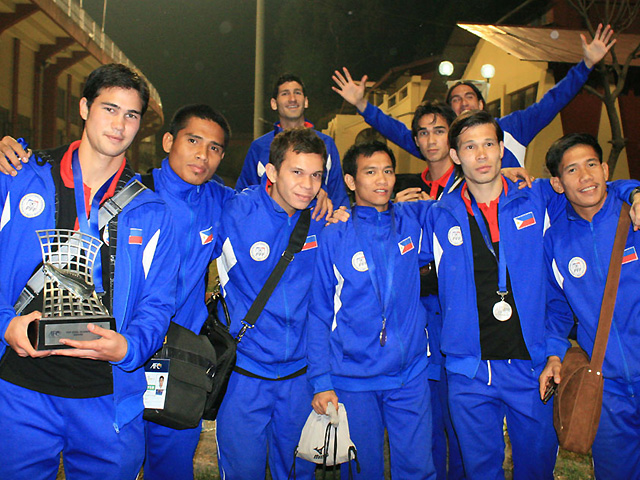
The semifinal against Turkmenistan started brightly with the Azkals going ahead through Phil Younghusband and holding onto the lead until the 80th minute when Turkmenistan fired a quick double. That put the Philippines in a playoff for third place, against Palestine, which had topped that qualification group in Myanmar.
The Philippines had managed a 0-0 draw back then, but there were no repeats of the solid defensive work both sides showed as they went about a seven goal thriller. A brace from Phil Younghusband was added to goals from both Guirado brothers to end the campaign in impressive fashion region, by beating Palestine for the first time in history.
Phil Younghusband grabbed the golden boot with six goals, seven including qualification, while including those stages Angel Guirado was the joint second top scorer with four goals overall. Younghusband’s scoring record also drew the attention of everyone else in the region, which explains why the opposition physically took him out of the games against Thailand and Singapore in the Suzuki Cup.
UFL - the return of the diaspora
UFL League prediction: Global win
UFL Cup prediction: Global win
Actual League winner: Global FC
Actual Cup winner: Stallions FC
It’s long been considered that the traditional route of Filipinos is to grow up, and study abroad, finding better paid jobs in other countries. The Filipino Diaspora has meant that millions of Filipinos live abroad and often make up a large minority in other countries, so much so that when the Philippines played Singapore in a friendly before the Suzuki Cup, the Filipinos outnumbered the home crowd of Singapore.
The OFWs have been the bedrock of the Philippine economy and they and their families should be rightly respected – a whole lot more than they usually do in the comments section of most football articles relating to the issue. However strong domestic growth and increased demand has seen the Philippines become one of the emerging economies in the continent and some of the children of the Diaspora have been returning to the Philippines.
Likewise in football, which is still an infant industry in the Philippines, the rapid growth of the National team and domestic league in the UFL has seen a huge number of the children of the Diaspora return to the Philippines to make it big.
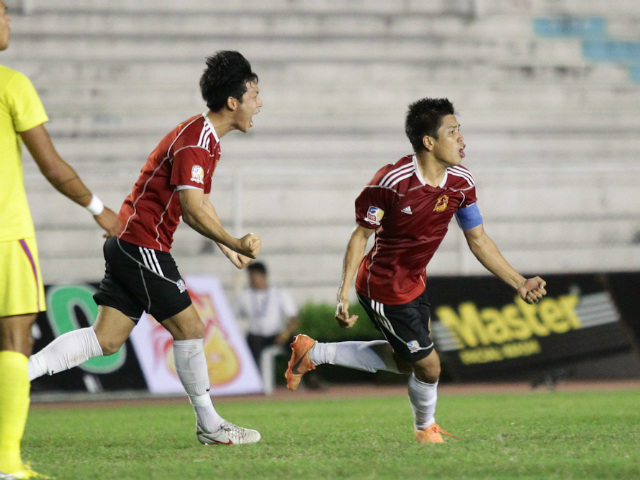
Kaya kept up most of the way, but their 30 goals scored was the worst in the top half and they lost out on goal difference. Loyola meanwhile was five points behind the pace as they fell in the final few games, likely tired from their fourth placed run in the Singapore Cup.
Just before the UFL Cup, I also predicted Global would win to make it a double for 2012. Unbeaten until the Final, they looked the favorites for the crown, but the Stallions crashed the party, winning Global 2-1. It capped an impressive 2012 for the Stallions who are coached by National women’s team Coach Ernie Nierras.
The Malditas also deserve an honorable mention for winning the LA Viking’s Cup at the end of the year, making huge strides throughout. Look out for the women’s team in 2013 to make more headway with a realistic shot of making the Women’s World Cup in 2015.
Peace Cup triumph
September was the month to honor the peace process and football is often the game which brings people together. During the First World War for example, on Christmas Day 1914 Allied and German forces took a break from shooting bullets at each other to come together to hit footballs at each other instead. It was a truly inspirational moment as it brought together groups of people who were ultimately there to kill each other, humanizing themselves and the conflict somewhat.
Almost a century on saw Guam, Macau, and Chinese Taipei join the reformatted Long Teng Cup, which admittedly saw more makeovers than the models’ dressing room at a fashion show. After cycling through several versions of using Paulino Alcantara’s name, to honor the Fil-Spanish striker who remains Barcelona’s top scorer ever, the name changed again.
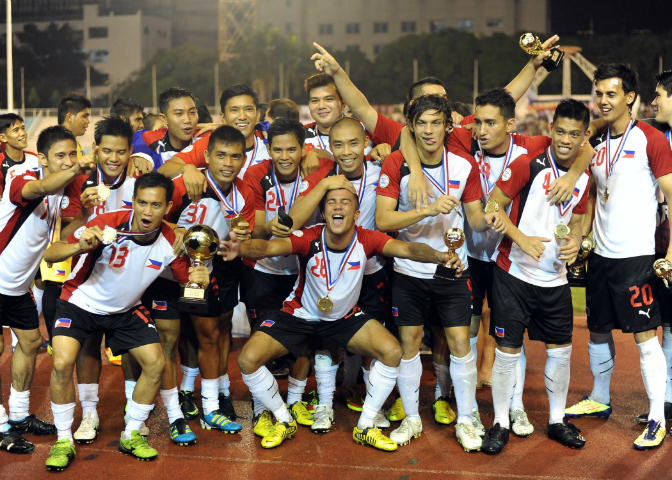
All that aside, the football got off to a surprising start as Macau held Chinese Taipei to a draw to win their first point in the Long Teng Cup/Peace Cup/all its other names. Guam, meanwhile, fiercely repelled the Philippine attack until a late Patrick Reichelt header finally undid the Matao defense. The Philippines went on to smash Macau 5-0 and beat Taipei 3-1 after a couple of gifts from the Taiwanese defense.
The victories meant that the Philippines had won their first tournament in over 99 years, their only other success being in the 1913 East Asian Games against China. Admittedly though, the win came against much weaker opposition and the Azkals were the heavy favorites to win.
Suzuki Cup
Prediction: semifinals
Actual: semifinals – losing to Singapore in the semis 1-0 on aggregate
The biggest regional tournament, the same which propelled the Azkals to fame back in 2010, was the focal point of the second half of 2012. The team looked worn out after three more games in September, drawing to Cambodia, beating Singapore, and losing to Laos. Even the win over Singapore had a huge slice of luck with Chieffy’s opening goal looping over the goalkeeper after hitting an unforgivably bad patch of grass.
It didn’t bode well, but the final tour in the Middle East was far more encouraging. A spirited draw with Bahrain, which could have been a win if Denis Wolf had taken one of three great chances, was followed by a narrow 2-1 loss to Kuwait.
So it came down to the group stage, another Group of Death for the Philippines, with the Azkals losing their opening game to pre-tournament favorites Thailand, before bouncing back to defeat Vietnam for the second successive time – incidentally their only wins over Vietnam. A win was still needed over Myanmar to guarantee progress, and the Azkals delivered, with Phil Younghusband scoring his first, and only, goal of the Suzuki Cup before Angel Guirado wrapped things up in injury time for another Philippine first in defeating Myanmar.
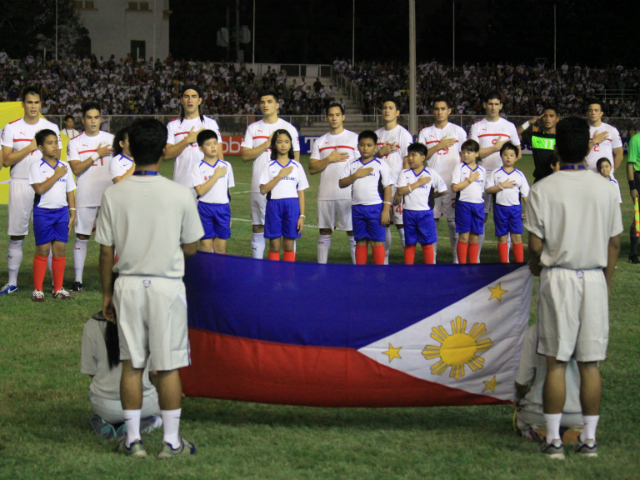
Reaching the semifinals was impressive in itself, only the second time the Philippines have achieved this, but such was the progress of the team that despite now being drawn along the other three of the top four rated ASEAN nations at the time, it wasn’t a shock to see them progress.
Losing to Singapore 1-0 on aggregate, from a preventable free-kick too, was disappointing in the end, yet the team should look back on the run with pride. They may have felt they were capable of going a step further, and indeed they are, but the semifinal appearance solidifies the progress of the National side and confirms that the Azkals are indeed part of the elite of South East Asia and they will be one to watch out for in 2014 as the side matures.
2012 in review
Over the course of the year the Philippines played 23 matches against international opposition. Coach Weiss has been at the helm for eleven wins (48%), six draws and six losses (26% each), including his time not so much at the helm in their loss against Thailand, when he was suspended for throwing the ball at Thai midfielder Anucha Kitpongsri. It was an amusing end to the match, which had left the Azkals’ coach frustrated with the Thai tactics of wasting time and overly physical play, which had included a few elbows.
Kitpongsri flying dangerously into Dennis Cagara before feigning injury was the last straw and Weiss aimed a basketball free throw shot onto the Thai goalscorer. Ultimately it didn’t change the scoreline and Kitpongsri had the last laugh as his goal turned out to be the winner, but it’s still good for the highlight reel and is a nice footnote.
The team started the year scoring a lot of goals. Built on a fluid attack, the 4-2-3-1 formation allowed the team to get forward as they scored nine goals in the five games of the Challenge Cup. By the end of the year though, the team had transitioned into a more defensive and conservative side using a 4-4-1-1 formation. Employing this tactic, they conceded just five goals in their last eight matches, including five clean sheets, but scored just six points.
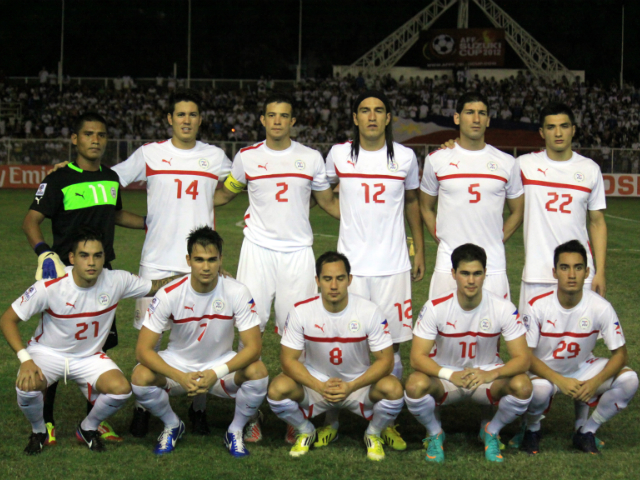
Most-improved in the world
However for this writer, the most impressive achievement of the year is the way in which the Azkals ended as the most improved nation in the world, again. In 2011 the Azkals were the most-improved and sported a record of five wins (36%), five draws (36%), and four losses (28%) against international opponents. This was an impressive year for the Azkals, where they qualified for the 2012 Challenge Cup and the second round of World Cup qualification, defeating Nepal and Sri Lanka 4-0, Bangladesh 3-0, and Mongolia 3-2 on aggregate.
To be the most-improved for the second year meant another huge leap compared to just twelve months ago, something achieved by boosting their win percentage from 36 percent to 48 percent. This was done by turning draws into wins as in 2011 they drew against Hong Kong, Chinese Taipei, Sri Lanka, Myanmar, and Palestine. In 2012 they played Myanmar, Palestine, and Chinese Taipei again and beat all three for the first time in history, while adding their first-ever victories against Singapore, India, and Tajikistan to start rewriting the history books.
Conceding nineteen goals in the year, less than a goal per game, was also impressive and the Philippines kept twelve clean sheets in 23 games, or 52 percent. They also scored almost 1.5 goals per game, which despite popular opinion isn’t the same number as an away goal.
As such, 2012 really is the banner year for the Azkals as they have now reached a level of success never attained by the team before. How well they can build on that for the next year will be the test, as to become a contender is the first step but to become the best is the ultimate goal. - AMD, GMA News
The Philippines' record against international sides for 2012
Won: 11 (48%)
Drew: 5 (26%)
Lost: 5 (26%)
Scored: 33
Conceded: 19
Clean sheets: 12
Biggest win: Philippines (150th) 5-0 Macau (200th)*
Biggest loss: North Korea (106th) 2-0 Philippines (156th)*
Win over highest-ranked opponent: Philippines (143rd) 1-0 Vietnam (138th)*
Most impressive result: Bahrain (115th) 0-0 Philippines (147th)*
Highest scoring match: Philippines (156th) 4-3 Palestine (162nd)*
Top goalscorer: Phil Younghusband, 8 goals
FTW Player of the Year: Rob Gier
*FIFA Rankings at the time of the match

