

 GMA Brandtalk
 Tracking
 Archives

UAAP scoring machines - the hot-shooting guards of summer
Your eyes don’t deceive you: Ray Ray Parks and Kiefer Ravena are among the best perimeter scorers in the UAAP. They’re counted on to score buckets from every position on the floor at a top-notch efficiency. But just how good are they and how close does everyone else come?
We took a look at the high-scoring guards who are expected to carry their teams on offense. What makes them elite, and how do the rest stack up? Using statistics from the recently concluded FilOil Cup, we want to get the debate going right before UAAP Season 76 rolls around.
The easiest way to go about this is to look at points per game, but that only takes the result into account. We want to look at how players score to produce those markers.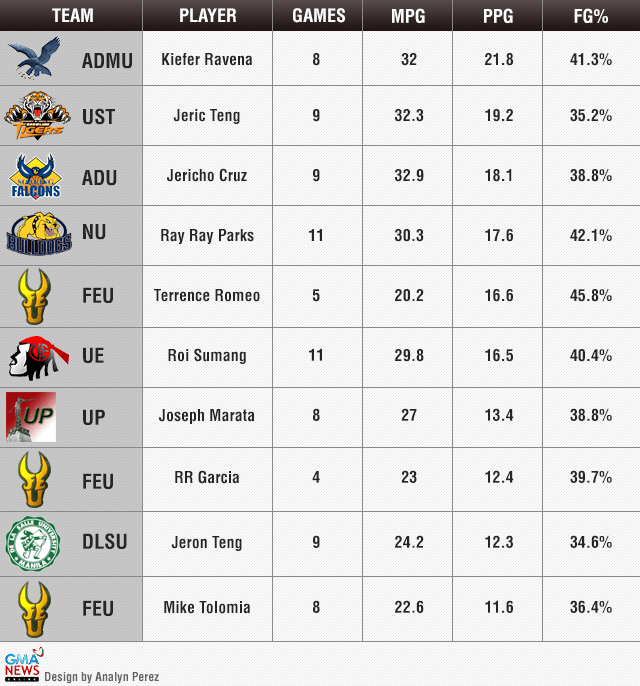
So in addition to those basic level stats, we're also going to look at a few advanced metrics.
The first is True Shooting Percentage (TS%), which is defined by BasketballReference as “a measure of shooting efficiency that takes into account field goals, 3-point field goals, and free throws.”
True Shooting Percentage = PTS / (2 * (FGA + 0.44 * FTA))
This means that TS% compares a given player’s scoring output against all the scoring opportunities, three-pointers, two-pointers and free throws, that he took to attain those points. A higher TS% means a player took fewer scoring attempts to produce his output.
Next is the free throw rate (FTR), gleaned from Dean Oliver’s Four Factors. The stat is simply the ratio between free throws made and field goals attempted.
FTR = FTM/FGA
Simply put, it shows how well a player puts himself in a position to score unobstructed from the charity stripe.
The last two measures for this piece will be the player’s free throw percentage (FT% - given his free throw rate, how often does he make those shots?) and his assists per game (APG - how often does he create scoring opportunities for his teammates?)
Here's how our players now stack up: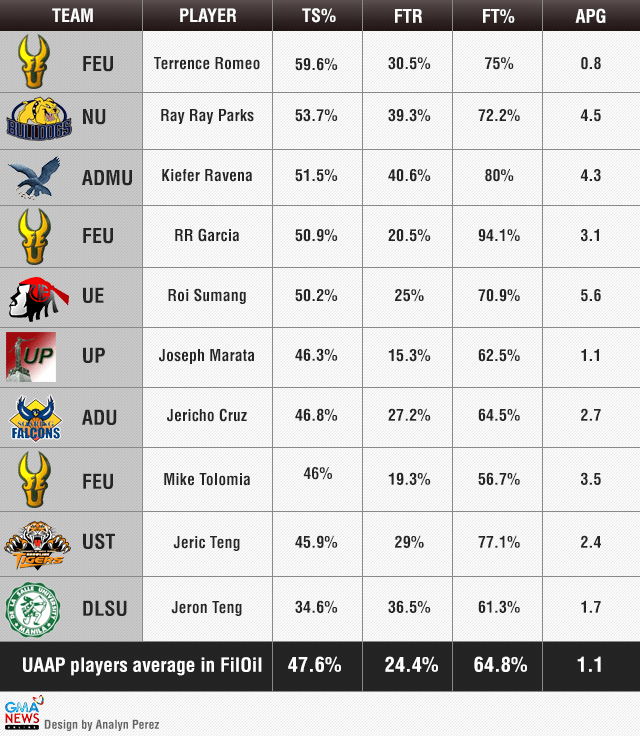
Given this data, here are some observations:
1. The numbers back up Ray Ray Parks’ two UAAP Most Valuable Player awards. He’s really good at picking his spots, getting to the rim at a high rate and converting his chances from the line. Moreover, Parks' 4.5 assists per game show that he doesn’t need the ball in his hands for his team to hurt opposing defenses.
3. Roi Sumang’s TS% is more amazing when you factor in that he takes fewer free throws than Parks or Ravena. He scores the bulk of his points on field goal attempts, while tallying 5.6 APG, showing how crucial he is to UE’s offensive game plan. If MVP awards weren’t completely subject to statistical points in the UAAP, this is your case for Sumang right here.
4. Terrence Romeo’s and RR Garcia’s TS% are likely inflated for two reasons. First, five games is a small sample size for Romeo, as he was suspended for the last three games of the tournament, owing to a disciplinary issue with new head coach Nash Racela. Second, Garcia’s minutes, along with Romeo’s and Mike Tolomia’s, indicate that Racela opted to give his bench more burn during the preseason.
Between less minutes, fresher legs and experimental line-ups, the Tamaraws’ preseason run doesn’t really show an accurate preview as to how this team will be run come the UAAP. Perhaps after the first round, this is a discussion we can revisit.
5. Those conditions, however, don’t take away from the fact that Romeo and Garcia are talented scorers. We just don’t know how close their FilOil performance is to the real deal. If anything, their summer stint opened the doors for Mike Tolomia, who despite possessing an average TS%, has already improved on last season's norms of 5.6 PPG on a 38.9 TS%. For better or worse, FEU has another volume-scoring guard should they need one.
6. Joseph Marata, the former DLSU Green Archer and now the UP Maroons’ de facto go-to guy, is stepping into a new role, given how he was just a bit player with Taft a few seasons ago. It will be interesting to see if he can elevate his game come the UAAP, but possessing numbers similar to Tolomia’s indicate he might not be an ideal choice for the role.
7. Jericho Cruz and Jeric Teng are regarded as go-to guys on their team and rightly deserve attention for their scoring skills. But the departure from Parks, Ravena and Sumang numbers-wise is clear, as the latter group is able to maintain a high TS% despite having similar usage rates (they consume the same number of shooting possessions on the floor) to Cruz and the older Teng.
8. You can interpret Jeron Teng’s numbers in two ways. The plus side is that individually, he’s the youngest player tasked to carry a team’s offense. But like I mentioned in a previous article, one of the nine things we learned during the FilOil Cup is Jeron needs to grow his game a bit more.
Jeron's stat line is mostly below average, but here’s what we should take away from that. His high free throw rate is a good result of his willingness to risk his body against taller defenders in the lane. Also, he took only eight three-point attempts during the entire FilOil Cup, which is either him recognizing limitations or the coaching staff wanting him to specialize inside.
Even then, Jeron has to make the shots that he takes, whether from the field or from the free throw line if he wants to raise his game to the level of his peers, especially as one of the couple of guys on the Green Archers who can create their own shots. - AMD, GMA News

