

 GMA Brandtalk
 Tracking
 Archives

ADVERTISEMENT
Filtered By: Sports
Sports
Four big lessons from the Clear Dream Match series
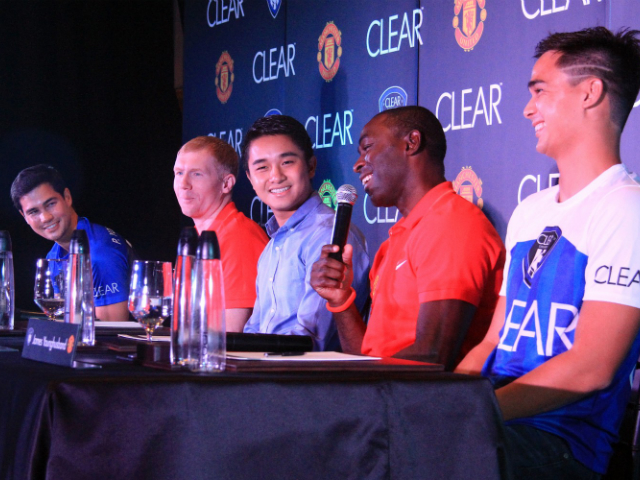
The Younghusbands and Manchester United greats Andy Cole and Paul Scholes chat during the press conference before Clear Dream Match III. Roehl Niño Bautista
The Clear Dream Matches have now, according to the organizers, ended. Team James takes the crown after losing the first 5-1, but winning the next two, 4-1 and 1-0.
What began as an exhibition of UFL All Stars got heavyweight cameos in the form of Fabio Cannavaro, Dennis Wise, Andy Cole, and Paul Scholes. Four players who, in their prime, would have made it into the starting lineup of almost every team around the world.
Simply seeing those players in the Philippines playing football was a privilege. With full, active, and paying crowds for the three matches, there were other great things to take away from the series.
However with a pitch that was nothing short of an embarrassment for the first two games, poor timing, and more marketing than football, there are other lessons to be learned too.
Lesson 1: Philippine football has potential
One of the biggest questions about Philippine football is whether there would be enough fans. Fans drive everything, from gate receipts, to the merchandising, to the audience for the advertising. Initially, the revival of football in the Philippines saw full crowds at the Rizal Memorial Stadium. Things dipped a bit and for some time Manila has been unable to host an international match, but soon Rizal Memorial Stadium will be back up and the Peace Cup will be the test to see how things are in terms of attendance now.
Domestically, though, the United Football League, undoubtedly the most important domestic competition, rarely fills up the Emperador Stadium. It has developed so much every year and the Azkals who used to ply their trade in the lower leagues of European football have come back to the Philippines to take part. Only six from the 23-man squad for the Challenge Cup have not played in the UFL at one point. And more discoveries are being made, as players like Simone Rota and Daisuke Sota show. With so much youth in the side too, the future is bright.
Big questions are asked about the sustainability of football, though. A recent article by Ryan Fenix showed how big losses for the top UFL Clubs are. But while imperfect, having a TV deal in place, having built the Emperador Stadium, and in particular, seeing the new hoards of children now playing football, are all way beyond expectations set a few years back. There is certainly a demand for football.
And the full attendances from the Clear Dream Matches show that people are willing to come out and pay. Football is on the map in the Philippines and has the potential to develop more.

Clear Dream Match 2 might be more remembered for the rain the two sides played in. Mark Cristino
Lesson 2: We need better facilities…owned by those in the football world
Nothing was more apparent after the second game than how bad the pitch at the University of Makati was. Watching true greats like Fabio Cannavaro and Dennis Wise play was overshadowed by watching said greats slide through a mud bath. As a kickaround, it may have been fun. As the face of Philippine football to these players and to the new audience the organizers were trying to reach, it was nothing short of embarrassing.
Yet the problem was obvious the previous year. A pitch that was regularly the reason for canceling UFL games in the beginning was never going to be good enough. Even in this third game where they had apparently booked out UMAK for a month to rehabilitate the field, the pitch was still bobbly and the ball took weird bounces, disrupting play. This was part of the reason the game was so slow and dull for the vast majority of fans. The other reason was the players were so tired after a grueling Challenge Cup campaign and with the UFL ongoing.
The poor pitch speaks to a greater problem, that the development of football is not the number one priority. All of the stadiums in Manila, for example, are owned by people outside of the footballing world. While UMAK is simply not good enough for Philippine football anymore, of Rizal Memorial Stadium, the Emperador Stadium, and the new Philippine Stadium in Bulacan, one is owned by the PSC which didn't allow the U23 Azkals to go to the SEA Games, one is owned by Megaworld, and the other by the Iglesia ni Cristo. For all three, football development is not the number one goal.
The solution? Clubs build their own facilities. It makes financial sense too. Instead of shelling out millions of pesos every year for training their senior and rapidly growing youth teams, they could invest in their own ground. By having their own field, they can dictate when their teams train, providing an undervalued stability to the club and their routines. Top teams in the UFL won't have to train at 10pm until midnight because that's the only slot left available.
The available artificial pitches like The Camp, Kick Off, BGC Turf, and Emperador are always in demand and renting out the field during the week can provide income generation too. There may not be many people making money in football yet, but there is money to be made in this area, money that instead of going to a large corporation can go to developing football further.

James Younghusband won the three-game "sibling rivalry" series 2-1. Roehl Niño Bautista
Lesson 3: Build the rivalry
The marketing of the Clear Dream Match was clever in one way: it built rivalry. This rivalry was the base of the marketing campaign and for good reason: rivalry generates interest. In sports it drives everything.
Rivalry comes from identity, it builds affiliation, and therefore support. It forces a choice, and therefore an interest. The rivalry between the Younghusbands generated interest for the three games but of course it can't do anymore than that. The Younghusbands aren't really trying to beat each other. They're brothers who, of course, support each other and who are both the faces of the brand. But the temporary rivalry did exactly what it was supposed to do: generate enough interest to sell the tickets and sell the Clear brand.
But Philippine football can learn from this and build the rivalries football is based on. Across the world football is about one city versus another, and eventually one country versus another. In the UFL, fans support one team, but so many switch after a season or two as their favorite player leaves or they don't do so well. Which team you support becomes about who you know, so if that player leaves, so does the fan. For the club to be bigger than the players, as it should be, it needs to be more rooted in a community.
Most often in football, the loyalty of fans comes from the location. With the National league on the horizon, teams having their own grounds may not just be better business it may well be a requirement. As clubs affiliate themselves with different areas, it makes more sense that they get a base in those areas.
Some clubs have loose links already, with Global in Leyte, Stallion in Iloilo, and Manila Jeepney the first to get government support. Solidifying those links will change everything. To make football sustainable, that identity will be key.
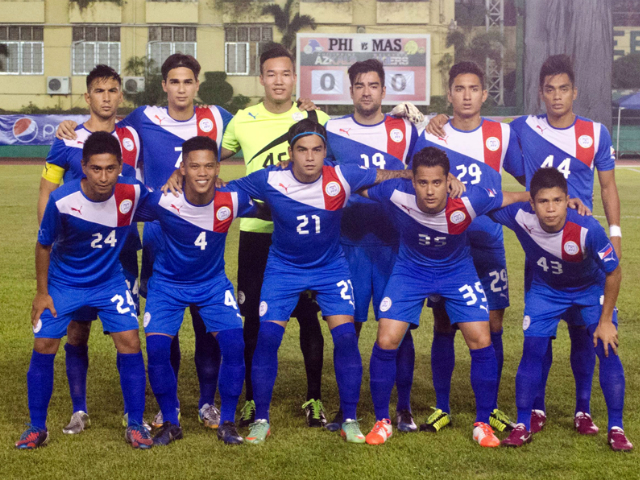
Will the next great Azkal be inspired by something like the Clear Dream Match? Ramon Lindo
Lesson 4: Think long-term sustainability, not short-term events
Football is an infant industry here and needs space and time to grow. The future is what should get focus, not short-term profits. Events like the Clear Dream Match can play their part, bringing over big names, but it must always be tied to this long-term vision to have any use, to have any legacy.
Apparently Clear spent somewhere near P500,000 to renovate the UMAK field. It's a lot of money and showed how serious they were. Yet the field was still poor, and in two or three months it will likely be ruined.
It's a lot of money. To stage the three games and bring over the four football stars would likely be tens of millions of pesos too. After the games have finished what will there be to show for it? That was money that could have gone into a stadium, or a quality youth academy, training for coaches, and other grassroots development.
So what is the legacy of the Clear Dream Match? Branding. There is nothing physical to remember from the games, nothing practical that it has done. There are no facilities the millions have left behind and no long-term support for any football club or young footballers. The message was that it would inspire kids to take up the sport, but there weren't many kids at the last game. Fewer who actually knew who Cannavaro, Wise, Scholes or Cole were, given they weren't born when the four were in their prime.
Sure many fans enjoyed the occasion, Manchester United probably has the biggest following of any English club in the Philippines. But what will be remembered is that four football legends played a match at UMAK, and that Clear sponsored everything.
But when asked what Philippine football needs to do to improve all four of the football legends had the same answer: grassroots. It's about developing the youth, providing the facilities for them to train and learn. Hopefully more can be done to look into that aspect. - AMD, GMA News

