

 GMA Brandtalk
 Tracking
 Archives

ADVERTISEMENT
Filtered By: Sports
Sports
YEAR-ENDER: World Cup finals cast long shadow over 2013
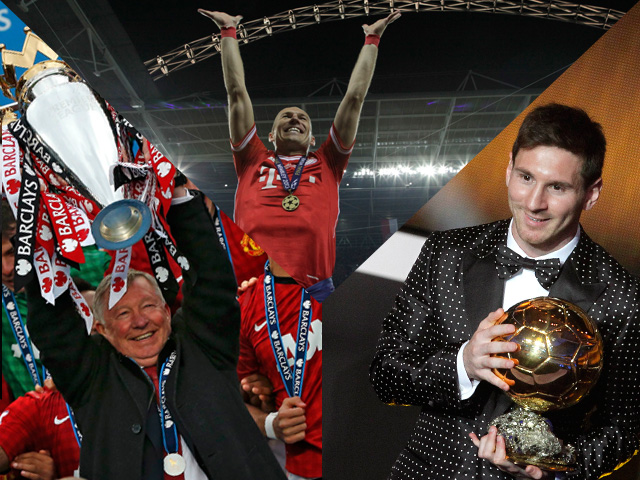
(L-R) Alex Ferguson retired, Bayern Munich dominated, as did Lionel Messi, in 2013.
LONDON - The World Cup finals are not taking place until the middle of next year but they cast a long and, at times, disturbing shadow over Brazil and the world of soccer in 2013.
As countries battled to qualify for the finals, Brazil was convulsed by protests in more than 100 cities about the vast amount of money being spent to stage the tournament.
Angry Brazilians targeted the Confederations Cup warmup event in June to gain maximum publicity for their grievances about the paucity of government funds for health, education, public transportation and welfare while billions were being spent on stadiums.
The building of those stadiums has caused no end of problems too, falling behind schedule to cause more headaches for world governing body FIFA and Brazil's World Cup organizers.
[Related: Brazil judge halts work on World Cup stadium after death - media]
An accident which killed two workers in Sao Paulo in November means the stadium being used for the opening match in June will not be ready until April. Fan violence at Brazilian championship matches is another worrying development.
The authorities are under no illusions about what could happen off the field next year, but what may happen on it will preoccupy the rest of the world.
Under Luiz Felipe Scolari, Brazil are emerging as favorites to win the World Cup for the sixth time. Victory on home soil would go some way to alleviate the pain of what is still regarded as a national tragedy - failing to win in 1950, the last time the World Cup was held in Brazil.
[Related: Brazil crushes 10-man Spain to win Confederations Cup]
Scolari has spoken at length about how the crowds at the Confederations Cup inspired players like Neymar, Fred and Paulinho to take the trophy with a scintillating 3-0 victory over world champions Spain in the final at Rio's Maracana.
Spain will be back to defend the title they won in South Africa in 2010 and attempt to become the first European side to win a World Cup in Latin America.
Vicente del Bosque's side qualified comfortably, coming through their preliminary matches unbeaten, and remained top of FIFA's world rankings throughout the year. But Spain faces tough competition from Brazil and the improving South American sides of Argentina and Chile, and also from much closer to home.
Emerging Germans
This year's outstanding European side was Germany, which ended the international year on a high while Bayern Munich regained the European club title.
Joachim Loew's youthful squad cruised through their World Cup qualifying campaign, winning nine and drawing one of their 10 matches to raise expectations they can become world champions for the first time since 1990.
Ranked second to Spain in FIFA's world list, Germany's inventive midfield boast attacking talents like Mesut Ozil, Mario Goetze and Thomas Mueller and are able to take the pressure off a sometimes less than impressive backline.
[Related: Ribery and Robben combine to give Bayern victory]
They ended the year with a 1-0 win over England at Wembley, the same venue at which Bayern beat Borussia Dortmund 2-1 in an all-German Champions League final full of drama and attacking football. The game had a twist in the tail as Arjen Robben, who missed a penalty when Bayern lost to Chelsea in the 2012 final, scored his club's late winner.
[Related: Bayern win German Cup final to complete treble]
Bayern, who also claimed the German title and cup, and Dortmund had emphatically proved Germany's club superiority over Spain in the semis.
Bayern thrashed Barcelona 7-0 on aggregate while Dortmund beat Real Madrid 4-1 in the first leg to go through 4-3 on aggregate. Whether these results reflect a switch in the balance of European power from Spain to Germany will be seen next year.
Ferguson retires
There was a shift in power at another of Europe's great fortresses when Alex Ferguson retired after almost 27 years as Manchester United's manager.
[Related: Ferguson gets win in emotional final game at Old Trafford]
In a career unlikely to be matched for the foreseeable future, Ferguson, who first came to prominence at Aberdeen in the early 1980s, won 49 trophies as a manager, including 13 Premier League titles and two Champions League successes.
Ferguson's departure, after United were crowned champions, left former Everton manager David Moyes in charge and his first few months proved problematic as the Old Trafford club struggled to keep in touch with the Premier League leaders.
Another exit from the English game could herald the start of a new era - at least that is what Real Madrid are hoping.
In August they paid a world record fee of 86 million euros ($117 million) for Tottenham Hotspur's Welsh midfielder Gareth Bale who joined the previous most-expensive player, Cristiano Ronaldo, at the Santiago Bernabeu.
Real had lost out to Barcelona in the La Liga title race and parted company with their manager, Jose Mourinho, as a result.
Lionel Messi of Argentina and Barcelona, who won the World Player of the Year award for the fourth time, and Portugal's Ronaldo continued their battle to be regarded as the greatest of their generation, but another man surpassed their achievements.
In September Ronaldinho helped Atletico Mineiro to the South American championship meaning he completed the golden trio of winning the World Cup (Brazil 2002), the Champions League (Barcelona 2006) and the Libertadores Cup.
[Related: Beckham's Miami soccer stadium search gets green light]
Another player, or now ex-player, involved in many a big money move was David Beckham, who called time on his career at the end of the 2012-13 season at title-winning Paris St Germain. Beckham is now looking at buying a franchise in the United States, where a once-great club was reborn this year.
New York Cosmos, the trailblazers of the old North American Soccer League (NASL) with Pele, Franz Beckenbauer and Carlos Alberto in the 1970s, returned to action after an absence of almost three decades and won the title in their first season.
Two tiny soccer-playing nations were happy for a brief appearance on the world stage. In January, Cape Verde Islands reached the African Cup of Nations for the first time and fought through to the quarterfinals before losing to Ghana.
Tahiti, the Oceania champions, qualified for the Confederations Cup and came up against Spain who beat them 10-0 at the Maracana in one of the more unlikely competitive internationals of recent times. - Reuters

