

 GMA Brandtalk
 Tracking
 Archives

ADVERTISEMENT
Filtered By: Sports
Sports
World Cup super-fan: A collection spanning the Telstar to the Brazuca
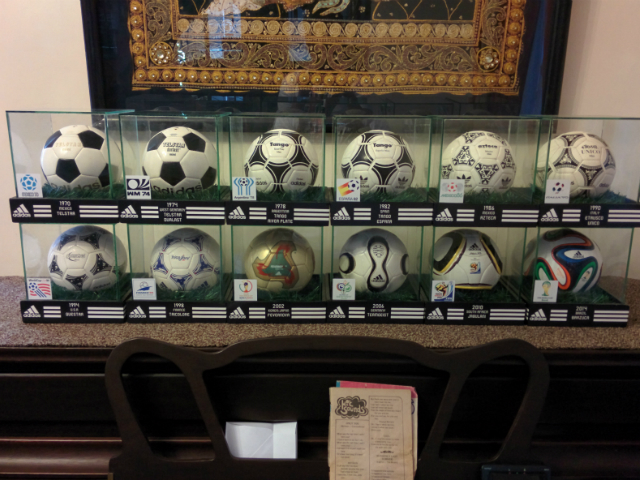
A history of the World Cup in game balls - Size 0 replicas of every match ball since 1970. Roehl Niño Bautista
Enter the Robeniol household and you'll see 12 small footballs on top of a piano. From the simple black and white design of the Telstar with hexagonal panels, to the colorfully eccentric shuriken-inspired design of the Brazuca, the display is a collection of official mini-replicas of the World Cup match balls made since 1970.
Each of the World Cup balls since 1970 have a unique name
Telstar - Mexico 1970
Telstar Durlast - West Germany, 1974
Tango Durlast - Argentina, 1978
Tango España - Spain, 1982
Azteca - Mexico, 1986
Etrusco - Italy, 1990
Questra - USA, 1994
Tricolore - France, 1998
Fevernova - Korea-Japan, 2002
Teamgeist - Germany, 2006
Jabulani - South Africa, 2010
Brazuca - Brazil, 2014
Telstar - Mexico 1970
Telstar Durlast - West Germany, 1974
Tango Durlast - Argentina, 1978
Tango España - Spain, 1982
Azteca - Mexico, 1986
Etrusco - Italy, 1990
Questra - USA, 1994
Tricolore - France, 1998
Fevernova - Korea-Japan, 2002
Teamgeist - Germany, 2006
Jabulani - South Africa, 2010
Brazuca - Brazil, 2014
“My initial exposure to international football was [on the] Playstation in 1998,” he said. “I think the same goes for football followers in our generation.”
As a kid, he couldn’t tell a club by its name, identifying one instead through shirt color and sponsor’s logo on the chest. Then from console to school field, his love for the sport grew, followed by his interest for the world’s biggest sporting tournament, held every four years.
“The original plan was to buy the Size 5 [playing size] match balls because I already had the Teamgeist from the 2006 World Cup in Germany and the Jabulani [2010 South Africa]. Then from eBay, I also got the Telstar Durlast from the 1974 World Cup,” Abi said in a mix of Filipino and English. “Then I realized it was expensive”
Buying the playing size balls would have set him back around Php8000 each. A full set, starting from 1970, when World Cup-specific balls were produced, costs Php24,000 and it didn’t even include yet the Jabulani. He instead opted to get a set of mini-replicas for Php4000 from the US.
The last time he recently checked, a set of mini-balls from the Telstar to the Jabulani costs Php8000.
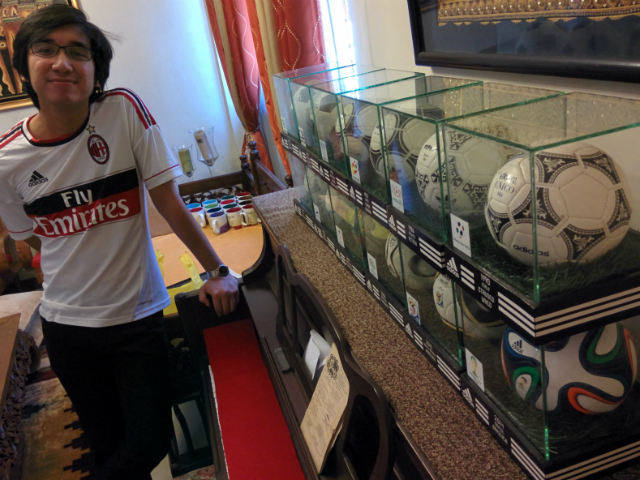
Abi Robeniol and his collection. Roehl Niño Bautista
In June 2002, a teenaged Abi tuned in to television at night, watching a bald man in a yellow top and blue shorts score against a team clad in black and white. Brazil won that World Cup in Japan with two goals from Ronaldo, beating Germany to earn the fifth star [signifying World Cup wins] on their kit’s badge. That year saw the gold Fevernova in action, which Abi used as a playing ball in high school.
“It’s now faded. You can barely tell it was a World Cup replica ball. Back then, we were not football fanatics, just simple players,” he said. “I used it to teach my brother how to play, and we used it on asphalt. I never knew how much it cost, and that it would be a collectors’ edition. It’s somewhere lost upstairs."
Each mini-replica is encased in display glass as it rests on a grass-like surface, with a black plywood label indicating the ball’s name, when it was used, and who hosted the World Cup that year.
“I had those casings custom-made, and it cost me Php 5000 for all twelve: for the glass, plywood, printing, and the faux grass, which is actually part of a Christmas decoration,” he said. “Imagine the cost if I got the Size 5.”
FIFA’s football regulations only cover Size 5 and Size 4 balls, although Law 2 of the rules states that match balls should be “of a circumference of not more than 70 cm (28 ins) and not less than 68 cm (27 ins).” Usage of other-sized balls are usually played by ear: younger age groups use smaller balls. Smaller balls are also sometimes used for skills training.
Size 1 and Size 0 balls are usually made for promotional/collection purposes, but they can be played with as well.
Size 1 and Size 0 balls are usually made for promotional/collection purposes, but they can be played with as well.
While he keeps an eye on the Samurai Blue this coming World Cup in Brazil, Abi naturally also has a heart for the Azkals, notwithstanding the 1-0 loss to Palestine in the recent AFC Challenge Cup finals. Days before the Azkals’ craze exploded in 2010, he was looking into acquiring a national men’s football team kit with this writer.
“Hopefully, in our lifetime, we see the Azkals in the World Cup. 2018? 2022? Who knows. We need a good grassroots program. 2030 perhaps?”
Abi’s recent addition to his collection is the Brazuca, which he just got last month. Looking for a Size 0 was and is still a challenge locally. Even the ball’s manufacturer’s local stores here couldn’t tell the difference between Size 0 and the Size 1 which they usually have on stock, so he got the 2010 edition, and recently the 2014 one online.
“Only a football store in Bonifacio Global City knows that they had a Size 0, but they didn’t have any stock left when I inquired for the Brazuca,” he said.
Alas, it turns out he may not be the only Filipino football fan seeking a collection of these spheres. - AMD, GMA News

