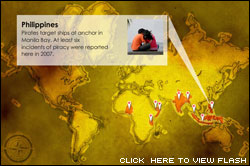
 MANILA, Philippines
 - The sea was peaceful that early evening of June 2006 when Alfonso Constantino was on duty aboard the
M/V Sea Epoch, a Panamanian-flagged ship carrying coal from the Middle East to Asia. As the carrier cruised smoothly off Somalia’s coast at around 6 p.m., Constantino noticed that the ship’s radar picked up three fishing vessels speeding behind. “Through the telescope I could see them getting closer to the ship," Constantino recalled. “At that point I said, ‘This is it, the pirates will hijack us.’" Constantino rushed to notify the ship’s Filipino captain, who then immediately gave the command to sound the vessel’s warning siren. But the pirates were undeterred. Speeding at 16 nautical miles per hour in the calm Somali waters near the Gulf of Aden, the fishing boats were quickly gaining in on them. The captain then told Constantino and the rest of the predominantly Filipino crew to assemble at the end of the ship and show their full force on the trailing pirates. “Some of us were shouting. Others waved broomsticks and thick wood slabs. The captain readied the fire house in case one of them gets stupid and decides to board the ship," he said. The 22-man crew managed to breathe a sigh of relief an hour later when the pirates gave up and disappeared in the darkness. Piracy has seen an upsurge in recent years, according to the International Chamber of Commerce’s International Maritime Bureau (IMB), a non-profit organization fighting against all types of maritime crime and malpractice. From January to June 2008, the IMB recorded more than 110 attacks by armed pirates, with 24 piracy incidents coming from Somalia. About 19 attacks in Somalia occurred in the Gulf of Aden, making it the number-one piracy hot spot in the world this quarter. The group said that Somali pirates are also becoming more aggressive. Some are equipped with high-powered guns including grenade launchers that could cause damage to big vessels. Well-funded by ransom willingly paid by ship owners, pirates in the African seas often come with big mother ships, which launch smaller, faster craft to slow down their targets vessels. Since the year began, more than 60 Filipino seafarers have been abducted in African waters. In the Gulf of Aden alone, a record four ships, carrying a total of 54 Filipino seafarers, were hijacked by pirates in August. But the number of Filipinos being abducted continue to rise.
Easy prey The upsurge of Filipino abduction in high seas is not at all surprising since the global shipping industry’s dependence on Philippine overseas labor makes Filipino seafarers more prone to abduction than any other nationals in the world. Constantino’s ship was actually an exceptional case. In fact, in 1986, the ship was boarded by six armed men - including a boy carrying a jungle bolo (knife) — while it was anchored in an Indonesian port. Fortunately, the crew managed to react quickly and closed the ship’s cabin doors. The pirates left the ship two hours later with only a few gallons of paint in tow.
No more pirates of the Caribbean?
Despite the huge success of the film, “Pirates of the Caribbean" recent data show that piracy in these waters is becoming more like a myth. Since 2004, the International Maritime Bureau has not recorded a single incident of pirate attack in the Caribbean seas.
Others are not so lucky. When a Malaysian-owned ship was hijacked last August 19, a Filipino crew member was accidentally killed. Philippine authorities said his body remains inside the stolen ship. The Philippine Department of Foreign Affairs (DFA) admitted that it is very likely that Filipino seafarers would be abducted every time a ship is hijacked overseas. “One-third of the ship manning requirement of the world is supplied by Filipinos," Crescente Relacion, executive director of the DFA office of the undersecretary for migrant workers' affairs told GMANews.TV. “This puts them at a very high risk." According to Relacion, there are roughly 350,000 Filipino seafarers deployed all over the world, most of them onboard ships that transit African waters particularly the Gulf of Aden. The Gulf of Aden, an important waterway for shipping, is within the Arabian Sea. It is between Yemen on the south coast of the Arabian Peninsula and Somalia in the Horn of Africa. It connects with the Red Sea through the Babel Mandeb strait in the northwest. In 2007, the IMB recorded 263 incidents of piracy and armed attacks on ships worldwide, including 43 in Indonesia, 42 in Nigeria and 31 in Somalia. Compared to the same period in 2006, the IMB noted a 10 percent increase in the reported cases of pirate attacks in high seas. “Piracy is on the increase wherever there is no strong government order," said Captain Pottengal Mukundan, Director of the IMB. "That applies currently to Nigeria and Somalia, which are currently the hotspots of piracy." “If governments decide to take action against piracy, and systematically enforce the law with arrests, trials and condemnations, that will reduced the number of attacks". An insider from the maritime industry said most Somali kidnappers demand between 10 to 50 million dollars for the return of all the crew members and the ship’s cargo. The ransom however is just a piece of cake to the ship owners since they could easily demand $80 million for a single trip of a cargo ship. The growth of global commerce in the past two decades crowded the oceans with dry-bulk carriers and supertankers loaded with every good imaginable, Forbes.com reported. The world currently transports 80 percent of all international freight by sea. The report added that more than 10 million cargo containers are moving across the world's oceans at any one time. According to the IMB, container ships were the most attacked ships by pirates in 2007, followed by general cargo vessels, bulk carriers, product tankers, tankers and chemical tankers. While piracy easily affect the crew members who are attacked, it also hampers the exchange of goods and materials. Most of the attacked vessels carry with them valuable commodities including oil, coal, food and supplies. “Piracy not only affects the crew on board the vessels, traders and governments," the IMB report said, “[It also has its effects] at the grassroots route the common man who may probably be deprived of much needed aid being shipped to him."
Cash or Crew? NUMBERS
266, 533 – Philippine Overseas Employment Agency’s tally of Filipino seafarers deployed all over the globe in 2007.
120 - Number of reported pirate attacks in African waters last year, based on IMB data.
80 – Number of Filipinos that are still held captive by Somali pirates as of September 18.
10th - The Philippines' ranking in the most pirate-prone areas in the world, according to the IMB.
9 - Number of Filipino seafarers freed by pirates last September 12.
0 - Number of pirate attacks in the Caribbean seas since 2004.
Alarmed by the spate of attacks on ships with Filipinos onboard, DFA Secretary Alberto Romulo said the agency might review the contracts of seamen who board vessels that are vulnerable to high sea robberies. “I suggest that we look into the contracts of the seafarers so that they won’t be allowed to board ships that will pass through dangerous areas," he said. Romulo said he had already instructed the Office of the Undersecretary for Migrant Workers Affairs to study the proposal “very closely." The office is headed by Undersecretary Esteban Conejos Jr. “We cannot risk the lives of our seafarers. We have to look into their safety," he added. "To ban Filipino seafarers in certain pirate-prone seas is like telling the ship to avoid the water," said Nelson Ramirez, president of the United Filipino Seafarers (UFS). “That’s impossible. Every ship that goes to the Middle East or Africa would have to pass through the Gulf of Aden. Where would the ships go then?" Ramirez told GMANews.TV in an interview. Ramirez said such a policy would force seafarers to go underground and seek illegal means to be deployed overseas. “No Filipino seafarer would sign any contract at all. Ship owners too may not hire Filipinos," he added. Despite the surplus of Filipino seafarers here in the country, there is a 35,000 shortage in ship officers worldwide. Ramirez said another deployment ban would spell the unemployment of thousands of Filipino seafarers. Ramirez, however, said they would not discourage Filipinos from manning ships that pass through seas that are considered hot spots for piracy. Aside from training all seafarers to combat hijacking scenarios, ship owners also need to actively participate in safeguarding the welfare of their crew and ship, he said. “Ship owners have to force the United Nations to patrol these areas that are prone to piracy," Ramirez said. “Perhaps, it wouldn’t hurt the ship owners to shoulder some of the expenses in patrolling the seas." However, Capt. Mukundan does not believe the use of private security services on ships would be very effective. He said that is not the right response to the problem of piracy, agreeing with the line taken by the London-based UN agency IMO (International Maritime Organization). “The use of weapons is likely to make the problems worse rather than helping to solve them," he said.
- GMANews.TV 

 GMA Brandtalk
 Tracking
 Archives


