

ADVERTISEMENT
Filtered By: Topstories
News
From the city to the barrio: Shabu labs moving out of Metro Manila
By BRENDA BARRIENTOS, GMA News Research
MANILA, Philippines - A posh subdivision in Parañaque City appeared to have become a favorite location for alleged shabu factories in the past years. Multinational Village in Barangay Moonwalk gained notoriety as a shabu-making lair: law enforcers raided at least four clandestine shabu laboratories in the subdivision from 2003 to 2005. The proximity of the village to the Ninoy Aquino International Airport could be one of the reasons shabu-makers chose to nestle there. Since the first discovery of a shabu factory in the late 1990s until 2005, shabu laboratories were located in highly accessible urban areas for easy transport. Areas near airports and seaports were preferred for such clandestine establishments, obviously to facilitate the transport of chemicals used in shabu manufacture. But a study by GMA News Research indicates that this may no longer be the case. While access used to be the main consideration in choosing a shabu laboratory site, data from the Philippine Drug Enforcement Agency (PDEA) shows that isolation may be the emerging trend since three years ago. PDEA data on dismantled shabu laboratories from 2006 to 2008 shows a gradual increase in shabu labs relocating to secluded rural barangays. (see map) 
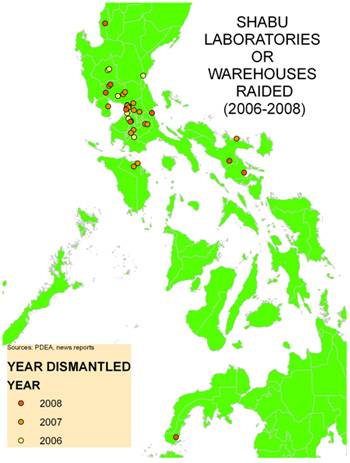
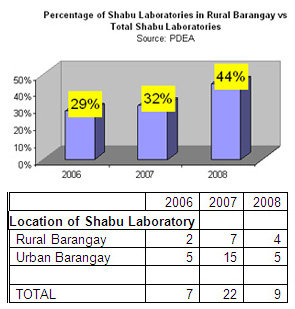
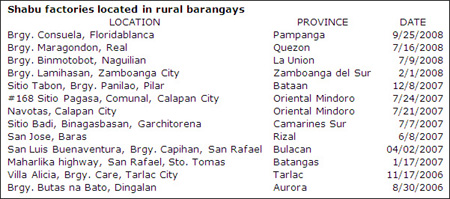
Using Geographic Information System, News Research mapped the 38 shabu laboratories/warehouses found in 2006 (7 shabu labs), 2007 (22) and 2008 (9). The GIS shows an increasing number of shabu factories in rural barangays. In 2006, 29 percent of the raided laboratories were in rural areas. This increased to 32 percent in 2007 and 44 percent in 2008. A rural barangay has a population of less than 5,000 and lacks a sizeable business establishment. Shabu laboratories were discovered in Bulacan and Laguna in 2006. In 2007, shabu factories were found in Oriental Mindoro and Camarines Sur. In 2008, the factories were in La Union in the Ilocos Region, Legazpi City and Iriga City in Bicol and Zamboanga City. Based on police reports, some establishments were disguised as farms, resorts and fishponds. The emerging pattern indicates that illegal drug traffickers are now more willing to go to great lengths to hide their trade. Former senator and Drug Watch Philippines founder Ernesto Herrera said this is a natural course in the shabu-making business. âShabu laboratory operators need some form of seclusion for their own protection, because the smell alone could get the neighbors suspicious. Sa amoy pa lang, kapag sa residential area na yan, mataas ang risk na malaman kung anong activity ang ginagawa diyan," Herrera said. Police and PDEA reports show that raids on these clandestine shabu factories were prompted by neighborsâ complaints of nauseating odor. Herrera said urban areas are highly accessible, thus, any illegal activity can be detected. âIn urban areas, media is very active. Madaling puntahan agad kung sakaling mabalitang may suspicious activities na na-re-report," Herrera said. On the other hand, rural areas are harder to access so they provide a good camouflage, he added. The 2008 World Drug Report issued by the United Nations Office on Drugs and Crime (UNODC) says more and more shabu laboratories are located away from Metro Manila from 2006 to 2008. The report attributed this to heightened law enforcement. Drug lords opt to locate in southern Luzon, Bicol, even Mindanao, the report said. Shabu factories were also discovered during raids conducted in Cebu in 2004 and Davao City and Cagayan de Oro City in 2005. The presence of these shabu laboratories is proof of what has been feared for quite some time: that the Philippines is no longer just an importer of shabu. Experts say the strategic location of the country makes it a vital link in the production, distribution and consumption of illegal drugs in the region. The UNODC considers the Philippines as a major trafficking and manufacturing site of shabu. PDEA said shabu remains the drug of choice of majority (63 percent) of local drug users. Drug Watch says the some local police and government officials are party to the crime of illegal drugs manufacture. âDrug lords need protection. Bukod sa geographical, I guess they have some sort of protection from local officials â police or barangay officials," said Herrera. âI think they are part of the conspiracy. Imposibleng hindi nila alam. Lalo na kung laboratory yan, no way na hindi malaman ng mga barangay tanod dahil they are the ones checking the activities in their area. They are supposed to visit the place," he added. Barangay permits are required before a building is erected, or before some sort of factory is built. Early this month, Interior Secretary Ronaldo Puno announced a âone-strike policy" against police officers who fail to wipe out illegal drugs in their area, especially those who do not lead anti-drug operations and ignore adverse reports on the presence of illegal drug dens or laboratories or widespread drug use. Puno said local officials may be administratively charges if they fail to act on PDEA or police reports on the âillegal sale of narcotics, rampant delivery and use of such illegal drugs and the discovery of marijuana plantations, laboratories of shabu and other illegal substances in their respective communities." - GMA News Research


More Videos
Most Popular

