We use cookies to ensure you get the best browsing experience. By continued use, you agree to our privacy policy and accept our use of such cookies. For further information, click FIND OUT MORE.
A total of 16 Filipino seafarers were abducted by Somali pirates in just a span of one week, leaving the total number of Filipino seamen held hostage abroad to 38, local and foreign officials said Friday.
According to the Department of Foreign Affairs (DFA), the Malaysian fishing vessel Thai Union 3, with two Filipino crew members on board, was seized about 200 nautical miles north of Seychelles by pirates last October 29. The vessel also had two Ghanaian and 23 Russian crew members. In a separate statement, the Council of the European Union said that a Greek-owned bulk carrier named MV Delvina, this time with 14 Filipino seafarers, was hijacked off Somalia early November 5. Aside from the Filipino seafarers, MV Delvina also had 7 Ukrainian crew. This brings the total number of kidnapped Filipino seafarers to 38, with 36 in the hands of Somali pirates and the remaining two with Nigerian militants. Filipinos are identified as one of the most vulnerable nationalities to pirate abductions since they compose one-third of the world’s shipping manpower requirement or an estimated 350,000 seafarers. Gentle pirates? Although Somali pirates are armed with high-powered guns, Nelson Ramirez, president of the United Filipino Seafarers, said it is unlikely that they would harm the Filipino seafarers.
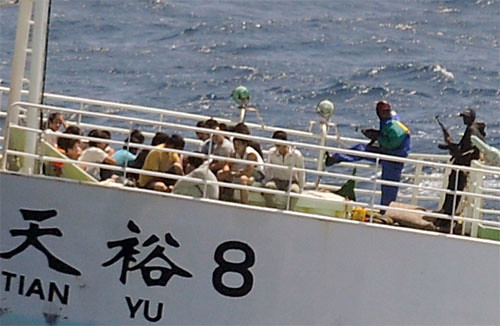
Pirates guard the crew of the Chinese fishing vessel FV Tianyu 8 as it sailed through the Indian Ocean on Nov. 13, 2008. Three Filipino seafarers were on board the ship. The ship and crew have since been released. US Navy file photo
"They (pirates) are not there to harm them (seafarers) because they are their leverage," Ramirez told GMANews.TV on Friday. According to Ramirez, shipowners are often forced to give out more ransom money for the safe release of its crew. But last year, Filipino seafarer Jason Dumagat died on board the Malaysian ship MT Bunga Melati when he was hit by a stray bullet from the boarding Somali pirates. Dumagat’s body was stored in the ship’s freezer until the ship and its crew were released weeks later. In case seafarers are abducted, Esteban Conejos Jr., DFA undersecretary for migrant workers’ affairs, said Filipino crew members could always deal with the situation through language adaptability. “We have even given our seafarers certain basic language courses in Somalia like how to say ‘no,’ ‘yes,’ ‘eat,’ and ‘water,’" Conejos said in an earlier interview. The DFA said it has already instructed the Philippine Embassies in Singapore and Nairobi to assist in securing the safe release of the two Filipino seamen on board Thai Union 3, adding that the vessel’s local manning agency has assured that the crew is currently in good condition. But it has yet to issue a statement regarding the 14 other seafarers. Pirate abductions on the rise Pirate attacks worldwide in the first nine months of 2009 exceeded the whole of last year's total because of more frequent raids in the Gulf of Aden and off the east coast of Somalia, the International Maritime Bureau (IMB) said.
38 SEAFARERS STILL HELD HOSTAGE
Win Far 161 - Hijacked on April 6 with 17 Filipinos. MV Charelle- Hijacked on June 13 with 3 Filipinos. Thai Union 3- Hijacked on October 29 with 2 Filipinos. MV Delvina - Hijacked on November 5 with 14 Filipinos. Sichem Peace - Hijacked on July 4 with 2 Filipinos.* * Except for the Sichem Peace, all the ships mentioned are in the hands of pirates in Somalia.
- Data collected by GMANews.TV
According to the maritime watchdog group, the number of attacks rose to 306 between January and September, surpassing the 293 incidents recorded throughout 2008. The use of guns in the attacks more than doubled to 176 cases in the first nine months of 2009 from 76 in the same period of last year, the report added. The higher number of attacks was due mainly to increased Somali pirate activity off the Gulf of Aden, one of the world's busiest sea lanes, and the east coast of Somalia, which combined accounts for 147 cases, the report said. Somalia has been ravaged by violence and anarchy since 1991 and piracy has flourished off its coast, making the Gulf of Aden one of the most dangerous waterways in the world. 'Mother ships' The IMB said Somali attacks decreased in the third quarter of 2009 compared to the first half of the year because of monsoon-related poor weather. However, the pirates have recently started to increase attacks after a period of quiet. The pirates use sophisticated equipment and so-called larger "mother ships" to enable them to strike hundreds of miles (kilometers) offshore. The multimillion-dollar ransoms they share are a fortune in their impoverished country. Manila does not directly negotiate with the hostage-takers but continues to coordinate with the transitional government of Somalia and the shipping firms to work for the immediate and safe release of the hostages. Somalia has no central government. The Philippine government had already tied up with local manning agents in Manila to come up with a recommendation on how to prevent the further abduction of Filipino sailors. The International Maritime Bureau has called on the United Nations to take action to secure the waters and stop the piracy menace in the Gulf of Aden. Despite the presence of US-led coalition forces patrolling the area, pirate attacks continue in the Gulf of Aden, one of the world’s busiest shipping lanes. - with Joseph Holandes Ubalde, GMANews.TV and an AP report


 GMA Brandtalk
 Tracking
 Archives