Land is getting ever so scarce for the ever rising population of the dead. There is hardly enough, decent resting place for them in Metro Manila. Four cities — Las Piñas, Pasay, Quezon City, and Malabon — have allotted less than 1 percent of their total land area to cemeteries, according to a review of land use and population statistics by GMA News Research and GMANews.TV. Data from the Housing and Land Use Regulatory Board showed that only 0.12 percent or 4.59 hectares of Las Piñas’s 3,380-hectare land area has been allotted for cemeteries.
Cities | Total land area in hectares | Total cemetery area in hectares | % of cemetery area to total land area |
| 1. Las Piñas | 3,830 | 4.59 | 0.12 % |
| 2. Pasay | 1,390 | 3.33 | 0.24 % |
| 3. Quezon City | 16,620 | 76.45 | 0.46 % |
| 4. Malabon | 2,340 | 11.93 | 0.51 % |
| 5. Makati | 2,736 | 34.2 | 1.25 % |
| 6. Muntinlupa | 4,670 | 69.58 | 1.49 % |
| 7. Pasig | 1,300 | 19.5 | 1.50 % |
| 8. Marikina | 2,150 | 37.84 | 1.76 % |
| 9. Caloocan | 5,580 | 100.4 | 1.80 % |
| 10. Navotas | 1,069 | 21.59 | 2.02 % |
| 11. Mandaluyong | 1,125 | 25.2 | 2.24 % |
| 12. Parañaque | 4,770 | 127.83 | 2.68 % |
| 13. Manila | 3,830 | 122.17 | 3.19 % |
| 14. Taguig | 3,370 | 180.29 | 5.35 % |
Sources:
HLURB, LGU Web sites On the other hand, statistics from the Department of Health (DOH)’s Center for Health Development in Metro Manila (CHDMM) showed that Las Piñas’s crude death per year in 2004 was 4.1 persons per 1,000 people. The city’s total population based on Census 2000 was 474,162. Thus, the number of people who die in Las Piñas yearly could be about 1,944 (the result is based on dividing the total population by 1,000 and then multiplying it by 4.1 persons). Pasay has a land area of 1,390 hectares, but only 0.24 percent or 3.33 hectares are apportioned for burial lots. CHDMM data showed that in 2004, Pasay’s crude death per year was 4.7 persons for every 1,000 people. The city’s total population in 2000 was 374,121. Thus it is estimated that there are at least 1,758 people who die in Pasay yearly. Meanwhile, in Quezon City, Metro Manila's largest city by land size that covers 16,620 hectares, only 0.46 percent or 76.45 hectares are used as graveyard. Based on CHDMM 2004 data, crude death per year in Quezon City was 4.3 persons per 1,000 people. Its total population as of 2000, stood at 2,291,513, thus there are at least 9,853 people who die yearly in Quezon City. In Malabon, only 0.51 percent or 11.93 hectares of the city’s total land area of 2,340 hectares is utilized as burial grounds. CHDMM 2004 figures showed that crude death per year in Malabon was 2.7 persons per 1,000 people. The city’s total population as of 2000, was 357,199, thus there are at least 964 people who die in Malabon per year.
Cities | Crude death rate as of 2004 | Estimated no. of people who die per year | Total Population |
| 1. Makati | 6.4 | 3,016 | 471,379 |
2. Manila | 6.2 | 10,333 | 1,666,675 |
3. Muntinlupa | 5.5 | 2,199 | 399,844 |
4. Pasay | 4.7 | 1,758 | 374,121 |
5. Pasig | 4.4 | 2,342 | 532,400 |
6. Quezon City | 4.3 | 9,853 | 2,291,513 |
7. Marikina | 4.2 | 1,835 | 1,233,000 |
8. Las Piñas | 4.1 | 1,944 | 474,162 |
9. Parañaque | 4.1 | 1,844 | 449,881 |
10. Navotas | 4.1 | 944 | 230,403 |
11. Mandaluyong | 4.0 | 1,113 | 278,474 |
12. Caloocan | 3.3 | 4,068 | 1,233,000 |
13. Malabon | 2.7 | 964 | 357,199 |
14. Taguig | 2.0 | 985 | 492,677 |
Sources:
HLURB, LGU Web sites 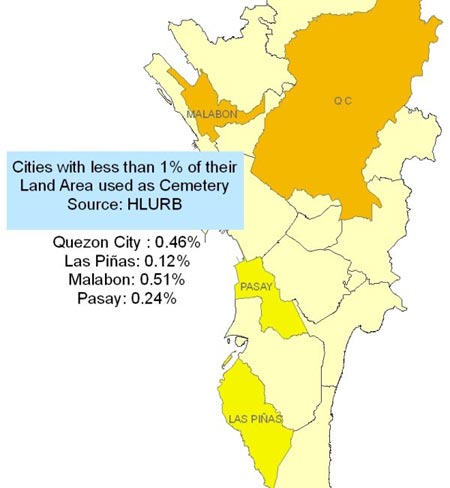 Burial plot areas
 Assuming that each burial plot area for the dead is 2.44 meters (as recommended for ground internment under Quezon City’s Board of Commissions Resolution No. 681 series of 2000), the number of dead people who could be accommodated in the four cities would be the following: * Las Piñas -18,836 or 3.9 percent of the total population * Pasay – 13,672 or 3.6 percent of the population * Quezon City – 313,328 or 13.7 percent of the population * Malabon – 48,910 or 13.7 percent of the population. The estimate is conservative because it did not take into consideration areas in cemeteries that are being used for open spaces and other infrastructures. The computation also assumed that no dead people had earlier been buried in the cemeteries, thus the high accommodation capacity.
- with reports from Brenda Barrientos, GMANews.TV/GMA News Research 

 GMA Brandtalk
 Tracking
 Archives


