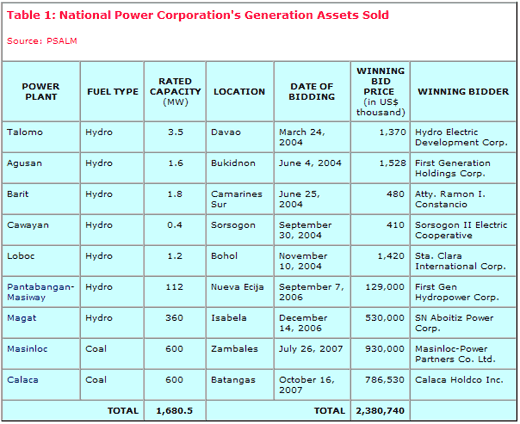
IT WAS hailed as a groundbreaking law that would not only result in lower power rates for both household and industrial consumers, but would also unburden the government of some P38 billion in annual subsidies to the power sector. At the time, no less than President Gloria Macapagal Arroyo said that had Congress failed to pass the Electric Power Industry Reform Act (EPIRA), it would have meant the continued ballooning of the debts of the National Power Corporation (NPC). That would have deprived the government of much needed funds to meet the Filipinos’ other basic needs, which the chief executive even itemized in terms of 16,000 classrooms, 127,000 hectares of irrigated land, 76,000 low-cost houses, or 6,300 kilometers of road. That was more than six years ago. Today residential power rates are double what they were in January 2001, when Arroyo first came to power, while the country’s industrial electricity rates are the highest in Asia. At the end of 2001, NPC’s debts and obligations stood at P851 billion; by last year, the figure was hitting P1.2 trillion — and that was minus the P200 billion already absorbed by the national government in 2004 as mandated by EPIRA. Law falls short of goals EPIRA or Republic Act No. 9136 has thus joined a long line of laws that have fallen short of their objectives because of a combination of flawed provisions and implementation. In the case of EPIRA, these include the continued tolerance of old contracts whose onerous provisions have only contributed to the ever-rising debts of the NPC, monopolistic practices that have resulted in the abuse of market power, and the slow pace of the ordered privatization that has hindered competition. Ateneo de Manila University economics professor Aleta Domdom in fact says that EPIRA only introduced competition at the level of generation, with distribution still remaining monopolistic. “Even if the distributors face competition in terms of choosing among generators," she says, “they still have the power to raise prices, of course, subject to the approval of the ERC (Energy Regulatory Commission)." To be sure, the surge in world oil prices — which last week reached $96 a barrel — has contributed as well to steep electricity rates, especially since many local power plants depend on imported oil-based fuel. But Domdom says this is just one of several external factors that the crafters of EPIRA failed to emphasize enough. “The increase in world-oil price is greater than the appreciation of the peso-dollar exchange rate," notes Domdom. “Then there is also the fast growth of China which competes in the demand for world energy sources. When demand increases, but supply remains the same, prices tend to increase." Luring investors IRONICALLY, HIGH electricity prices are being used to lure in investors, says economist Maitet Diokno-Pascual, former president and now board member of the Freedom from Debt Coalition (FDC). She says the situation is due as well to the overpriced excess capacity from the contracts with independent power producers (IPPs) that the Ramos administration entered into during the energy crisis in the early 1990s. “Its contractual obligations to the IPPs are the single biggest reason for the fatal financial bleeding of the NPC, posing additional burden to the government's fiscal position," seconds FDC power campaign team coordinator Maris de la Cruz. Even the Department of Energy (DoE) has acknowledged that payments to IPPs — which last year amounted to P536 billion — explain why the Philippines continue to have higher electricity rates. Former energy secretary Raphael Lotilla, lamenting over a government decision two decades ago to honor all the country’s debts, remarks, “I wish we could undo all this, but this should also tell us that our policy decisions have an economic cost." With a strong peso, the NPC has managed to post remarkable net incomes in the last two years, sustaining a financial recovery in 2005 with profits of almost P86 billion. But it's a turnaround from seven consecutive years of losses, with revenues largely going to payments to the IPPs. This is because of the take-or-pay provision in their power contracts that requires the NPC to pay for a fixed volume of electricity at fixed rates, whether or not the state-owned corporation actually uses the entire volume and whether or not the IPP actually produces the entire volume. Of the 90 percent generating capacity that NPC pays IPPs for, only 10 to 40 percent is actually produced and used, says de la Cruz. And this is on top of other risk-free provisions in the contracts as fuel cost and foreign exchange loss guarantees. Burden on consumers The NPC has routinely passed on the bulk of the costs of these guarantees to consumers, reflected early on in electricity bills as the purchased power adjustment (PPA) but now hidden, FDC says, under “several categories but primarily under generation costs." In 2002, President Arroyo ordered a cap to what the NPC could recover from consumers for the IPP contracts; the charge thus shrunk from P1.25/kWh to 40 centavos/kWh. But this has proven disastrous to NPC as it slashed revenues by 85 centavos/kWh. After only two years, NPC had already absorbed a loss amounting to a staggering P16 billion. Today the NPC debt stock has a value of half a trillion pesos. The government absorbs one-third of the NPC’s debts even as it incurs loans to restructure the entire power sector. Restructuring was part of the Asian Development Bank (ADB)'s 1995 energy policy that prescribed full recovery costs, reduction of subsidies, aggressive promotion of private sector involvement in the energy sector, and the creation of an enabling environment for private investors. EPIRA’s passage in 2001, in fact, was a condition for the release of much-needed loans from the ADB and Japan Export-Import Bank amounting to $950 million. Last December, ADB also extended a $450-million Power Sector Development Program loan, primarily meant for the servicing of NPC's debts. The Bank estimates that about $9.1 billion would be needed to finance the power sector until 2010. Seven years of debate EPIRA WAS passed after seven long years of debates involving three Congresses. Its primary objectives include developing indigenous energy alternatives, lowering the high cost of electric power in the country, and encouraging private and foreign investment. It was supposed to set in motion the deregulation of the power industry through the privatization of at least 70 percent of NPC's assets. This privatization, which is being handled by the Power Sector Assets and Liabilities Management Corporation (PSALM), is among the preconditions for EPIRA’s envisioned open access and retail competition in which big consumers are free to choose from which to get their supply of electricity. Yet up until this year, only 11 percent of NPC’s generating assets in Luzon and Visayas had been privatized. Indeed, it was only last month that Calaca Holdco Inc., a consortium led by France's Suez-Tractebel, won the bidding for the 600-MW Calaca coal-fired plant in Batangas for $786.53 million. There had been two failed biddings in the last three years mainly because of the absence of supply contracts assigned to it. (A transition supply contract is a power supply agreement offered to NPC customers while state-owned generation facilities are still undergoing privatization, as mandated by EPIRA.) The Masinloc coal-fired plant had the same problem with supply contracts. But its sale in December 2004 failed because its declared buyer, YNN Pacific Consortium, turned out to be a mere broker, “not a legitimate player in the power industry," as Senator Aquilino Pimentel Jr. put it. Last July 26, PSALM finally declared a consortium led by Singapore's AES Transpower Pte Ltd the winning bidder for the Masinloc plant. The consortium offered $930 million for the 600-megawatt facility in Zambales, a key component of the Luzon grid. The sale of the two power plants now brings the status of privatization of NPC's generation assets at 38.76 percent, equivalent to 1,680.5-MW capacity out of a total of 4,335.7 MW. This is only 11 percentage points shy of the 50-percent PSALM has targeted for the year. It therefore expects to achieve the 70-percent privatization level that would signal open access and retail competition by the end of 2008.
 For privatization, too
 Among the plants PSALM has lined up for privatization within the year are the 175-MW Ambuklao-Binga hydropower plant package (in November); the 192.5-MW Palinpinon geothermal facility; and the 146.5-MW Panay diesel-fired power plant package (in December). PSALM is also preparing to bid out the National Transmission Corporation (TransCo) via a 25-year concession before year-end. TransCo was created under EPIRA to operate and maintain the NPC’s segregated transmission assets. But four rounds of bidding have already failed since 2003 because of the issue of securing a franchise with Congress — which issues one only after the concession is awarded. YET FOR Francisco Viray, former energy secretary under President Fidel Ramos and now president of the PHINMA Group's Trans-Asia Power Generation Corporation and Trans-Asia Oil and Energy Development Corporation, the earlier delays may have even turned out to be a “blessing in disguise." “Delay was seen as negative in the EPIRA implementation. Now it's a positive development," he says, pointing to the good price government fetched from the sale of the two plants. He attributes this to a lesson learned from the failed biddings: that the plants need to have transition supply contracts to attract big players. Supply contracts of 265 MW and 287 MW had been secured for the Masinloc and Calaca plants, respectively, when they were finally sold. But FDC’s Pascual comments, “They're way off target so I guess any sale is good." She thinks investor uncertainty or a lack of investor interest in the industry remains because of several factors, among them the small market for electricity sellers particularly given a situation of excess capacity.
The relevant market “The biggest market, the most relevant market, would be the Meralco (Manila Electric Company) franchise area," she says. “But the EPIRA allowed cross-ownership between distribution and generation, and allowed utilities like Meralco to enter into supply arrangements with sister generating companies. So what's left of the Meralco market for the privatized NPC generators to compete over is quite small." Put in perspective, the Philippine market is a rather puny one as the country consumes only about 45,000 gigawatt-hours (gWh) of electricity in a year. Compare that, says Pascual, to the level of electricity consumption in Thailand and Indonesia, where it is slightly over 100,000 gWh, or over 200,000 gWh in Taiwan, and more than 300,000 gWh in South Korea. Moreover, the demand for electricity at peak levels is only in the range of 8,000 MW to 9,000 MW, while total installed capacity as of last year was at 15,803 MW. “If you narrow it down further to the Luzon market," says Pascual, “we're talking of micro, not mini, levels here as far as the power sector is concerned." At the same time, Pascual is concerned over Masinloc’s (as well as Calaca’s) high price tag. Being a pivotal supplier, Masinloc could create a shortage in the market if its supply is withheld, thereby allowing it to raise spot market prices of electricity. “Wittingly or unwittingly," Pascual says, “the ERC is now providing a new incentive to investors: ‘Buy this plant because it has market power, and we won't penalize you for abusing it.’"
Lack of regulation Independent consultant Edna Espos says the same thing. Privatization may be picking up, she argues, but it is mainly because investors are encouraged by the apparent lack of regulation to curb generation charges as shown by NPC rates both in the wholesale electricity spot market (WESM) and bilateral contracts. Espos says that Masinloc’s clients should brace themselves for higher fees. She says the winning bid price of $930 million for the nine-year-old plant is already more than the cost of a new one. “They (Masinloc buyer) will be getting service from a second-hand plant that requires higher maintenance costs," she says. “Of course, they will be charging all these costs to consumers." Still, she says that the high prices the plants are fetching could settle the issue of NPC's stranded debts that, under EPIRA, will be imposed on electricity end-users. Stranded debts refer to any unpaid financial obligations of the NPC after the sale of its plants. Viray likewise sees this as a possibility, at least for Masinloc and Calaca. He says the high prices they fetched should have totally wiped out their corresponding stranded debts. BUT EVEN as the NPC’s monopoly is finally being dismantled, the restructuring of the power sector is actually seeing a market that is headed for greater concentration. Family-owned distribution firms as the Lopez-controlled Meralco and the Aboitiz-owned Visayan Electric Company (VECO) and Davao Light and Power have even been thriving under EPIRA. Meralco has been a major player in the power distribution sector for the past 102 years, serving all of Metro Manila and parts of its surrounding areas. VECO's franchise area consists of Metro Cebu and six neighboring municipalities. “Just look at the WESM indicators of market concentration and you'll get the picture," says Pascual, who points out that the Lopez and Aboitiz groups have been buying the NPC’s small hydropower plants. Only four sets of electricity generators are involved in WESM: NPC, PSALM, Meralco's IPPs, and other IPPs. NPC and PSALM, both government corporations, account for 80 percent of available capacity in Luzon; Meralco IPPs take 19 percent while other IPPs have the remaining one percent. Meralco, by virtue of having sister companies and IPPs, gets to enjoy over 40-percent share in generated electricity.
Law favors the greedy If the private companies seem to be greedy, it’s because the law allows them to be so, says Espos. “Economically speaking, the business sector is expected to maximize profits," she says. “But what the law should do is to provide them incentives so that they balance maximizing profits with the public interest." Espos says that EPIRA's objectives were for the most part good, only that everything went downhill from there. Any inconsistency with the law, she says, can only happen because the regulatory agency allows it. Lotilla, for his part, attributes whatever failings in the runup toward full competition to a still imperfect environment. He says that not all the needed elements are in place — like NPC assets not yet fully sold, Meralco's dominance on the distribution side, and so on. He says that until all its assets are privatized, the NPC remains a competitor to new plant owners in the power generation market. And since it’s a very young market, says Lotilla, it has to go “through birth pangs." LOTILLA ALSO acknowledges that EPIRA itself is an imperfect piece of legislation. In fact, it was a product of much compromise and negotiations, and was even tainted by allegations of bribery involving congressmen in the 11th House of Representatives. And as soon as she signed the power reform bill into law, President Arroyo had called on Congress to immediately start working on its amendments. Since the 12th Congress, Arroyo has been certifying the “urgent enactment of needed consensus amendments to the law" purportedly to level the playing field even more and to institute additional safeguards for consumers. In the 14th Congress, the president's eldest son, Pampanga Congressman and House energy committee chair Juan Miguel 'Mikey' Arroyo, has filed an amendatory bill to hasten the privatization of NPC assets. The changes being proposed include reducing from 70 percent to 50 percent the required generation capacity of NPC assets in Luzon and Visayas to be privatized, reducing from 70 percent to 50 percent the required portion of total energy output of IPPs to be transferred to IPP administrators, as well as allowing the national government to assume the NPC's remaining financial obligations of P400 billion. But with the recent successful auctions of the Masinloc and Calaca plants, whatever amendments being contemplated by legislators could be overtaken by the recent turn of events, says Viray. Even industry players caution against amending EPIRA. They say what is urgently needed is its “proper and more determined" implementation. Officials of First Generation Holdings Corporation, for instance, think the proposal to privatize only half of NPC’s assets violates the spirit of the law to minimize, if not eliminate, state involvement in the power industry. First Gen President Federico Lopez even warned recently that any amendments would “crack open a hornet’s nest of controversy and uncertainty that will reverse all the gains achieved thus far." For civil-society stakeholders, though, the power sector needs nothing short of an overhaul. FDC’s Pascual says real change in the industry needs the participation of all the stakeholders, primarily the consumers. “It has to start from below," she says, “from the communities that do not enjoy electricity, to the communities that are being forced to accept dirty fossil fuel plants in the name of progress, to ordinary communities that can't afford the high electricity rates we continue to pay despite the strong peso and so-called robust economy."
A commission of power TO INTRODUCE competition in the generation sector, EPIRA called for the creation of a wholesale electricity spot market a year after it took effect. As a marketplace for the trading of electricity, the WESM is a venue for generators/sellers to offer their outputs and specify their prices to buyers. It also serves as a mechanism to encourage investors to participate in the generation sector and attract buyers of the NPC plants. Yet last year, a price manipulation scandal broke out involving PSALM's trading teams, which were found to have engaged in uncompetitive behavior in the electricity spot market. The Enforcement and Compliance Office (ECO) of the Philippine Electricity Market Corporation (PEMC), which oversees the power market, found PSALM liable for abusing its market power by simultaneously raising the market clearing prices for three plants: Ilijan natural gas plant, and the coal-fired thermal power plants in Sual and Pagbilao. But the Energy Regulatory Commission ordered its own investigation terminated, finding no prima facie evidence of market abuse against PSALM. The regulatory agency likewise dismissed ECO's findings as mere “speculation, conjectures or guesswork." Maitet Diokno-Pascual, who has looked into ERC's handling of PSALM's market abuse, is aghast. “The ERC has a very extensive market data that showed exercise of market power," she says. “But instead of using that as evidence, it looked for price-fixing between NPC and PSALM. It didn't find any precisely because that's not how the abuse took place."
Quasi-judicial regulator The ERC is more known to the public as the agency that rules on petitions on power rate hikes. But the independent, quasi-judicial regulatory body has more than that on its plate, as the PSALM case shows. Pascual says that ERC’s “narrow understanding" of market power abuse will cost consumers P9 billion. That is the amount PSALM is collecting from WESM after the ERC decision, and which PSALM now wants Meralco and other utilities to collect from consumers. ERC is made up of five commissioners, all of them appointed by the president. Its current head is former Isabela Representative Rodolfo Albano Jr. Some have taken issue with the ERC’s independence, but independent industry consultant Edna Espos — who does not hide her dismay with the ERC for its handling of the WESM price manipulation case — says she has no quarrel with whoever heads the agency “for as long as they do it right." The FDC’s Pascual, however, doubts if the ERC understands its accountability to the consuming public. At least on one occasion, she says, it has even held its hearing for a rate-increase petition in the very office of the private utility it is supposed to regulate. “Maybe," she says, “it (ERC) sees itself as a guardian of the (power sector) reforms, as a partner of the industry players, more than a protector of public interest." Both erstwhile government energy chiefs Raphael Lotilla and Francisco Viray are more understanding. “I think they're doing their best considering the environment they're working in," says Viray, noting that everybody — the government, the private sector, the ERC — went through a learning curve with EPIRA. He also says the government set a very tight timetable for the law's implementation. Lotilla echoes his predecessor’s views. But he also says that there is a need to strengthen the ERC and suggests that there be more rules and guidelines “to effect things and help minimize the arbitrary exercise of discretionary power." —
Philippine Center for Investigative Journalism 

 GMA Brandtalk
 Tracking
 Archives


