

 GMA Brandtalk
 Tracking
 Archives

ADVERTISEMENT
Filtered By: Topstories
News
From one hazing victim’s dad to another: ‘Sorry po at ganito ang justice system natin’
The father of the late San Beda law student Marc Andre Marcos said the hazing incident that allegedly killed a student of De La Salle-College of St. Benilde over the weekend would not have occurred if the case for his son's death had already been resolved.
In a phone interview on News To Go on Tuesday, Mac Ferdie Marcos—who lost his son to a hazing incident in 2012—sent his sympathies to the family of Guillo Servando, a second-year BS Hotel, Restaurant, and Institution Management student, who was found unconscious inside a condominium unit in Manila on Sunday.
The 18-year-old was confirmed dead by a funeral parlor where his body was brought.
There were three other injured students found inside the said condominium unit: John Paul Raval, Lorenze Agustin, and a 17-year-old. They were brought to a hospital for medical treatment.
"Sorry po at ganito ang justice system natin," Marcos said, addressing Servando's father, Aurelio. "Kung sana naresolba agad ang kaso ni Marc Andre, siguro po sana magkakaroon ng deterrent sa fraternities na magsagawa ng mga ganitong gawain."
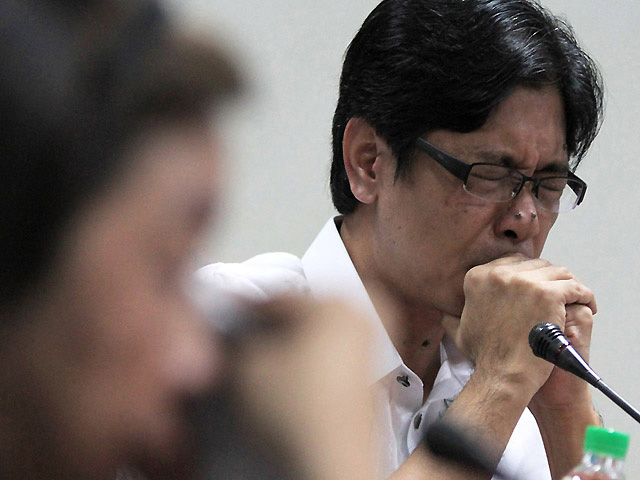
Mac Ferdie Marcos (right) and Myrna Reglos, parents of fraternity hazing victims Marc Andre Marcos and Marvin Reglos, became emotional during a Senate inquiry over the need to implement stricter penalties against hazing. Joseph Vidal
Case dismissed
Marc Andre died from extensive traumatic injuries in his upper and lower extremities as a result of alleged initiation rites of the Lex Leonum Fraternity at a farm in Dasmariñas, Cavite in July 2012.
In June 2013, nearly a year after the incident, Judge Perla Cabrera-Faller of the Cavite Regional Trial Court Branch 90 ordered the arrest of 10 members of Lex Leonum.
In September 2013, however, Faller ruled that the statement of the case's lone witness, fraternity member Cornelio Marcelo, failed to establish probable cause or that there was a conspiracy to inflict fatal injuries on Marc Andre.
"Under the Witness Protection Program pa nga 'yung witness namin and yet sinabi niya (ng judge) na sinungaling daw [ito]," Marcos said. "And though affidavits lang, naniwala siya sa mga ebidensiya ng mga akusado."
Marcos also said that the judge proved reckless in hastening the dismissal of the case.
"Napakatahasang pagpapawalang bahala sa rules na basta na lamang niya dinismiss 'yung kaso," the older Marcos said. "Ang determination ng probable cause ay dapat [ginagawa ng] prosecutor. Pero 'yung judge, inulit niya 'yung trabaho at sinabi niya na mali sila, na walang probable cause. It took one year for the prosecutor [to determine] na may probable cause and yet it took just one month para sabihin [ng judge] na walang probable cause, kaya po nakakalungkot."
Their motion for reconsideration is pending in court, and they have also taken the matter up to the Supreme Court, he added.
‘Wala pang example na nako-convict’
Marcos also said that while proving violation of the Anti-Hazing Law (R.A. 8049) is easy, it remains ineffective because no one has been convicted for it.
"Kasi wala pa pong napapatunayan or wala pa pong example na nako-convict sa anti-hazing law," he said. "Napakasimple po [nito]: I-determine lang ng court kung may hazing ba, 'yung mga officer may ginawa ba para itigil 'to, sino 'yung mga present doon at may namatay ba. Napakasimple pong batas na madaling patunayan sa korte."
His family, however, remains hopeful that Faller will change her mind, or that the Supreme Court will go against her ruling, he said.
Anti-hazing law
Anti-hazing law
Enacted in 1995, the Anti-hazing law states, "No hazing or initiation rites in any form or manner by a fraternity, sorority or organization shall be allowed without prior written notice to the school authorities or head of organization seven (7) days before the conduct of such initiation."
Calls to amend it rose anew after Marc Andre's death, with some lawmakers saying the existing law lacks teeth.
Justice is said to be slow for families of hazing victims. For the family of Lenny Villa, an Ateneo de Manila law student killed by hazing in February 1991, it came some 21 years after his death.
While five people involved in the incident were found guilty by the Supreme Court for reckless imprudence resulting in homicide, Villa's family said they were upset because punishment only came with imprisonment for four months to four years and a fine of P1 million.
Another death involving fraternities was that of University of the Philippines student Dennis Venturina, who was killed when members of a rival brotherhood attacked him and six other co-members of Sigma Rho on December 8, 1994.
Venturina was the only fatality in the incident.
Last month, the Supreme Court upheld the convictions for murder of five fraternity members connected to his death. —Rose-An Jessica Dioquino/ KG, GMA News

